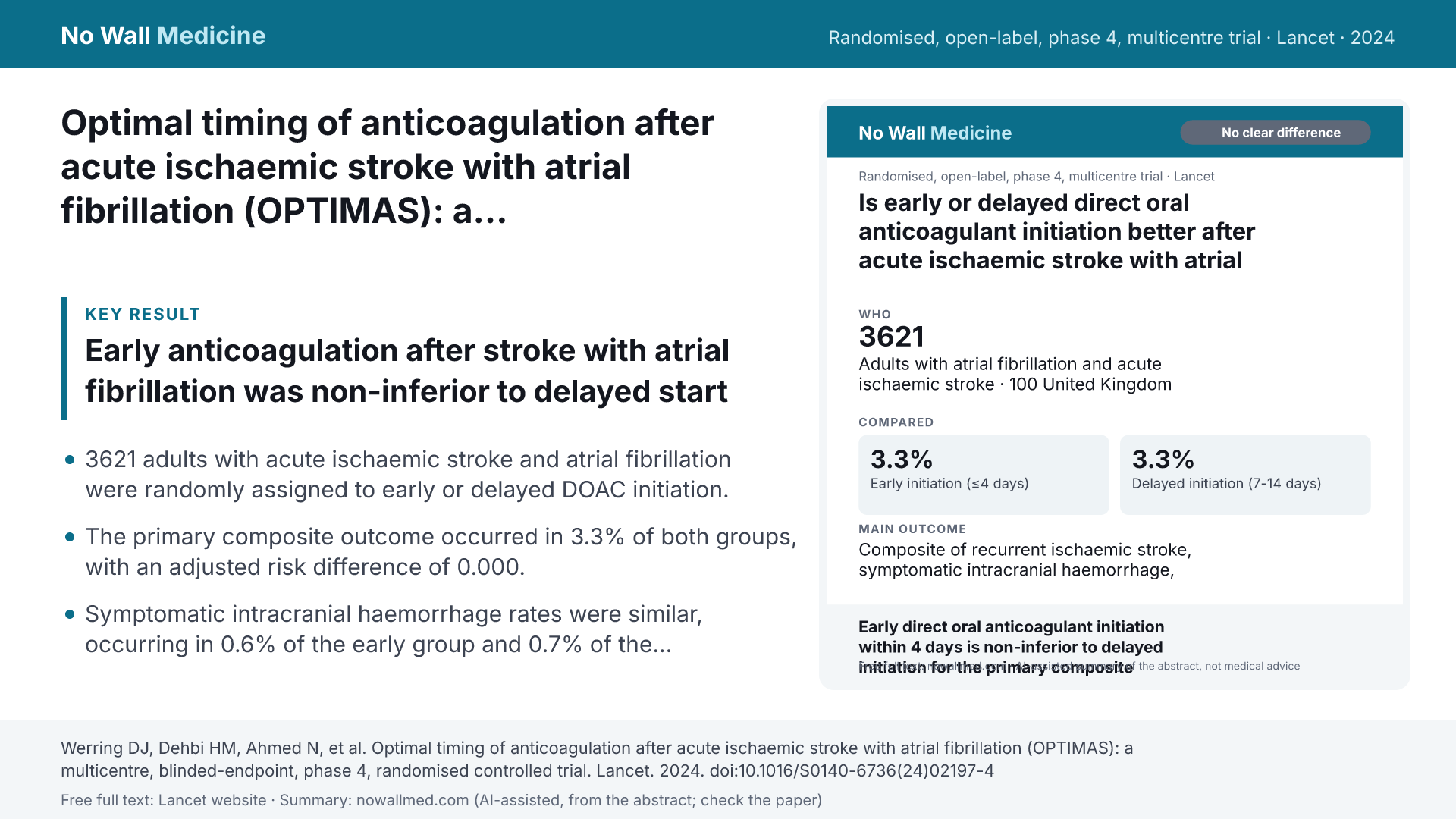
Early anticoagulation after stroke with atrial fibrillation was non-inferior to delayed start
Optimal timing of anticoagulation after acute ischaemic stroke with atrial fibrillation (OPTIMAS): a multicentre, blinded-endpoint, phase 4, randomised controlled trial
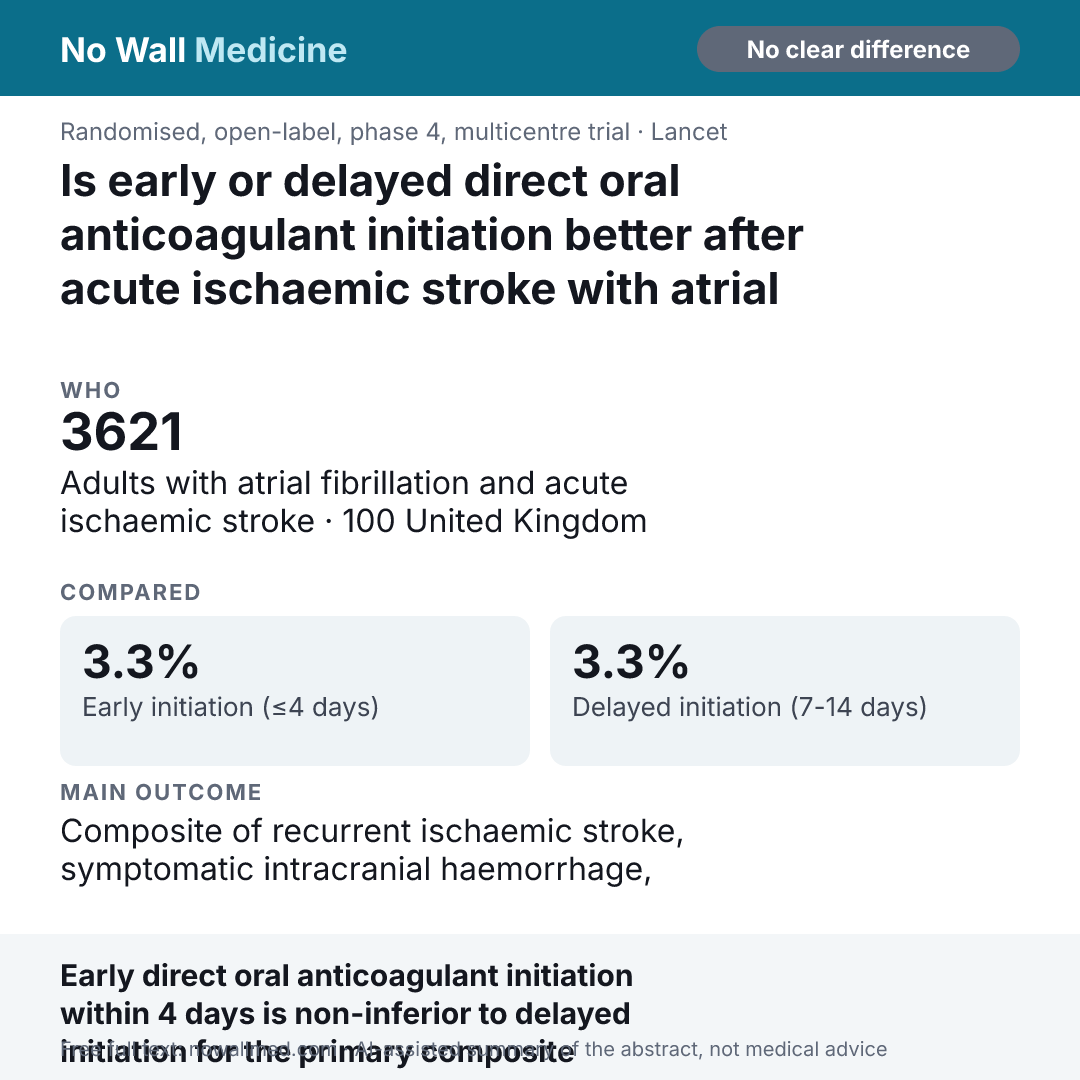
Randomised, open-label, phase 4, multicentre trialNo clear difference
Is early or delayed direct oral anticoagulant initiation better after acute ischaemic stroke with atrial fibrillation?
Who
3621
Adults with atrial fibrillation and acute ischaemic stroke · 100 United Kingdom hospitals
Compared
3.3%Early initiation (≤4 days)
3.3%Delayed initiation (7-14 days)
Main outcome
Composite of recurrent ischaemic stroke, symptomatic intracranial haemorrhage, unclassifiable stroke, or systemic embolism
Result: adjusted risk difference 0.000 (95% CI -0.011 to 0.012)
Bottom line: Early direct oral anticoagulant initiation within 4 days is non-inferior to delayed initiation for the primary composite outcome.
Funded by: British Heart Foundation
Lancet · 2024-10-23 · Save PNG
Same trial (ISRCTN17896007, NCT03759938)
Papers we list that report this registered trial, oldest first. Read a secondary analysis alongside the main results.
- Main results No clear difference
This paper Lancet 2024-10 - Related analysis No clear difference
Early or delayed blood thinner initiation showed no difference in patients with chronic kidney disease Stroke 2025-05 - Secondary analysis No clear difference
Timing of atrial fibrillation diagnosis does not change the effect of early blood thinner treatment Stroke 2026-04
Clinical question: Is early or delayed direct oral anticoagulant initiation better after acute ischaemic stroke with atrial fibrillation?
Key points
- 3621 adults with acute ischaemic stroke and atrial fibrillation were randomly assigned to early or delayed DOAC initiation.
- The primary composite outcome occurred in 3.3% of both groups, with an adjusted risk difference of 0.000.
- Symptomatic intracranial haemorrhage rates were similar, occurring in 0.6% of the early group and 0.7% of the delayed group.
Headline and key points written with AI from the paper’s abstract, with every number checked against it. Read the paper before relying on them.
Was this summary helpful?
Abstract
Background
The optimal timing of anticoagulation for patients with acute ischaemic stoke with atrial fibrillation is uncertain. We investigated the efficacy and safety of early compared with delayed initiation of direct oral anticoagulants (DOACs) in patients with acute ischaemic stroke associated with atrial fibrillation. Methods
We performed a multicentre, open-label, blinded-endpoint, parallel-group, phase 4, randomised controlled trial at 100 UK hospitals. Adults with atrial fibrillation and a clinical diagnosis of acute ischaemic stroke and whose physician was uncertain of the optimal timing for DOAC initiation were eligible for inclusion in the study. We randomly assigned participants (1:1) to early (ie, ≤4 days from stroke symptom onset) or delayed (ie, 7-14 days) anticoagulation initiation with any DOAC, using an independent online randomisation service with random permuted blocks and varying block length, stratified by stroke severity at randomisation. Participants and treating clinicians were not masked to treatment assignment, but all outcomes were adjudicated by a masked independent external adjudication committee using all available clinical records, brain imaging reports, and source images. The primary outcome was a composite of recurrent ischaemic stroke, symptomatic intracranial haemorrhage, unclassifiable stroke, or systemic embolism incidence at 90 days in a modified intention-to-treat population. We used a gatekeeper approach by sequentially testing for a non-inferiority margin of 2 percentage points, followed by testing for superiority. OPTIMAS is registered with ISRCTN (ISRCTN17896007) and ClinicalTrials.gov (NCT03759938), and the trial is ongoing. Findings
Between July 5, 2019, and Jan 31, 2024, 3648 patients were randomly assigned to early or delayed DOAC initiation. 27 participants did not fulfil the eligibility criteria or withdrew consent to include their data, leaving 3621 patients (1814 in the early group and 1807 in the delayed group; 1981 men and 1640 women) in the modified intention-to-treat analysis. The primary outcome occurred in 59 (3·3%) of 1814 participants in the early DOAC initiation group compared with 59 (3·3%) of 1807 participants in the delayed DOAC initiation group (adjusted risk difference [RD] 0·000, 95% CI -0·011 to 0·012). The upper limit of the 95% CI for the adjusted RD was less than the non-inferiority margin of 2 percentage points (pnon-inferiority=0·0003). Superiority was not identified (psuperiority=0·96). Symptomatic intracranial haemorrhage occurred in 11 (0·6%) participants allocated to the early DOAC initiation group compared with 12 (0·7%) participants allocated to the delayed DOAC initiation group (adjusted RD 0·001, -0·004 to 0·006; p=0·78). Interpretation
Early DOAC initiation within 4 days after ischaemic stroke associated with atrial fibrillation was non-inferior to delayed initiation for the composite outcome of ischaemic stroke, intracranial haemorrhage, unclassifiable stroke, or systemic embolism at 90 days. Our findings do not support the current common and guideline-supported practice of delaying DOAC initiation after ischaemic stroke with atrial fibrillation. Funding
British Heart Foundation.
Abstract reproduced under the article’s CC BY licence.
Headline, design, result, key points, caveat and citation as plain text.
Cite this article
Werring DJ, Dehbi HM, Ahmed N, et al. Optimal timing of anticoagulation after acute ischaemic stroke with atrial fibrillation (OPTIMAS): a multicentre, blinded-endpoint, phase 4, randomised controlled trial. Lancet. 2024. doi:10.1016/S0140-6736(24)02197-4
Spotted a mistake? Suggest a correction