Higher doses of guideline-directed heart failure medications were associated with better outcomes after hospital discharge
Optimization of Evidence-Based Heart Failure Medications After an Acute Heart Failure Admission: A Secondary Analysis of the STRONG-HF Randomized Clinical Trial
Post hoc secondary analysis of a randomized clinical trialBenefit found
Does the degree of guideline-directed medical therapy doses achieved affect outcomes after acute heart failure admission?
Who
515
Patients with acute heart failure not treated with optimal doses
Compared
Low dose (<50%)
0.10Medium dose (50% to <90%) (95% CI -4.88 to 5.07)
3.13High dose (≥90%) (95% CI -1.98 to 8.24)
Main outcome
180-day heart failure readmission or death and 90-day quality of life
Result: adjusted hazard ratio 0.89 (95% CI 0.81-0.98) per 10% dose increase
Bottom line: Achieving higher guideline-directed medical therapy doses was associated with reduced heart failure readmission, death, and improved quality of life.
JAMA Cardiol · 2023-12-27Download image
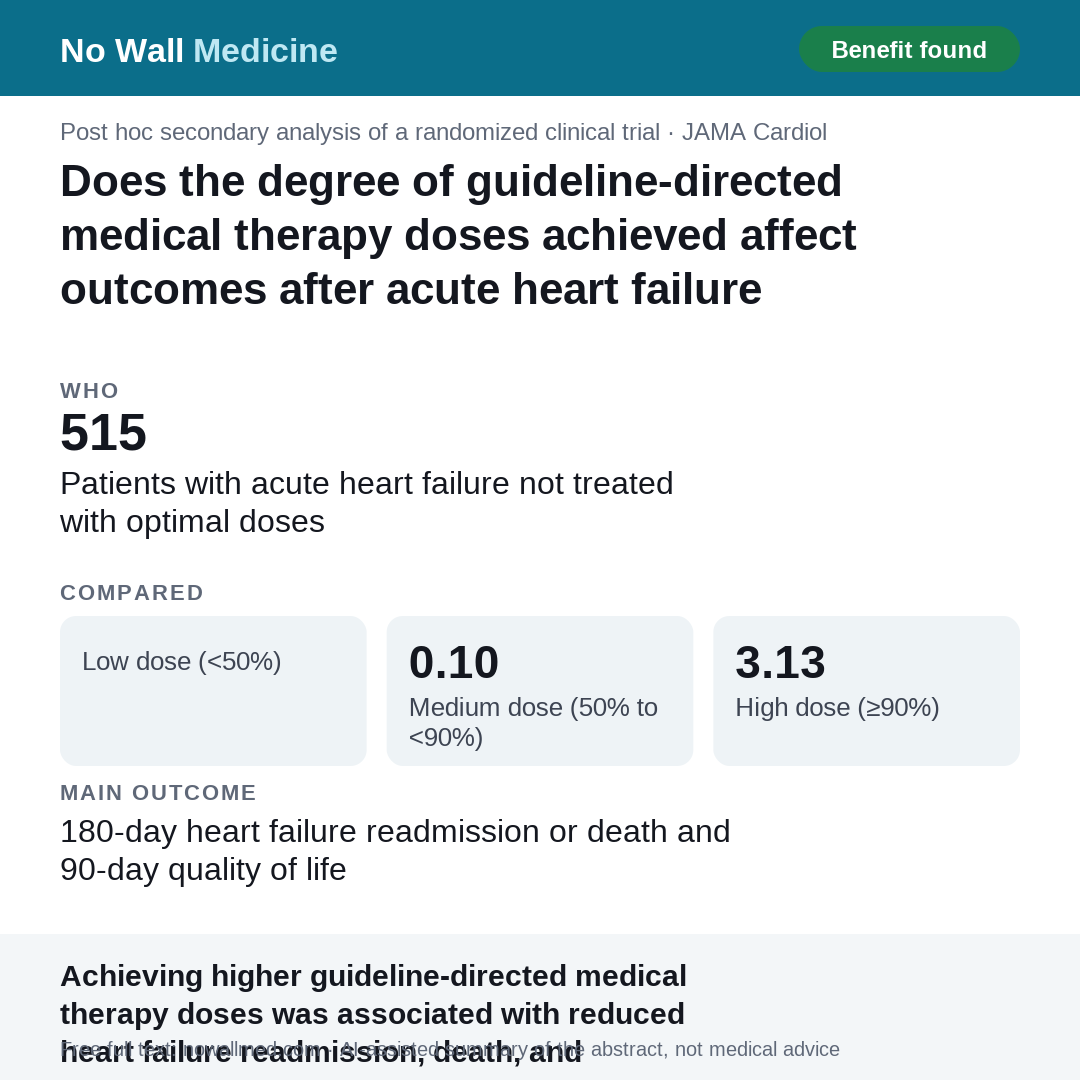
Clinical question: Does the degree of guideline-directed medical therapy doses achieved affect outcomes after acute heart failure admission?
Why it matters: It was unknown how the specific degree of guideline-directed medical therapy doses achieved during high-intensity care relates to patient outcomes.
Key points
- Researchers analyzed 515 patients receiving high-intensity care after an acute heart failure admission to see how medication dose levels related to health outcomes.
- A 10% increase in the average percentage of optimal medication doses was associated with a reduction in 180-day heart failure readmission or all-cause death.
- At 2 weeks, 7.6% of patients achieved low doses, 49.3% achieved medium doses, and 43.1% achieved high doses of the three medication classes.
Headline and key points written with AI from the paper’s abstract, with every number checked against it. Read the paper before relying on them.
Was this summary helpful?
Subject terms
Cite this article
Cotter G, Deniau B, Davison B, Edwards C, Adamo M, Arrigo M. Optimization of Evidence-Based Heart Failure Medications After an Acute Heart Failure Admission: A Secondary Analysis of the STRONG-HF Randomized Clinical Trial. JAMA Cardiol. 2023. doi:10.1001/jamacardio.2023.4553
Spotted a mistake? Suggest a correction
Top studies every Monday
The week’s key trials and guidelines in your specialties, plus any topics you follow. By email, free.
Get the weekly digest