Sensorized home exercise technology improved arm and hand function more than paper-based programs after stroke
Optimized Home Rehabilitation Technology Reduces Upper Extremity Impairment Compared to a Conventional Home Exercise Program: A Randomized, Controlled, Single-Blind Trial in Subacute Stroke
Single-blind, randomized controlled trialBenefit found
Does optimized home rehabilitation technology reduce upper extremity impairment compared to conventional home exercise?
Who
27
Participants in the subacute phase of stroke
Compared
sensorized exercise: 8.0 ± 4.6 points
conventional therapy: 3.0 ± 6.1 points
Main outcome
change in Upper Extremity Fugl-Meyer score
Bottom line: A sensor-based exercise system significantly reduced upper extremity impairment compared to a paper-based home exercise program.
Limitation: 2 participants in the conventional therapy group were lost to follow-up
Neurorehabil Neural Repair · 2023-01-12Download image
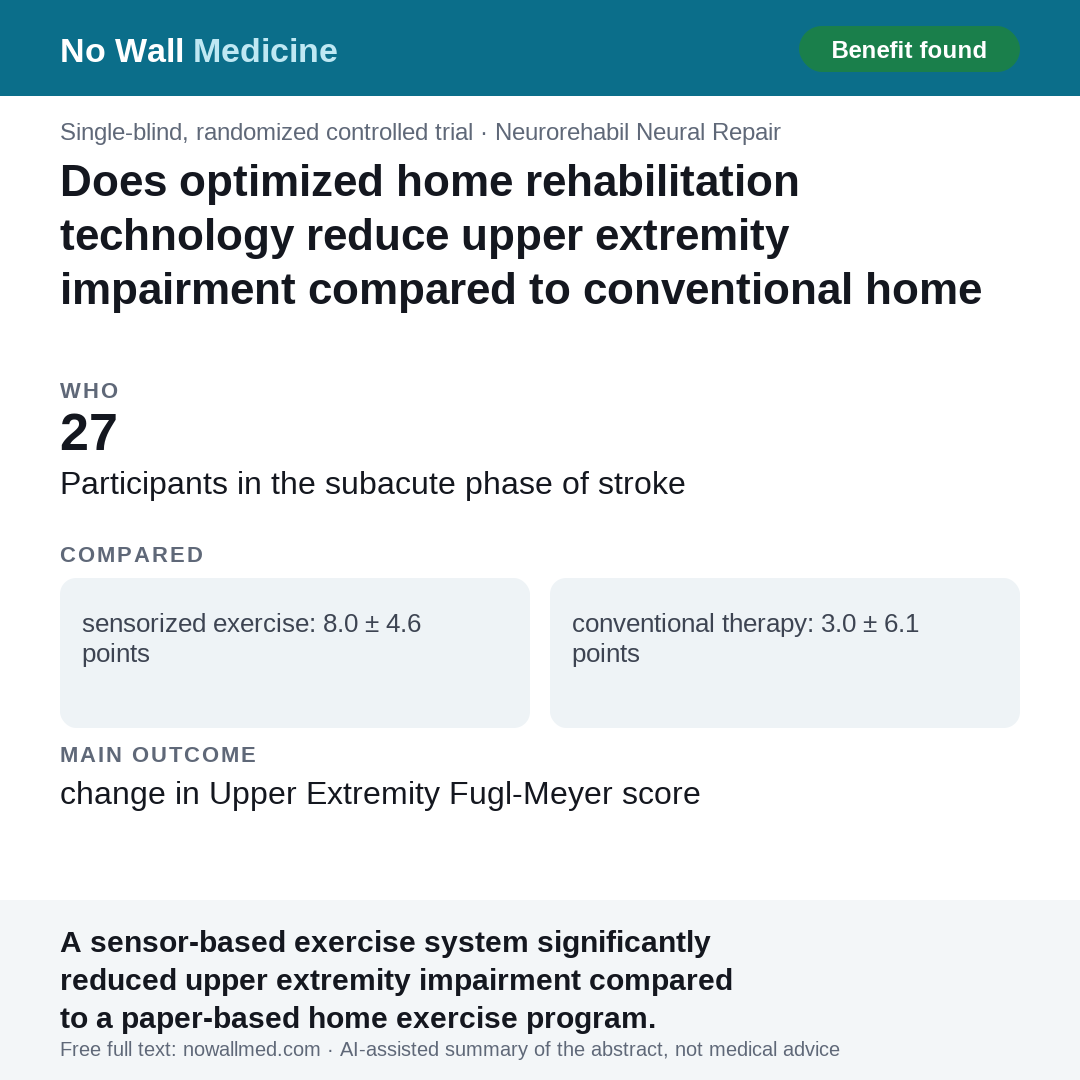
Clinical question: Does optimized home rehabilitation technology reduce upper extremity impairment compared to conventional home exercise?
Why it matters: Patients often show limited benefit from paper-based home exercise programs when attempting to recover arm and hand function after a stroke.
Key points
- Researchers studied 27 participants in the subacute phase of stroke, comparing a sensorized exercise system to a conventional paper-based exercise book.
- The sensorized group improved by an average of 8.0 ± 4.6 points on the Fugl-Meyer upper extremity scale compared to 3.0 ± 6.1 points for the conventional group.
- The sensorized exercise group showed no significant changes in muscle stiffness or pain scores.
Headline and key points written with AI from the paper’s abstract, with every number checked against it. Read the paper before relying on them.
Was this summary helpful?
Subject terms
Cite this article
Swanson VA, Johnson C, Zondervan DK, Bayus N, McCoy P, Ng YFJ. Optimized Home Rehabilitation Technology Reduces Upper Extremity Impairment Compared to a Conventional Home Exercise Program: A Randomized, Controlled, Single-Blind Trial in Subacute Stroke. Neurorehabil Neural Repair. 2023. doi:10.1177/15459683221146995
Spotted a mistake? Suggest a correction
Top studies every Monday
The week’s key trials and guidelines in your specialties, plus any topics you follow. By email, free.
Get the weekly digest