Oral immunotherapy suppresses specific gene activity in blood after peanut exposure in children
Oral immunotherapy suppresses peripheral blood transcriptomic response to peanut in peanut allergy
Randomized trialBenefit found
How does oral immunotherapy alter the peripheral blood transcriptome in peanut allergy?
Who
73
73 children aged 4 to 14 years with high-threshold peanut allergy
Compared
Oral immunotherapy: 100% achieved desensitization
Avoidance: 21% achieved desensitization
Main outcome
Desensitization and peripheral blood transcriptome response to peanut
Bottom line: Oral immunotherapy induces desensitization and suppresses specific transcriptional processes triggered by peanut exposure.
JACI · 2025-11-11Download image
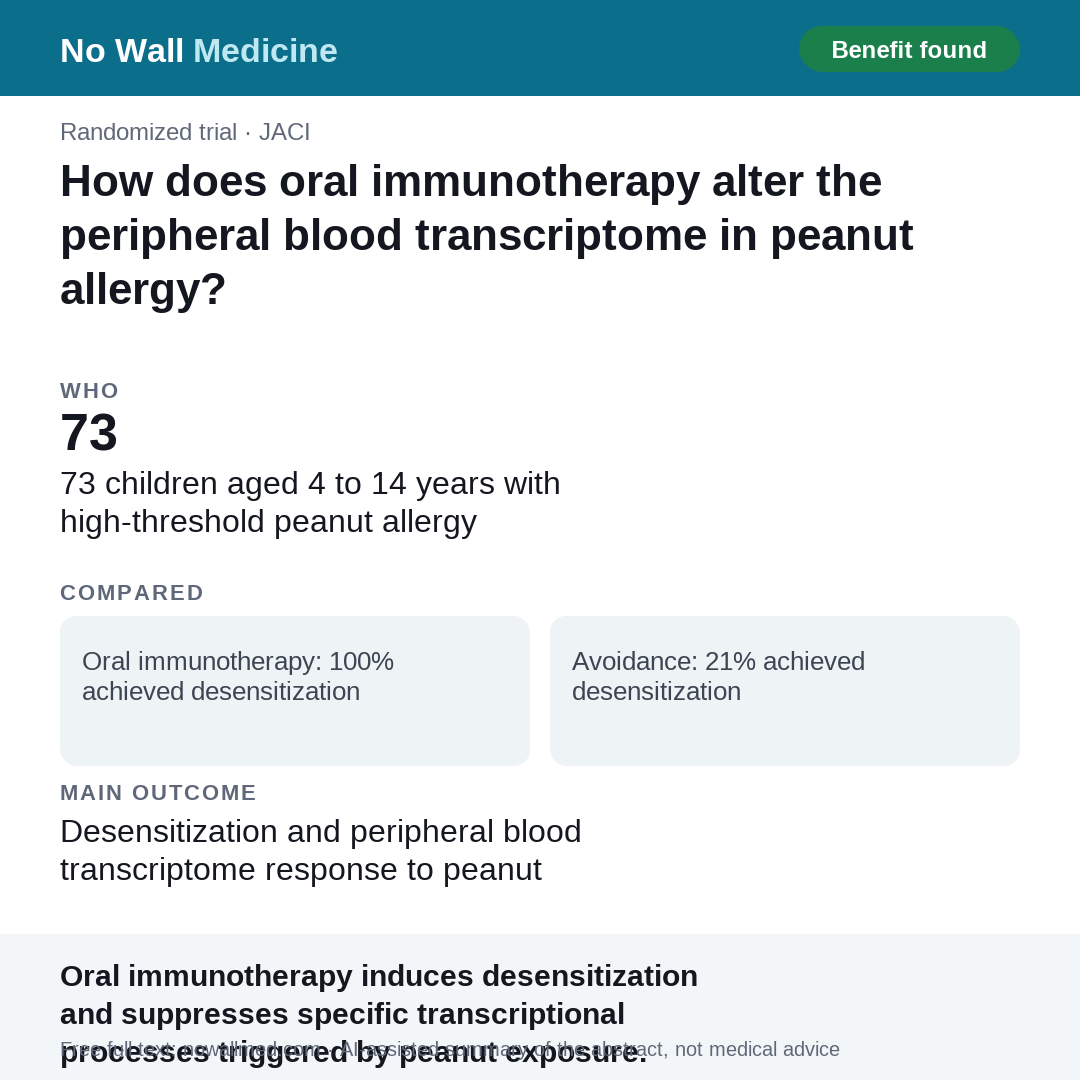
Clinical question: How does oral immunotherapy alter the peripheral blood transcriptome in peanut allergy?
Why it matters: The biological mechanisms that explain how oral immunotherapy induces desensitization in people with peanut allergy are not fully understood.
Key points
- Researchers studied 73 children aged 4 to 14 years with peanut allergy who were randomized to receive daily peanut doses or avoid peanut.
- The entire oral immunotherapy group (100%) achieved desensitization compared with 21% in the avoidance group.
- Oral immunotherapy was associated with the suppression of a 295-transcript signature involving neutrophil degranulation and signaling of interleukin-4 and interleukin-13.
Headline and key points written with AI from the paper’s abstract, with every number checked against it. Read the paper before relying on them.
Topics
Cite this article
Zhang L, Chun Y, Reed K, Grishina G, Lo T, Wang J. Oral immunotherapy suppresses peripheral blood transcriptomic response to peanut in peanut allergy. JACI. 2025. doi:10.1016/j.jaci.2025.10.030
Spotted a mistake? Suggest a correction