Clinical tumor response grade was associated with organ preservation and survival in rectal cancer patients
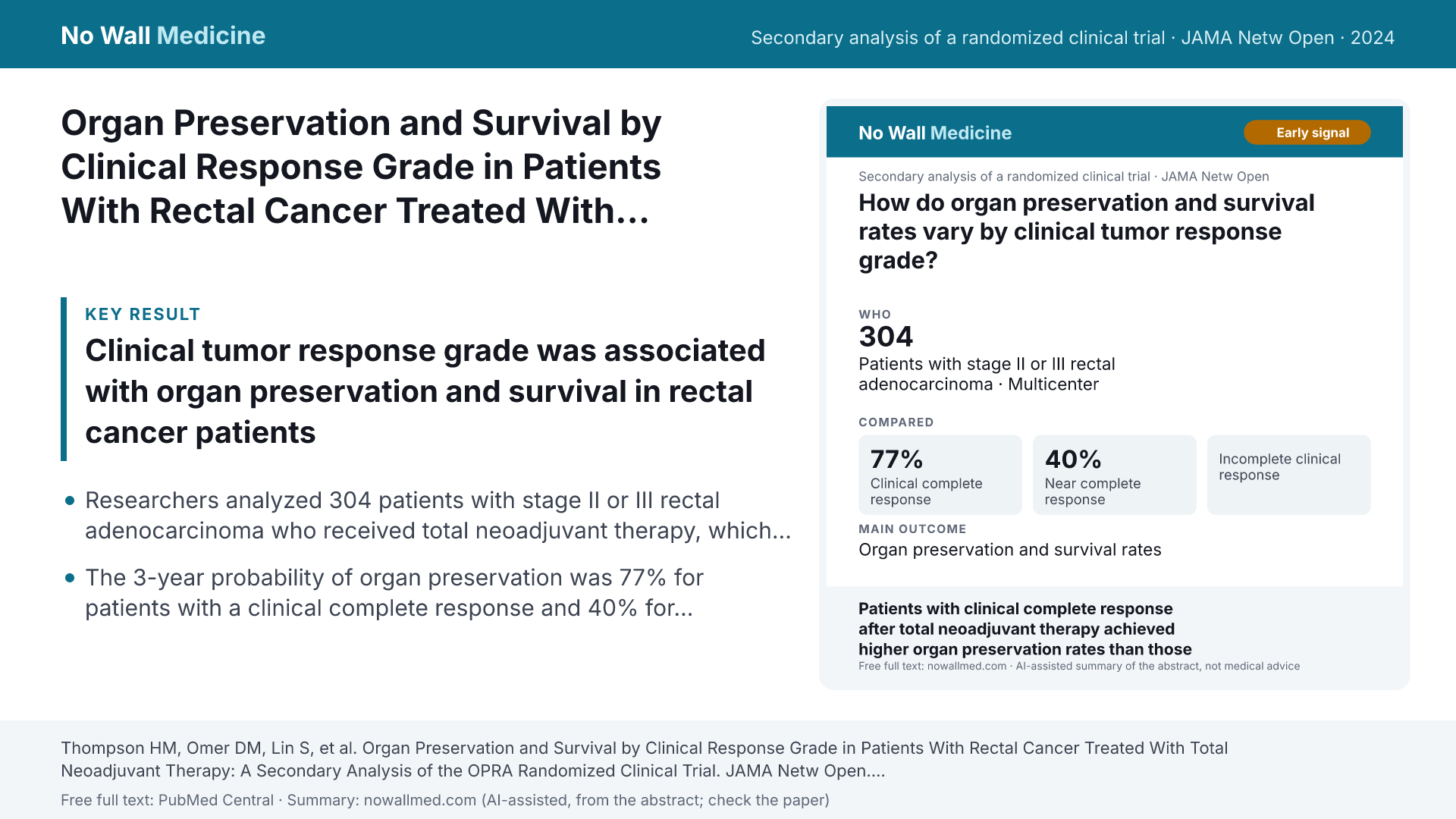
Organ Preservation and Survival by Clinical Response Grade in Patients With Rectal Cancer Treated With Total Neoadjuvant Therapy: A Secondary Analysis of the OPRA Randomized Clinical Trial
Secondary analysis of a randomized clinical trialEarly signal
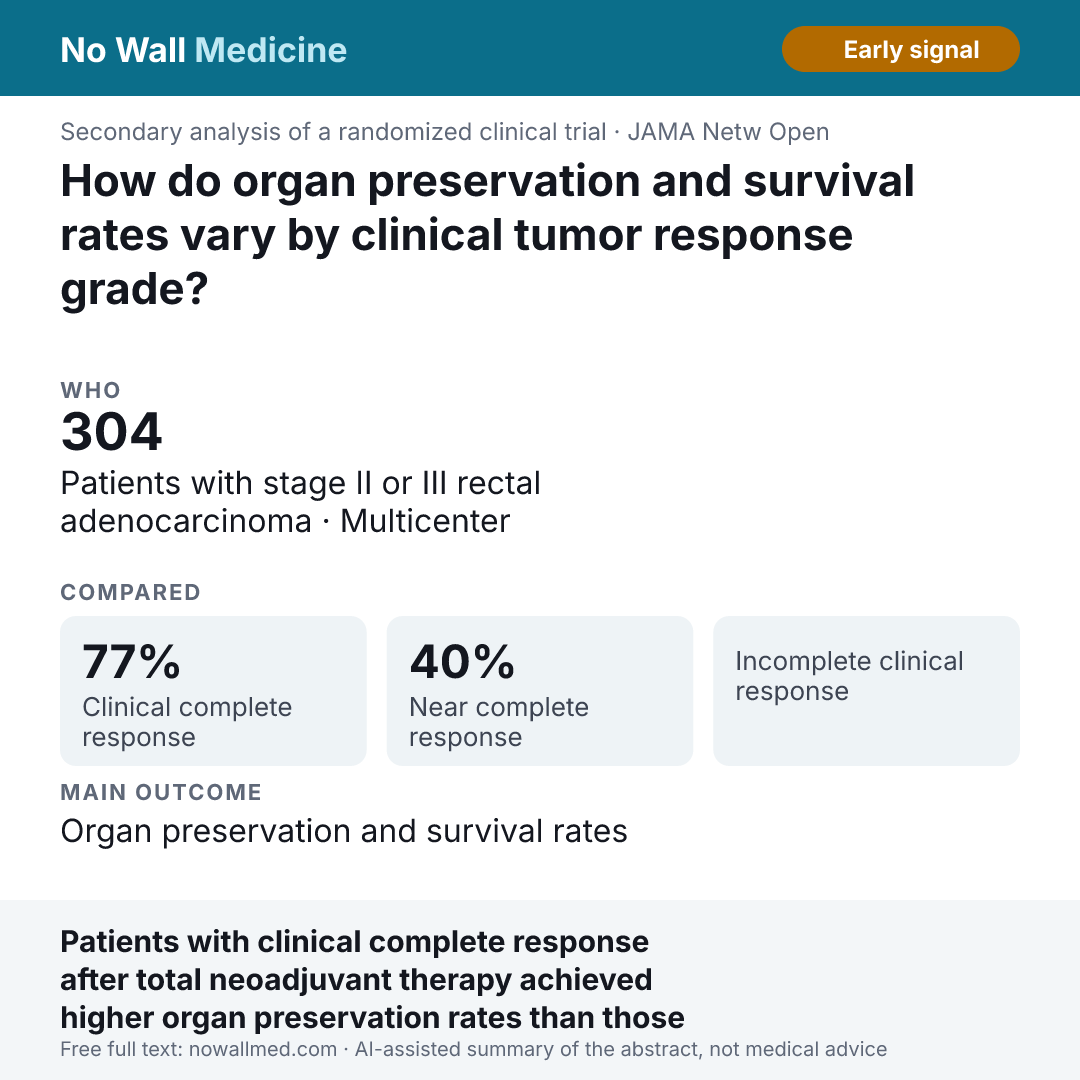
How do organ preservation and survival rates vary by clinical tumor response grade?
Who
304
Patients with stage II or III rectal adenocarcinoma · Multicenter
Compared
77%Clinical complete response (95% CI, 70%-85%)
40%Near complete response (95% CI, 32%-51%)
Incomplete clinical response
Main outcome
Organ preservation and survival rates
Bottom line: Patients with clinical complete response after total neoadjuvant therapy achieved higher organ preservation rates than those with near complete response.
JAMA Netw Open · 2024-01-02 · Save PNG
Same trial (NCT02008656)
Papers we list that report this registered trial, oldest first. Read a secondary analysis alongside the main results.
- Longer follow-up No clear difference
Long-term results show different organ preservation rates for two rectal cancer treatment sequences J Clin Oncol 2023-10 - Secondary analysis Early signal
This paper JAMA Netw Open 2024-01 - Secondary analysis Key finding
MRI response categories predicted organ preservation and survival in rectal cancer patients Radiology 2024-09
Clinical question: How do organ preservation and survival rates vary by clinical tumor response grade?
Why it matters: It is important to determine how different levels of tumor response after total neoadjuvant therapy affect the ability to avoid surgery and long-term survival.
Key points
- Researchers analyzed 304 patients with stage II or III rectal adenocarcinoma who received total neoadjuvant therapy, which is chemotherapy and radiation before surgery.
- The 3-year probability of organ preservation was 77% for patients with a clinical complete response and 40% for those with a near complete response.
- Clinical tumor response grade was associated with disease-free survival, local recurrence-free survival, distant metastasis-free survival, and overall survival.
Headline and key points written with AI from the paper’s abstract, with every number checked against it. Read the paper before relying on them.
Was this summary helpful?
Subject terms
Headline, design, result, key points, caveat and citation as plain text.
Cite this article
Thompson HM, Omer DM, Lin S, et al. Organ Preservation and Survival by Clinical Response Grade in Patients With Rectal Cancer Treated With Total Neoadjuvant Therapy: A Secondary Analysis of the OPRA Randomized Clinical Trial. JAMA Netw Open. 2024;7(1):e2350903. doi:10.1001/jamanetworkopen.2023.50903
Spotted a mistake? Suggest a correction