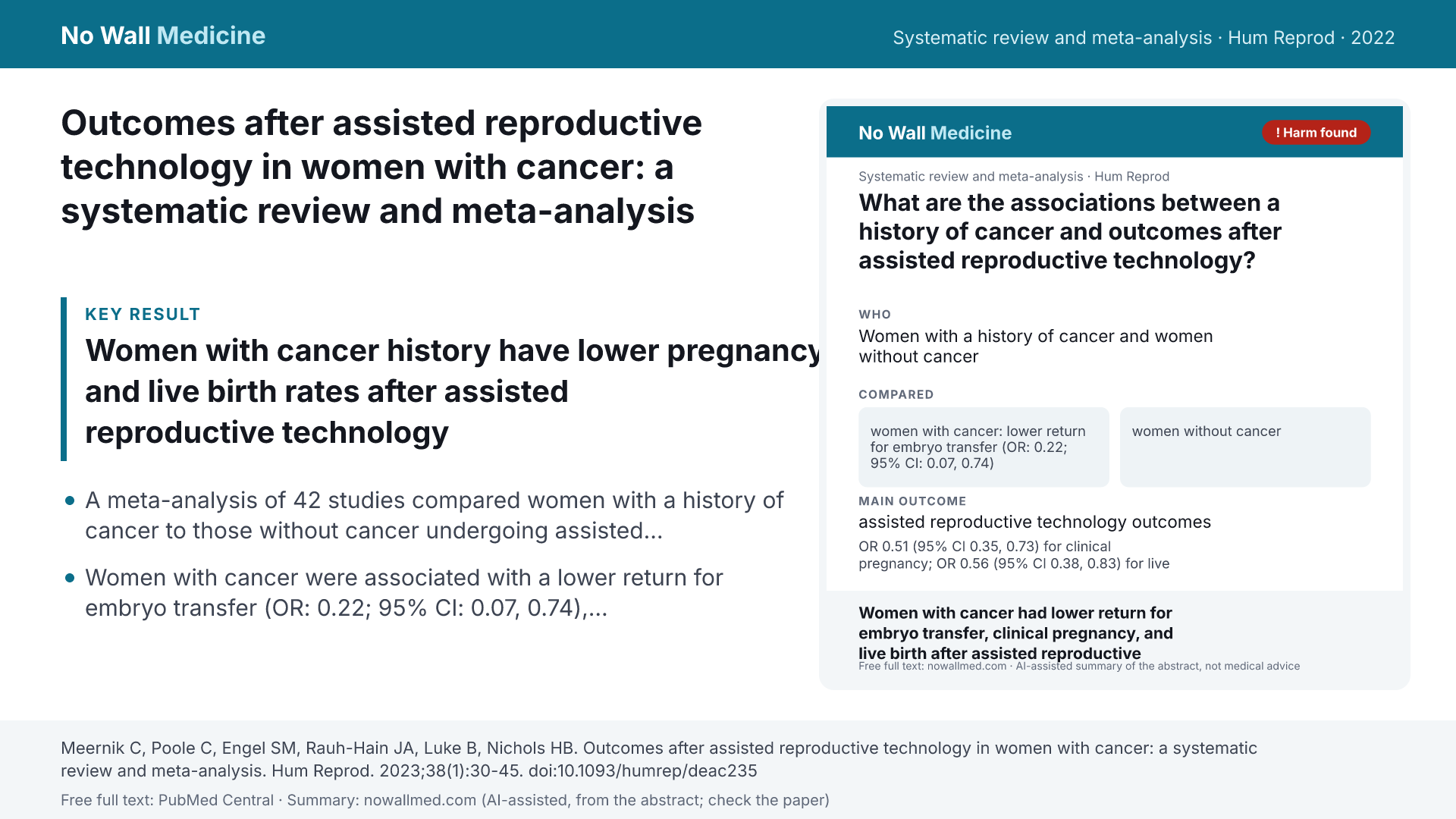
Women with cancer history have lower pregnancy and live birth rates after assisted reproductive technology
Outcomes after assisted reproductive technology in women with cancer: a systematic review and meta-analysis
Systematic review and meta-analysisHarm found
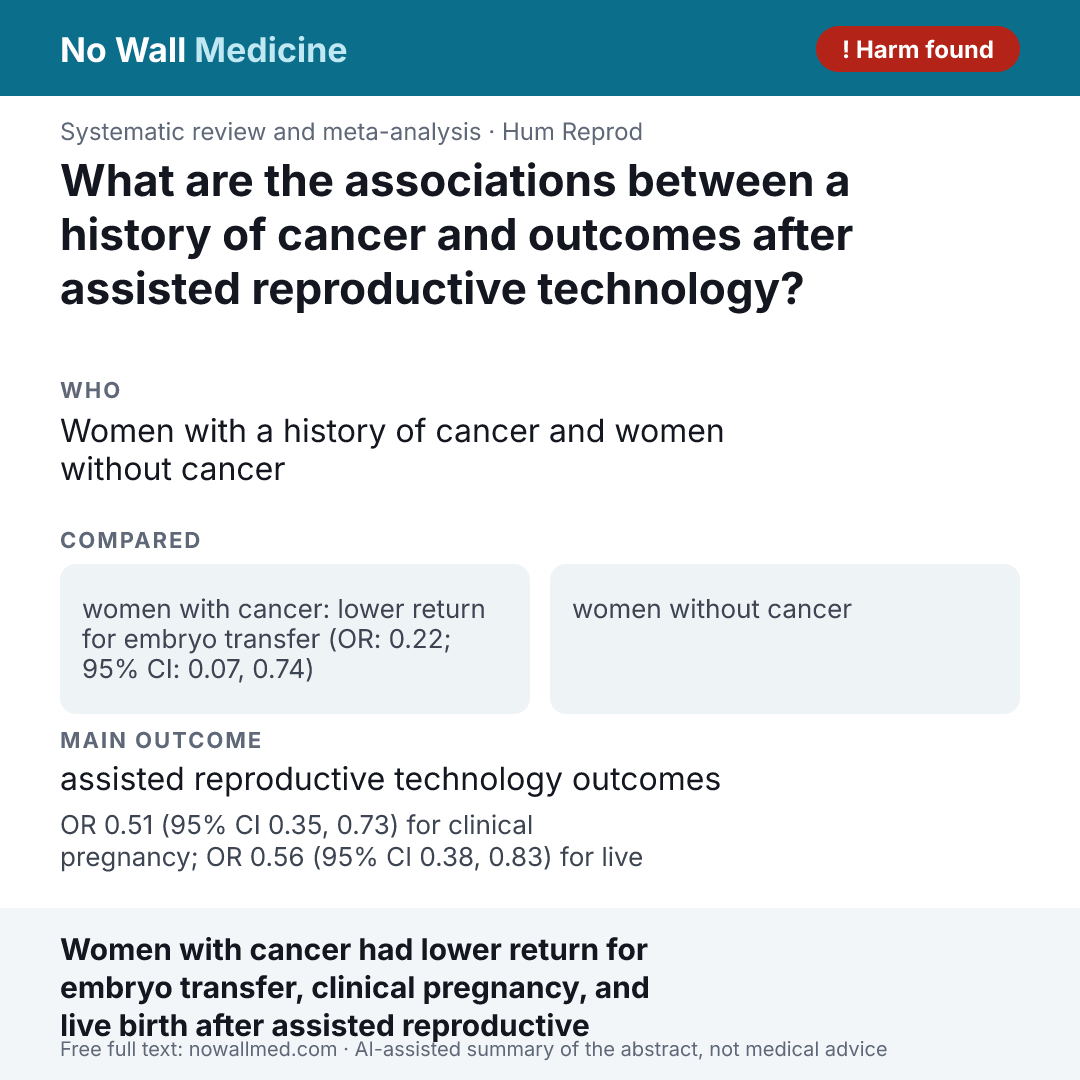
What are the associations between a history of cancer and outcomes after assisted reproductive technology?
Who
Women with a history of cancer and women without cancer
Compared
women with cancer: lower return for embryo transfer (OR: 0.22; 95% CI: 0.07, 0.74)
women without cancer
Main outcome
assisted reproductive technology outcomes
Result: OR 0.51 (95% CI 0.35, 0.73) for clinical pregnancy; OR 0.56 (95% CI 0.38, 0.83) for live birth
Bottom line: Women with cancer had lower return for embryo transfer, clinical pregnancy, and live birth after assisted reproductive technology.
Limitation: Appreciable confounding is possible in studies lacking adequate control for age and substantial among-study heterogeneity was observed.
Hum Reprod · 2022-11-08 · Funded by National Cancer Institute
Why it matters: Small, single-institution studies have suggested that cancer and its treatment may negatively affect assisted reproductive technology outcomes, but more evidence was needed.
Headline and visual abstract written with AI from the paper’s abstract, with every number checked against it. Read the paper before relying on them.
Was this summary helpful?
Subject terms
Cite this article
Meernik C, Poole C, Engel SM, Rauh-Hain JA, Luke B, Nichols HB. Outcomes after assisted reproductive technology in women with cancer: a systematic review and meta-analysis. Hum Reprod. 2023;38(1):30-45. doi:10.1093/humrep/deac235
Spotted a mistake? Suggest a correction