Long-term treatment for super-refractory status epilepticus was associated with lower mortality and higher disability
Outcomes and Treatment Approaches for Super-Refractory Status Epilepticus: A Systematic Review and Meta-Analysis
Systematic review and meta-analysisMixed results
What are the clinical characteristics, outcomes, and treatment approaches for super-refractory status epilepticus?
Who
1200
Adult patients with nonanoxic super-refractory status epilepticus
Compared
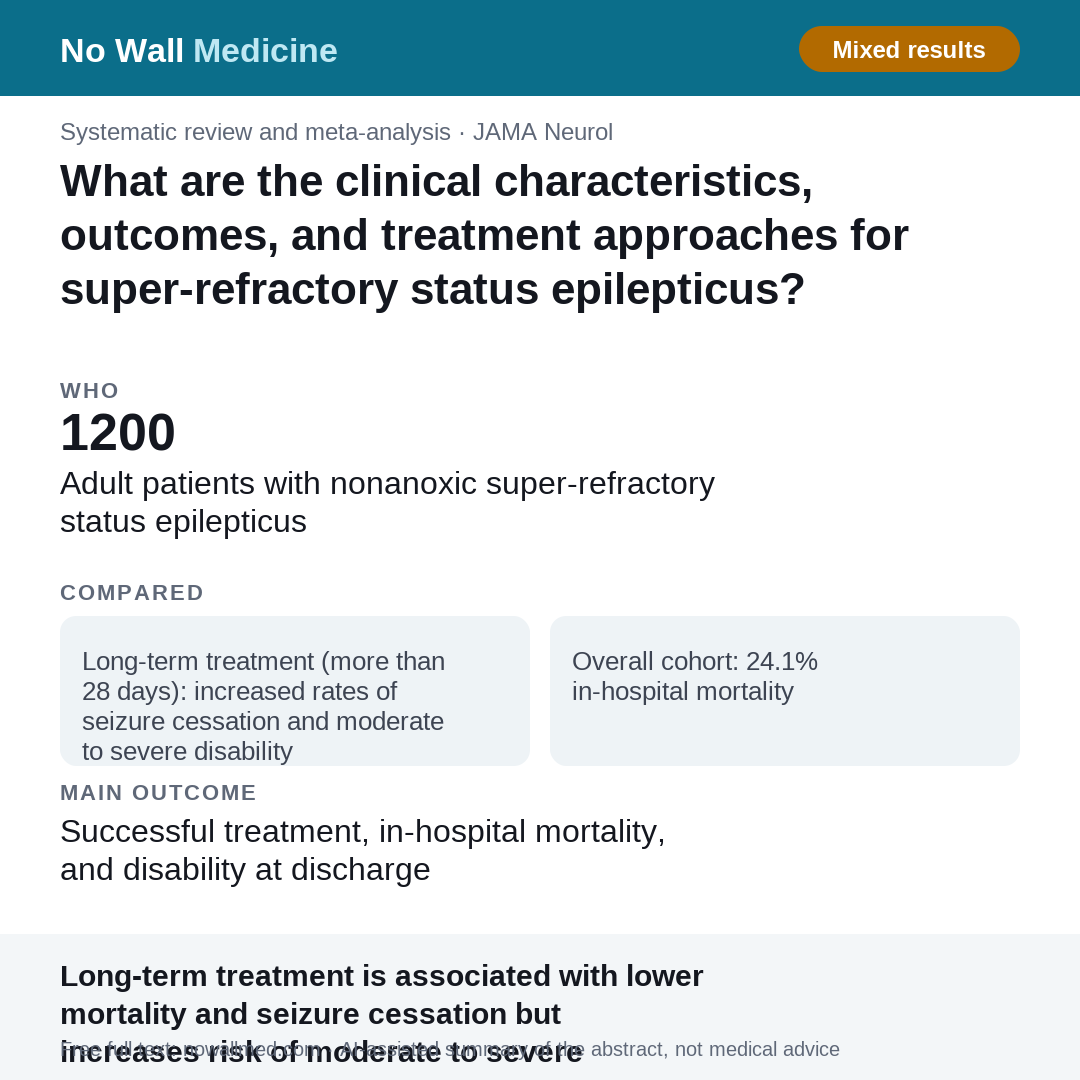
Long-term treatment (more than 28 days): increased rates of seizure cessation and moderate to severe disability
Overall cohort: 24.1% in-hospital mortality
Main outcome
Successful treatment, in-hospital mortality, and disability at discharge
Bottom line: Long-term treatment is associated with lower mortality and seizure cessation but increases risk of moderate to severe disability.
Limitation: Missing data were neither imputed nor completed by contacting the study authors.
JAMA Neurol · 2023-07-31Download image
Clinical question: What are the clinical characteristics, outcomes, and treatment approaches for super-refractory status epilepticus?
Why it matters: Clinical knowledge regarding the characteristics, causes, outcomes, and optimal treatment approaches for super-refractory status epilepticus is currently sparse.
Key points
- Researchers analyzed 95 articles and 30 conference abstracts involving 1200 adult patients with nonanoxic super-refractory status epilepticus, a condition where seizures continue 24 hours after starting anesthesia.
- In-hospital mortality was 24.1%, and only 26.8% of patients had none to slight disability at discharge.
- Long-term treatment lasting more than 28 days was associated with stabilized mortality and increased seizure cessation, but also with increased rates of moderate to severe disability.
Headline and key points written with AI from the paper’s abstract, with every number checked against it. Read the paper before relying on them.
Was this summary helpful?
Cite this article
Cornwall CD, Krøigård T, Kristensen JSS, Callesen HE, Beier CP. Outcomes and Treatment Approaches for Super-Refractory Status Epilepticus: A Systematic Review and Meta-Analysis. JAMA Neurol. 2023. doi:10.1001/jamaneurol.2023.2407
Spotted a mistake? Suggest a correction
Top studies every Monday
The week’s key trials and guidelines in your specialties, plus any topics you follow. By email, free.
Get the weekly digest