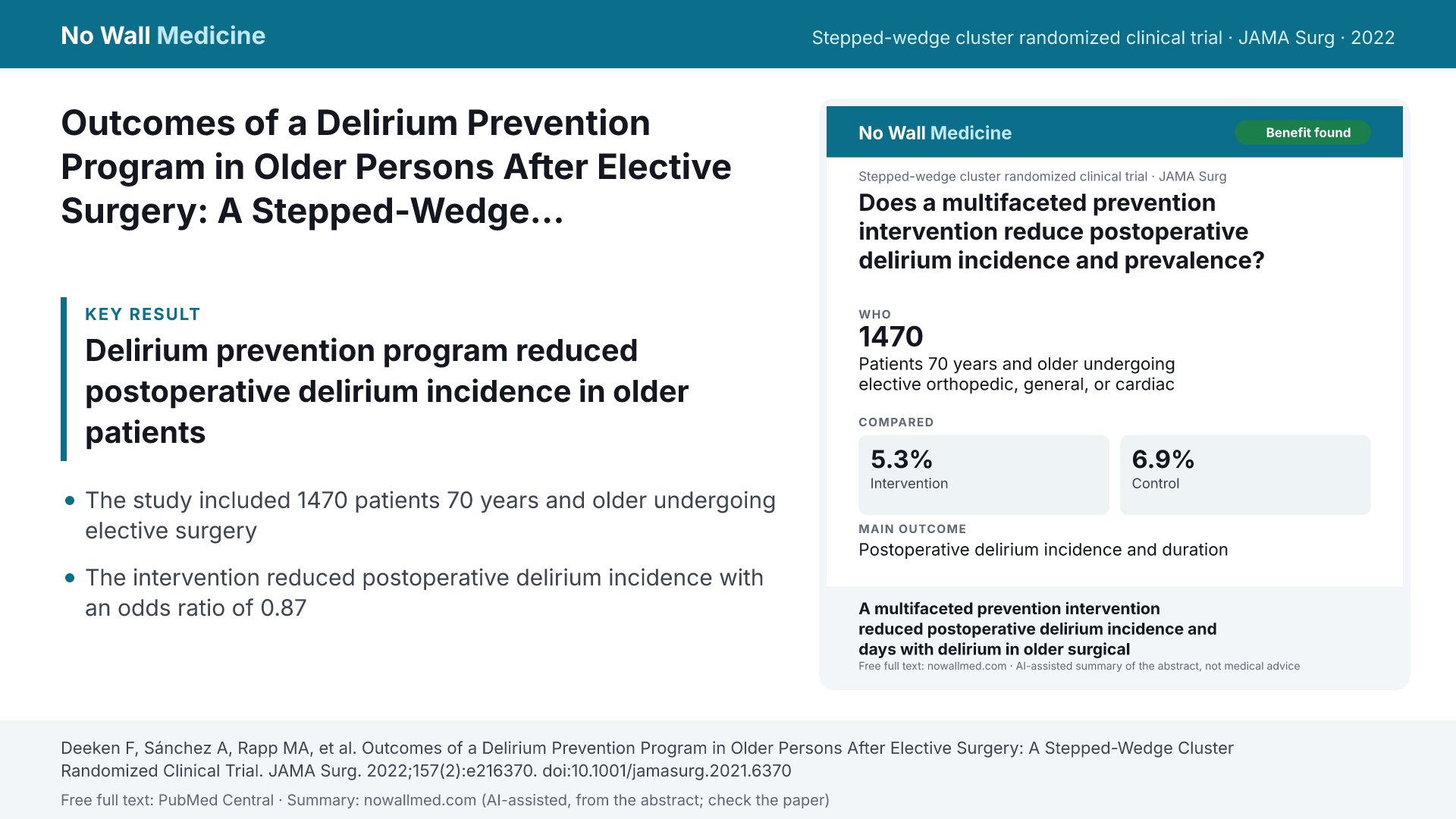
Delirium prevention program reduced postoperative delirium incidence in older patients
Outcomes of a Delirium Prevention Program in Older Persons After Elective Surgery: A Stepped-Wedge Cluster Randomized Clinical Trial
Stepped-wedge cluster randomized clinical trialBenefit found
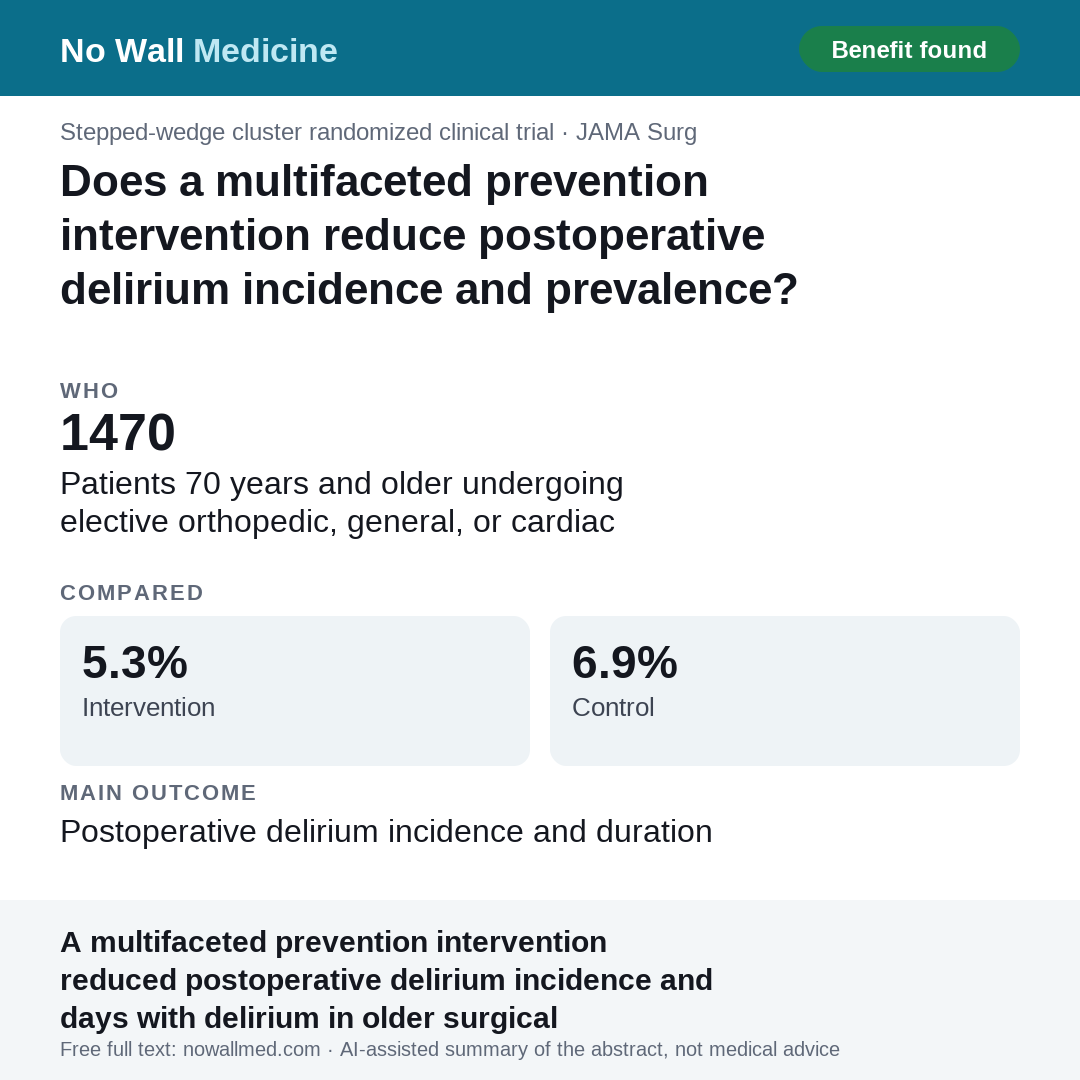
Does a multifaceted prevention intervention reduce postoperative delirium incidence and prevalence?
Who
1470
Patients 70 years and older undergoing elective orthopedic, general, or cardiac surgery · 5 German tertiary medical centers
Compared
5.3%Intervention
6.9%Control
Main outcome
Postoperative delirium incidence and duration
Result: odds ratio 0.87 (95% CI 0.77-0.98)
Bottom line: A multifaceted prevention intervention reduced postoperative delirium incidence and days with delirium in older surgical patients.
JAMA Surg · 2022-02-09Download image
Clinical question: Does a multifaceted prevention intervention reduce postoperative delirium incidence and prevalence?
Why it matters: Delirium prevention approaches applicable to different surgical settings remain unexplored
In absolute numbers
Intervention: 5.3% · Control: 6.9% → a difference of 1.6 percentage points, so about 63 people would need the treatment for 1 more to benefit (number needed to treat) over the trial’s follow-up.
Worked out by us from the two group results above, not reported by the authors. Check the paper for the exact outcome and timing.
Key points
- The study included 1470 patients 70 years and older undergoing elective surgery.
- The intervention reduced postoperative delirium incidence with an odds ratio of 0.87.
- The effect was significant in patients undergoing orthopedic or abdominal surgery but not cardiac surgery.
Headline and key points written with AI from the paper’s abstract, with every number checked against it. Read the paper before relying on them.
Was this summary helpful?
Subject terms
Headline, design, result, key points, caveat and citation as plain text.
Cite this article
Deeken F, Sánchez A, Rapp MA, et al. Outcomes of a Delirium Prevention Program in Older Persons After Elective Surgery: A Stepped-Wedge Cluster Randomized Clinical Trial. JAMA Surg. 2022. doi:10.1001/jamasurg.2021.6370
Spotted a mistake? Suggest a correction