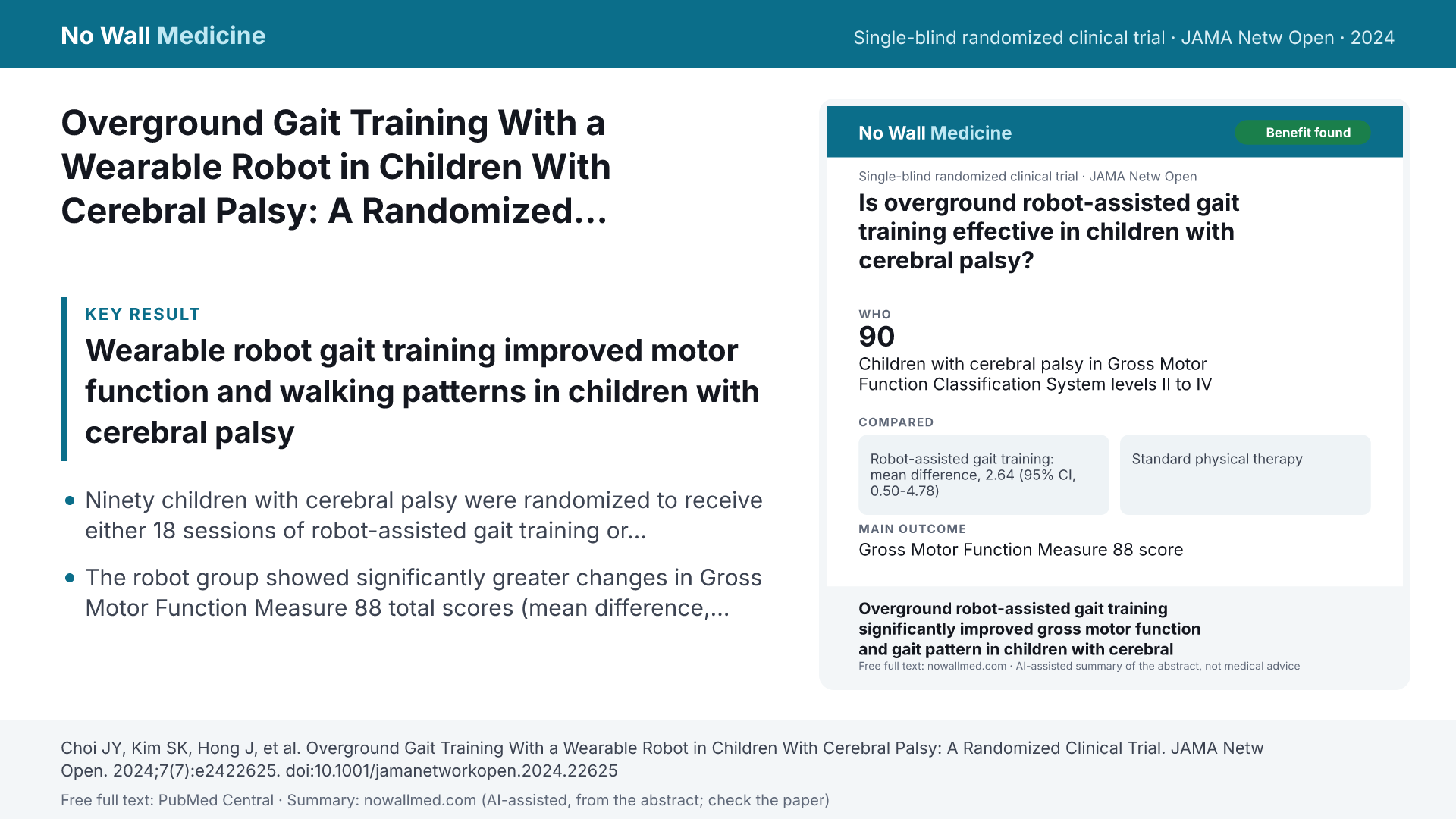
Wearable robot gait training improved motor function and walking patterns in children with cerebral palsy
Overground Gait Training With a Wearable Robot in Children With Cerebral Palsy: A Randomized Clinical Trial
Single-blind randomized clinical trialBenefit found
Is overground robot-assisted gait training effective in children with cerebral palsy?
Who
90
Children with cerebral palsy in Gross Motor Function Classification System levels II to IV · 5 rehabilitation institutions in Korea
Compared
Robot-assisted gait training: mean difference, 2.64 (95% CI, 0.50-4.78)
Standard physical therapy
Main outcome
Gross Motor Function Measure 88 score
Result: mean difference, 2.64 (95% CI, 0.50-4.78)
Bottom line: Overground robot-assisted gait training significantly improved gross motor function and gait pattern in children with cerebral palsy.
JAMA Netw Open · 2024-07-01Download image
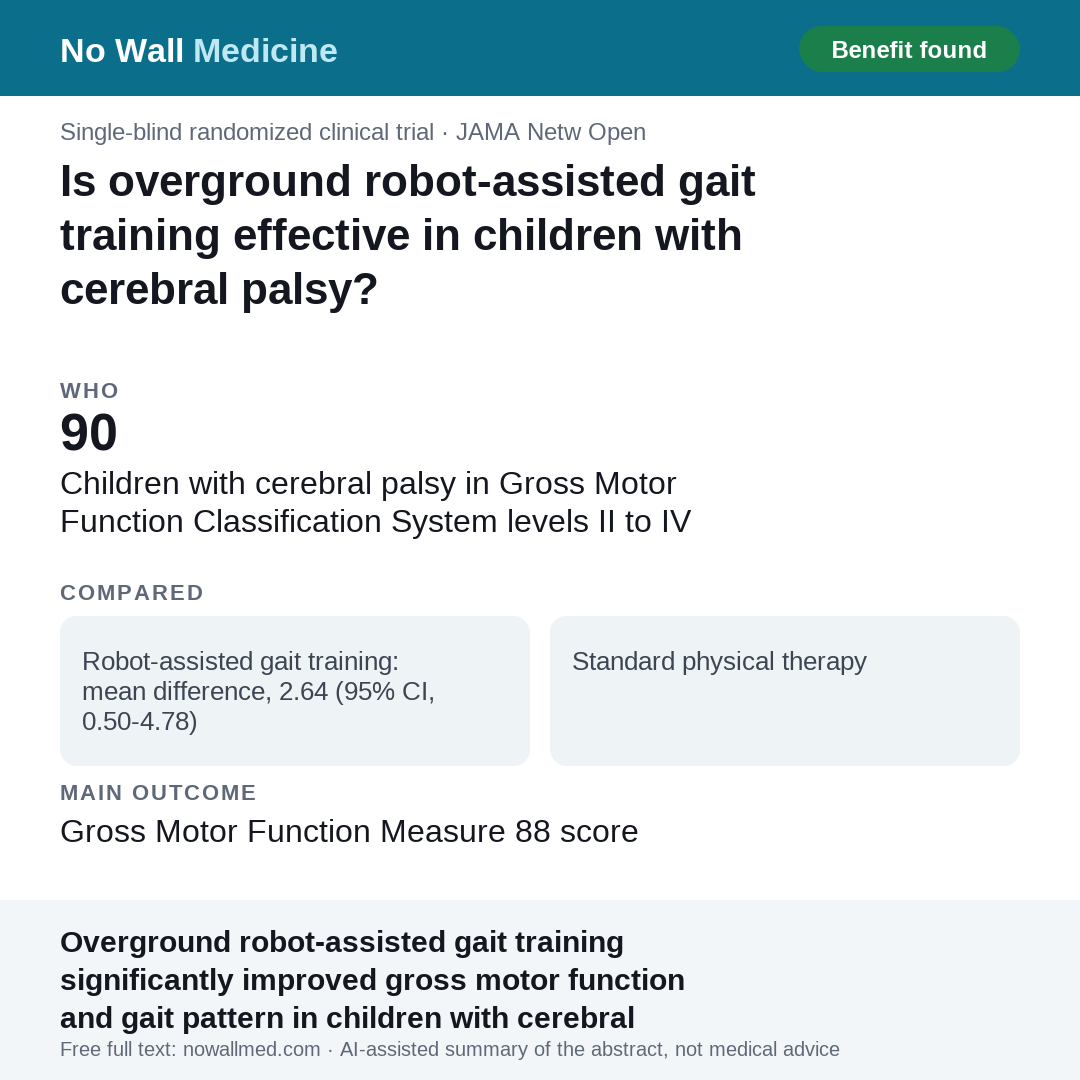
Clinical question: Is overground robot-assisted gait training effective in children with cerebral palsy?
Why it matters: It was unknown if using an untethered, torque-assisted, wearable exoskeletal robot for overground walking training is effective for children with cerebral palsy.
Key points
- Ninety children with cerebral palsy were randomized to receive either 18 sessions of robot-assisted gait training or standard physical therapy over 6 weeks.
- The robot group showed significantly greater changes in Gross Motor Function Measure 88 total scores (mean difference, 2.64) and PEDI-CAT responsibility domain scores (mean difference, 2.52).
- At a 4-week follow-up, the robot group had significantly greater improvements in balance control (mean difference, 1.48) and Gait Deviation Index (mean difference, 6.48).
Headline and key points written with AI from the paper’s abstract, with every number checked against it. Read the paper before relying on them.
Was this summary helpful?
Subject terms
Cite this article
Choi JY, Kim SK, Hong J, Park H, Yang SS, Park D. Overground Gait Training With a Wearable Robot in Children With Cerebral Palsy: A Randomized Clinical Trial. JAMA Netw Open. 2024. doi:10.1001/jamanetworkopen.2024.22625
Spotted a mistake? Suggest a correction
Top studies every Monday
The week’s key trials and guidelines in your specialties, plus any topics you follow. By email, free.
Get the weekly digest