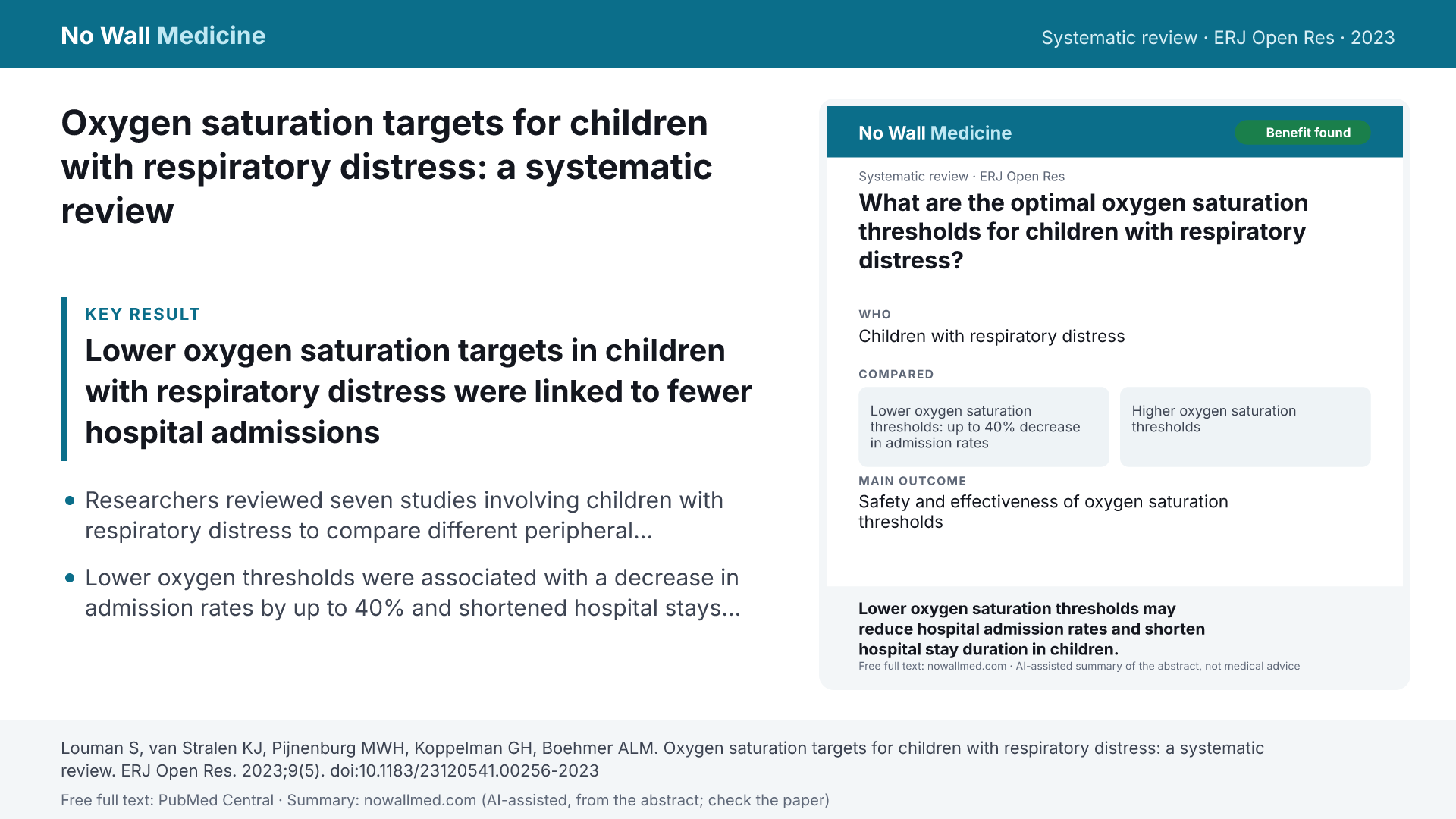
Lower oxygen saturation targets in children with respiratory distress were linked to fewer hospital admissions
Oxygen saturation targets for children with respiratory distress: a systematic review
Systematic reviewBenefit found
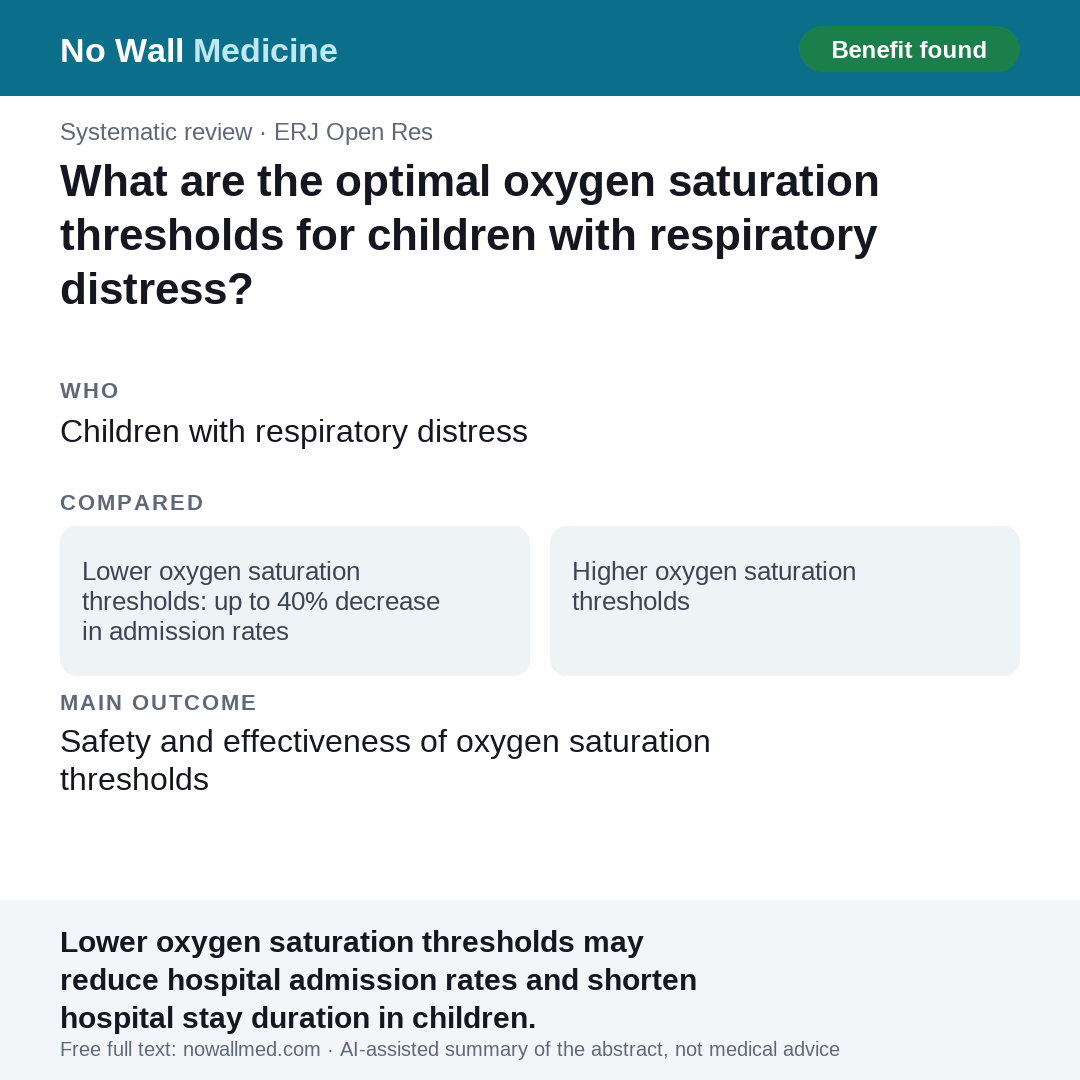
What are the optimal oxygen saturation thresholds for children with respiratory distress?
Who
Children with respiratory distress
Compared
Lower oxygen saturation thresholds: up to 40% decrease in admission rates
Higher oxygen saturation thresholds
Main outcome
Safety and effectiveness of oxygen saturation thresholds
Bottom line: Lower oxygen saturation thresholds may reduce hospital admission rates and shorten hospital stay duration in children.
Limitation: Studies were highly heterogeneous in setting, design, population and outcomes.
ERJ Open Res · 2023-10-16Download image
Clinical question: What are the optimal oxygen saturation thresholds for children with respiratory distress?
Why it matters: The specific oxygen saturation thresholds for children experiencing breathing difficulties are poorly studied.
Key points
- Researchers reviewed seven studies involving children with respiratory distress to compare different peripheral oxygen saturation (the amount of oxygen in the blood) thresholds.
- Lower oxygen thresholds were associated with a decrease in admission rates by up to 40% and shortened hospital stays by 10-18 h.
- Lower oxygen thresholds were linked to equivalent mortality, neurocognitive outcomes, and readmission rates compared to higher thresholds.
Limitation the authors note: Studies were highly heterogeneous in setting, design, population and outcomes, and the risk of bias varied from low to high.
Headline and key points written with AI from the paper’s abstract, with every number checked against it. Read the paper before relying on them.
Was this summary helpful?
Cite this article
Louman S, van Stralen KJ, Pijnenburg MWH, Koppelman GH, Boehmer ALM. Oxygen saturation targets for children with respiratory distress: a systematic review. ERJ Open Res. 2023. doi:10.1183/23120541.00256-2023
Spotted a mistake? Suggest a correction