Oxygen saturation targets for children with respiratory distress: a systematic review
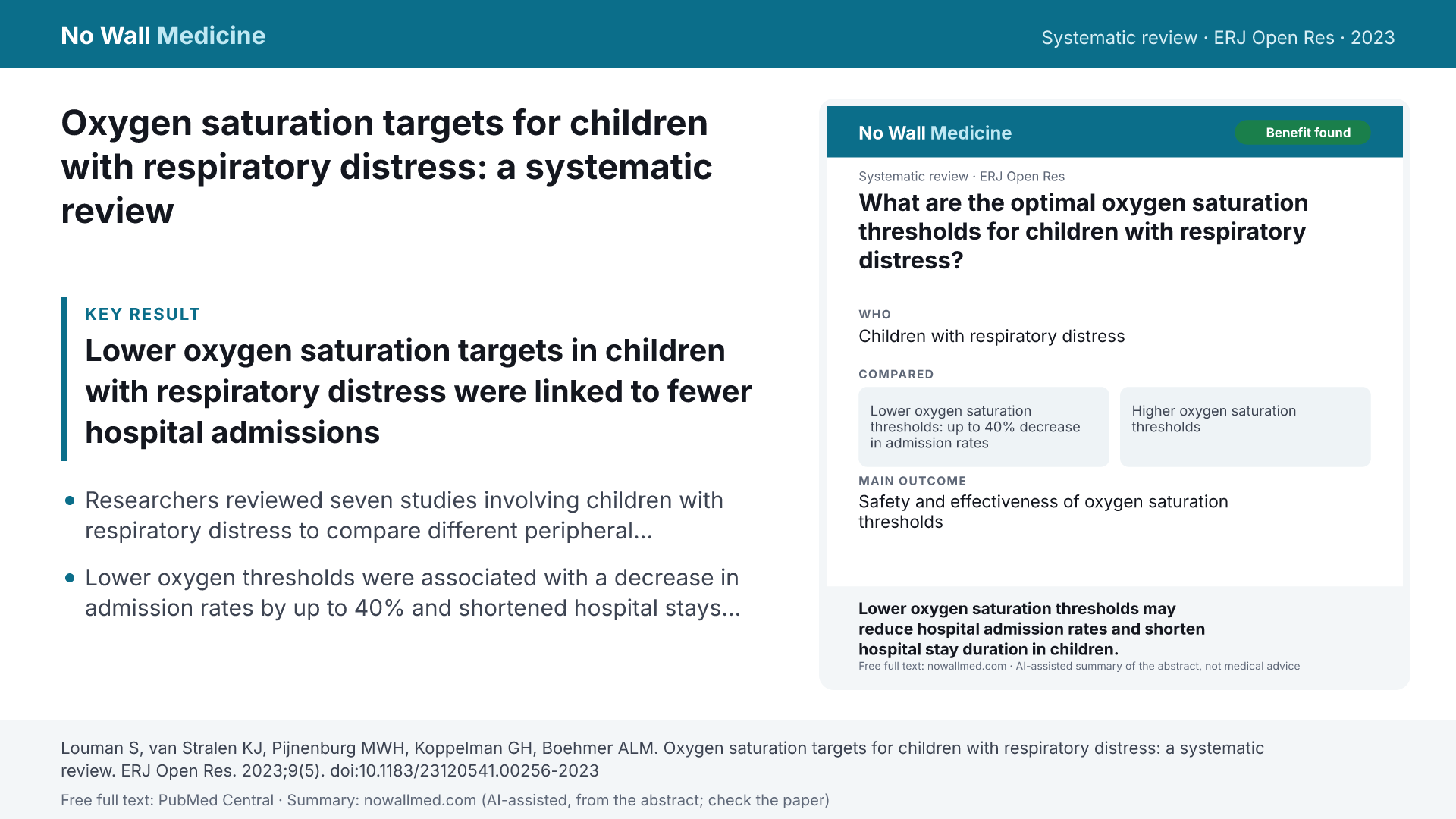
Key result: Lower oxygen saturation targets in children with respiratory distress were linked to fewer hospital admissions
Key points
- Researchers reviewed seven studies involving children with respiratory distress to compare different peripheral oxygen saturation (the amount of oxygen in the blood) thresholds.
- Lower oxygen thresholds were associated with a decrease in admission rates by up to 40% and shortened hospital stays by 10-18 h.
- Lower oxygen thresholds were linked to equivalent mortality, neurocognitive outcomes, and readmission rates compared to higher thresholds.
Why it matters: The specific oxygen saturation thresholds for children experiencing breathing difficulties are poorly studied.
Limitation the authors note: Studies were highly heterogeneous in setting, design, population and outcomes, and the risk of bias varied from low to high.
Discussion prompts
- Would these patients look like yours? Who was left out?
- Is the main outcome one that matters to patients?
- Is the difference large enough to change what you do?
Cite: Louman S, van Stralen KJ, Pijnenburg MWH, Koppelman GH, Boehmer ALM. Oxygen saturation targets for children with respiratory distress: a systematic review. ERJ Open Res. 2023;9(5). doi:10.1183/23120541.00256-2023
Free full text: PubMed Central · Summary and visual abstract: nowallmed.com/a/oxygen-saturation-targets-for-children-with-respiratory-distress-a-llvna5/ (AI-assisted from the abstract; check the paper before relying on it).