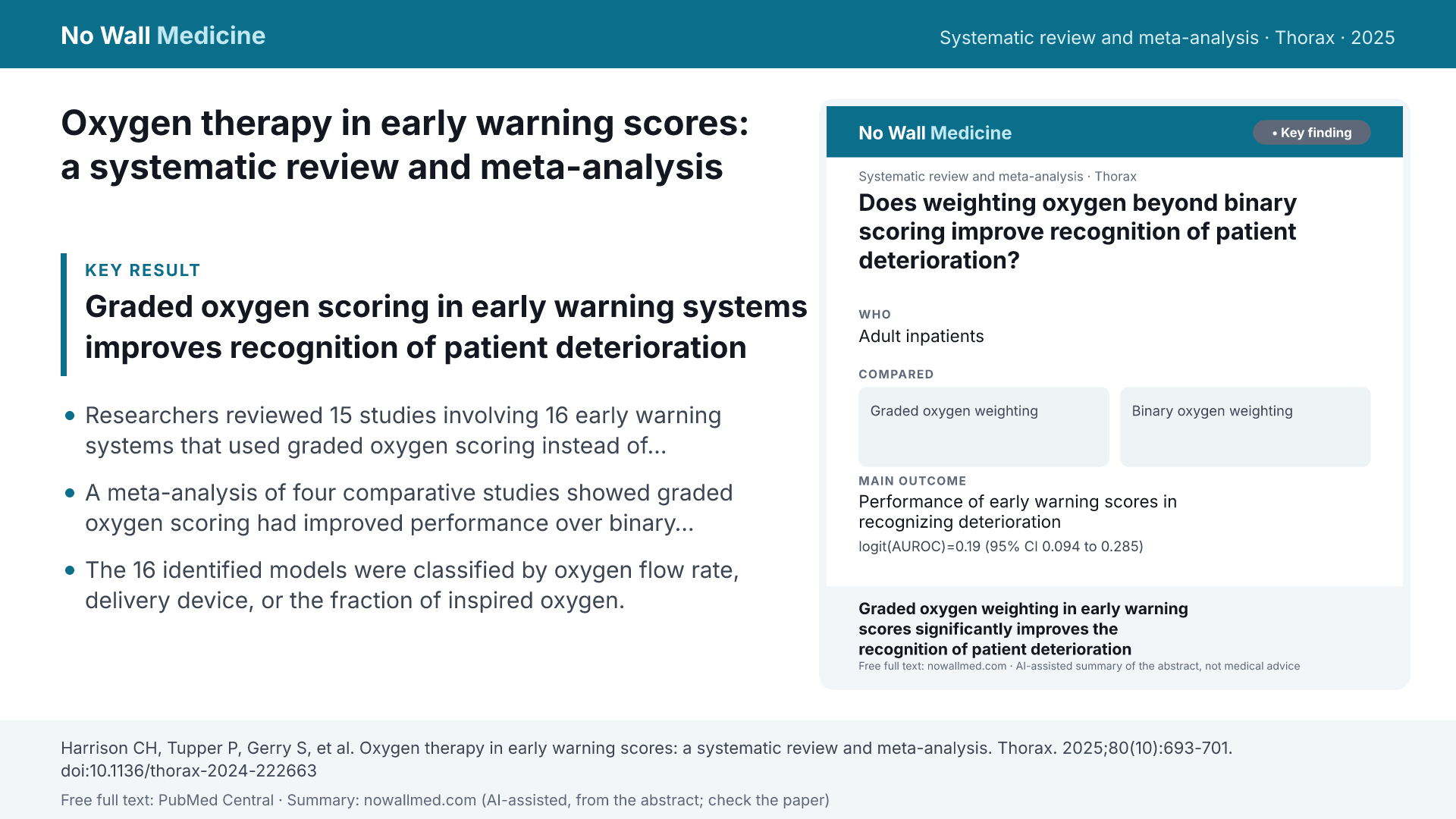
Oxygen therapy in early warning scores: a systematic review and meta-analysis
Key result: Graded oxygen scoring in early warning systems improves recognition of patient deterioration
Key points
- Researchers reviewed 15 studies involving 16 early warning systems that used graded oxygen scoring instead of simple binary scoring.
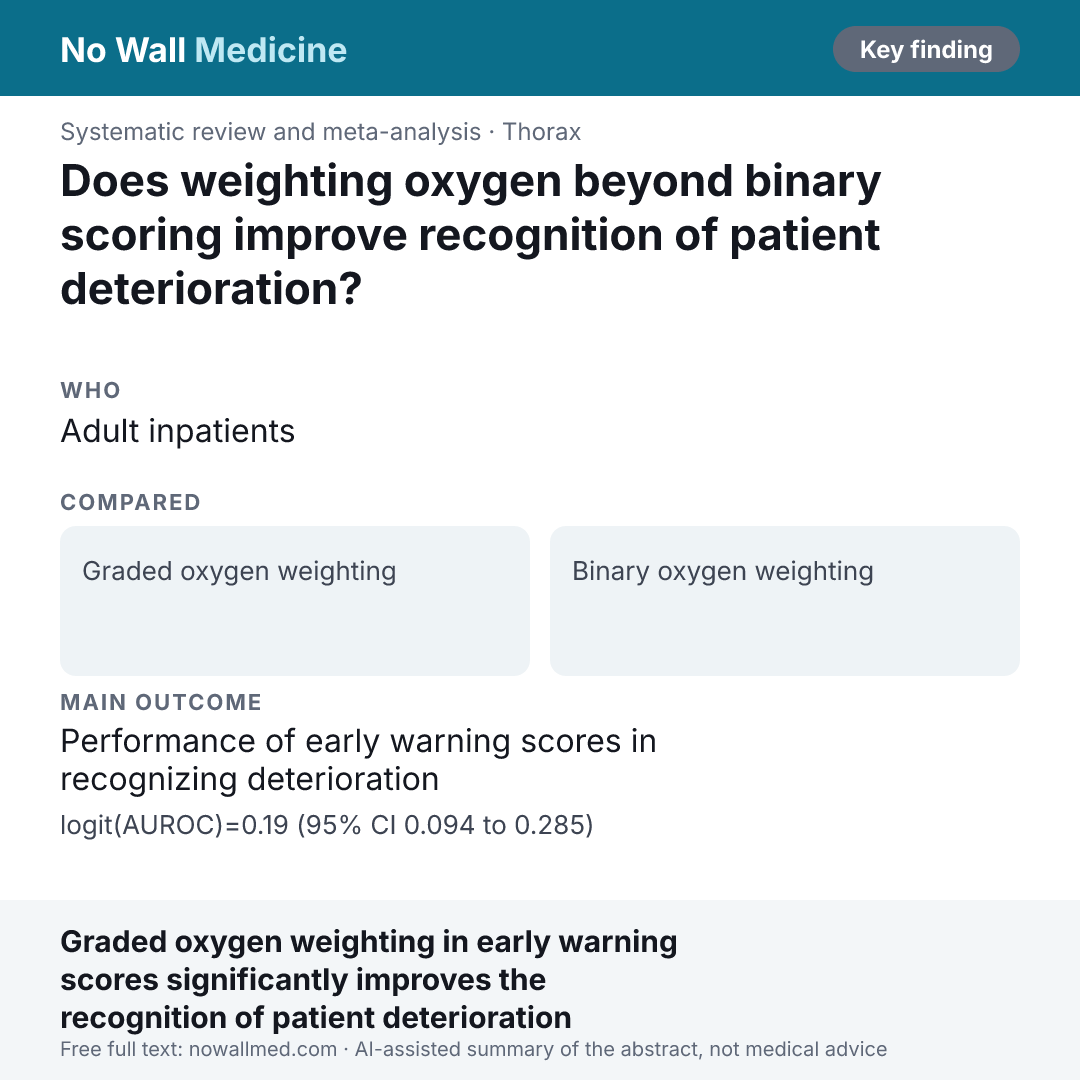
- A meta-analysis of four comparative studies showed graded oxygen scoring had improved performance over binary scoring with a logit(AUROC) of 0.19 (95% CI 0.094 to 0.285; p=0.002).
- The 16 identified models were classified by oxygen flow rate, delivery device, or the fraction of inspired oxygen.
Why it matters: Current early warning systems often assign a fixed number of points for supplemental oxygen regardless of the amount, which may fail to recognize patients with increasing oxygen needs.
Limitation the authors note: The authors stated that 15 of the 16 models were at high risk of bias.
Discussion prompts
- Would these patients look like yours? Who was left out?
- Is the main outcome one that matters to patients?
- Is the difference large enough to change what you do?
Cite: Harrison CH, Tupper P, Gerry S, et al. Oxygen therapy in early warning scores: a systematic review and meta-analysis. Thorax. 2025;80(10):693-701. doi:10.1136/thorax-2024-222663
Free full text: PubMed Central · Summary and visual abstract: nowallmed.com/a/oxygen-therapy-in-early-warning-scores-a-systematic-review-and-meta-mcd3mj/ (AI-assisted from the abstract; check the paper before relying on it).