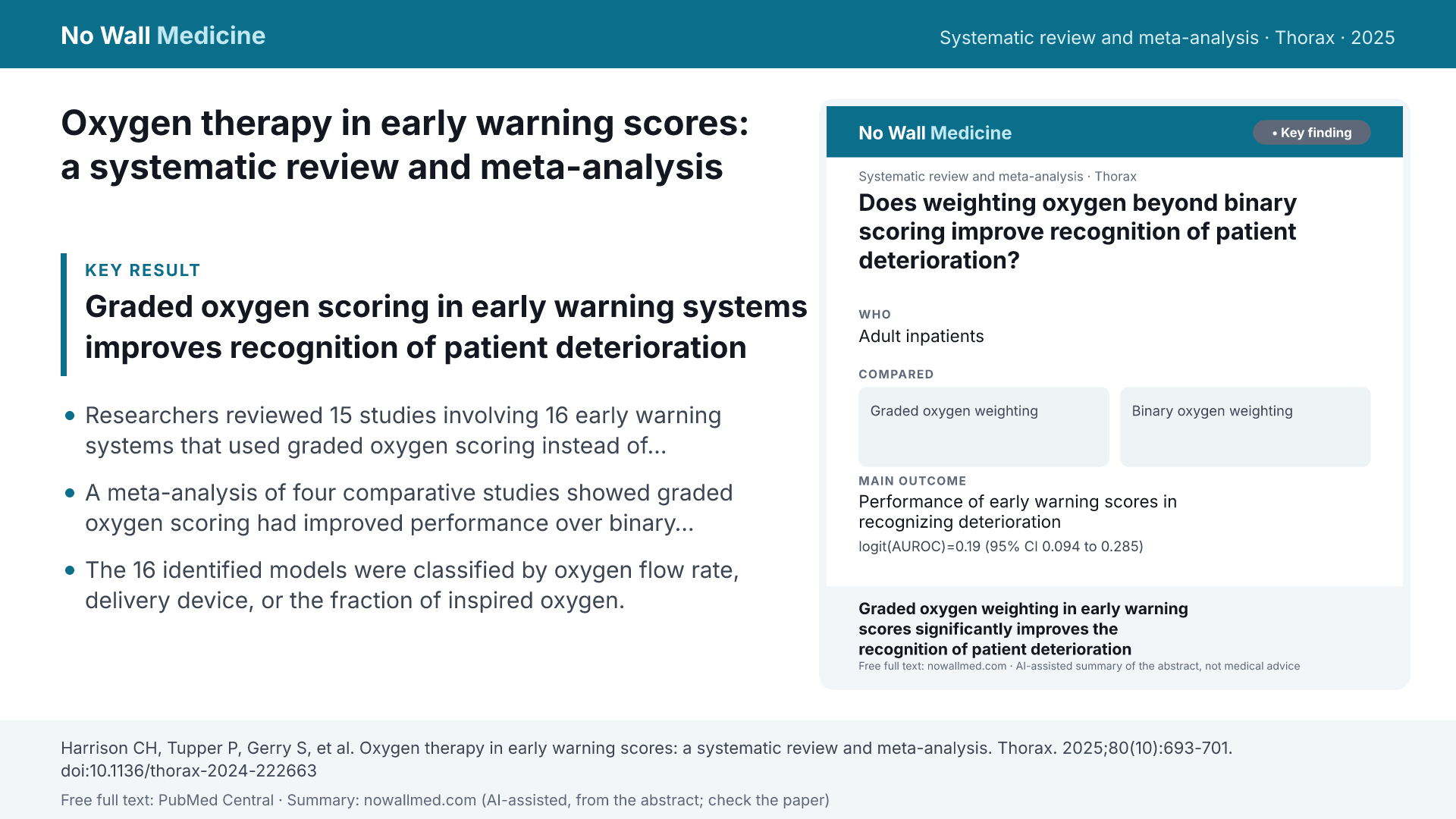
Graded oxygen scoring in early warning systems improves recognition of patient deterioration
Oxygen therapy in early warning scores: a systematic review and meta-analysis
Systematic review and meta-analysisBenefit found
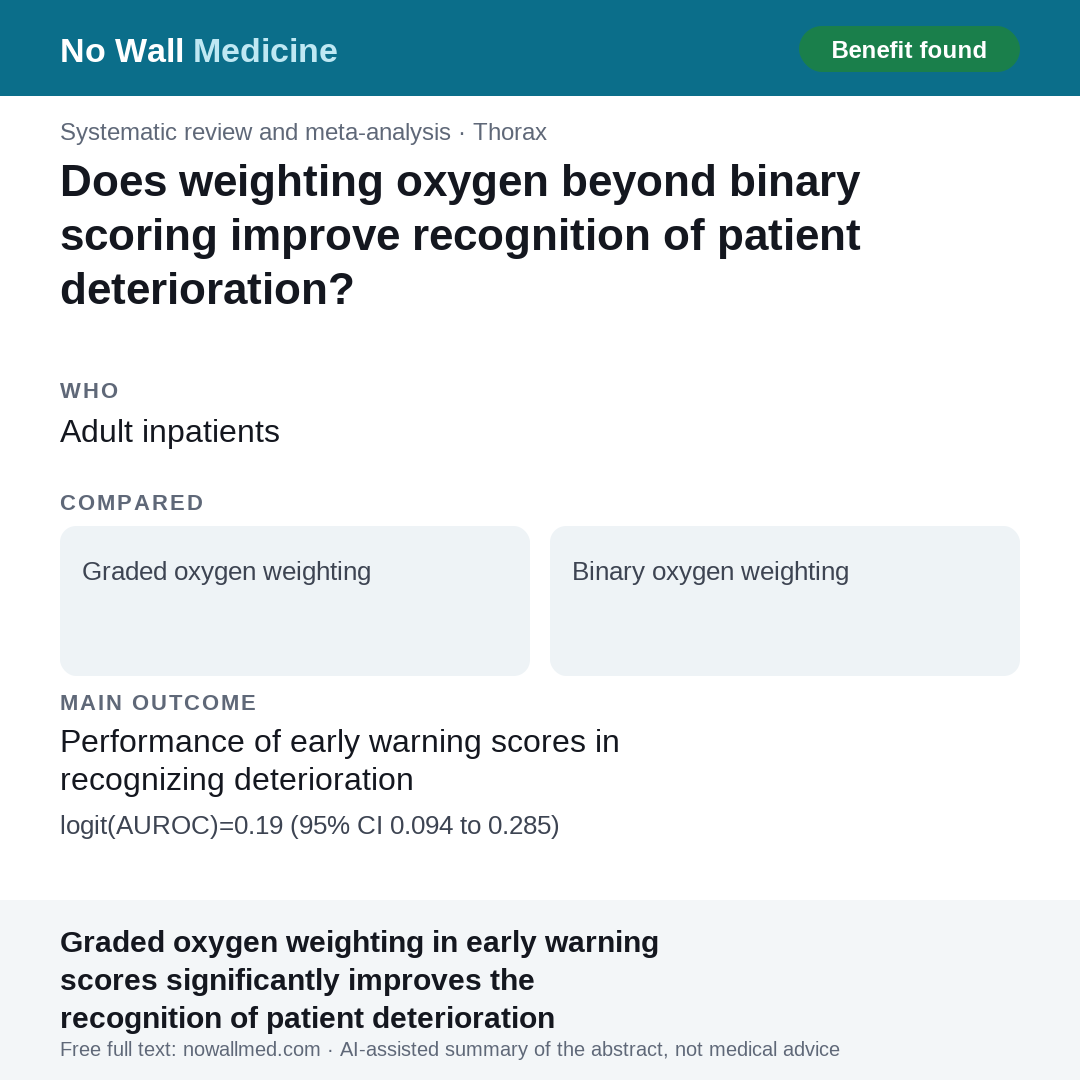
Does weighting oxygen beyond binary scoring improve recognition of patient deterioration?
Who
Adult inpatients
Compared
Graded oxygen weighting
Binary oxygen weighting
Main outcome
Performance of early warning scores in recognizing deterioration
Result: logit(AUROC)=0.19 (95% CI 0.094 to 0.285)
Bottom line: Graded oxygen weighting in early warning scores significantly improves the recognition of patient deterioration compared to binary scoring.
Limitation: 15 of 16 models were at high risk of bias.
Thorax · 2025-09-15Download image
Clinical question: Does weighting oxygen beyond binary scoring improve recognition of patient deterioration?
Why it matters: Current early warning systems often assign a fixed number of points for supplemental oxygen regardless of the amount, which may fail to recognize patients with increasing oxygen needs.
Key points
- Researchers reviewed 15 studies involving 16 early warning systems that used graded oxygen scoring instead of simple binary scoring.
- A meta-analysis of four comparative studies showed graded oxygen scoring had improved performance over binary scoring with a logit(AUROC) of 0.19 (95% CI 0.094 to 0.285; p=0.002).
- The 16 identified models were classified by oxygen flow rate, delivery device, or the fraction of inspired oxygen.
Limitation the authors note: The authors stated that 15 of the 16 models were at high risk of bias.
Headline and key points written with AI from the paper’s abstract, with every number checked against it. Read the paper before relying on them.
Was this summary helpful?
Abstract
Background
Early warning systems (EWS) used across the world typically assign a fixed number of points to patients receiving supplemental oxygen, regardless of amount. This ordinal binary approach may fail to recognise deteriorating patients who have an increasing oxygen requirement with otherwise stable observations. It is unclear whether weighting oxygen beyond binary scoring improves recognition of deterioration. Aims
We aimed to describe all general adult EWS that grade oxygen beyond binary scoring (part 1). Where reported, we summarised the performance of graded oxygen EWS in comparison to binary scoring (part 2). Methods
We systematically reviewed the literature, searching Embase, MEDLINE, CINAHL, Cochrane Central and Web of Science. We included studies of vital-sign-only EWS, for adult inpatients, which included grades of oxygen therapy above binary weighting ('graded oxygen weighting'). We summarised methods of including graded oxygen therapy. We performed a random-effects meta-analysis of the effects of graded oxygen weighting inclusion in comparison to binary weighting. Risk of bias was assessed using the Prediction model Risk Of Bias ASsessment Tool. Results
15 studies reported the development of 16 EWS with graded oxygen weighting, classified by flow rate, delivery device and/or fraction of inspired oxygen. Four studies compared graded oxygen EWS to binary oxygen EWS. Meta-analysis showed a significant improvement in the performance of graded oxygen EWS over binary oxygen EWS (logit(AUROC)=0.19; 95% CI 0.094 to 0.285; p=0.002). 15/16 models were at high risk of bias. Conclusions
16 EWS with graded oxygen weighting were identified. Graded oxygen models had improved recognition of deterioration. Future work should explore the optimal method of oxygen classification and how this could be integrated into future EWS. Prospero registration number
CRD42024443362.
Abstract reproduced under the article’s CC BY licence.
Subject terms
Cite this article
Harrison CH, Tupper P, Gerry S, Michael V, Bedford JP, Smith C. Oxygen therapy in early warning scores: a systematic review and meta-analysis. Thorax. 2025. doi:10.1136/thorax-2024-222663
Spotted a mistake? Suggest a correction
Top studies every Monday
The week’s key trials and guidelines in your specialties, plus any topics you follow. By email, free.
Get the weekly digest