Palonosetron as prophylaxis for post-discharge nausea and vomiting: a prospective, randomised, double-blind, placebo-controlled trial in ambulatory surgery
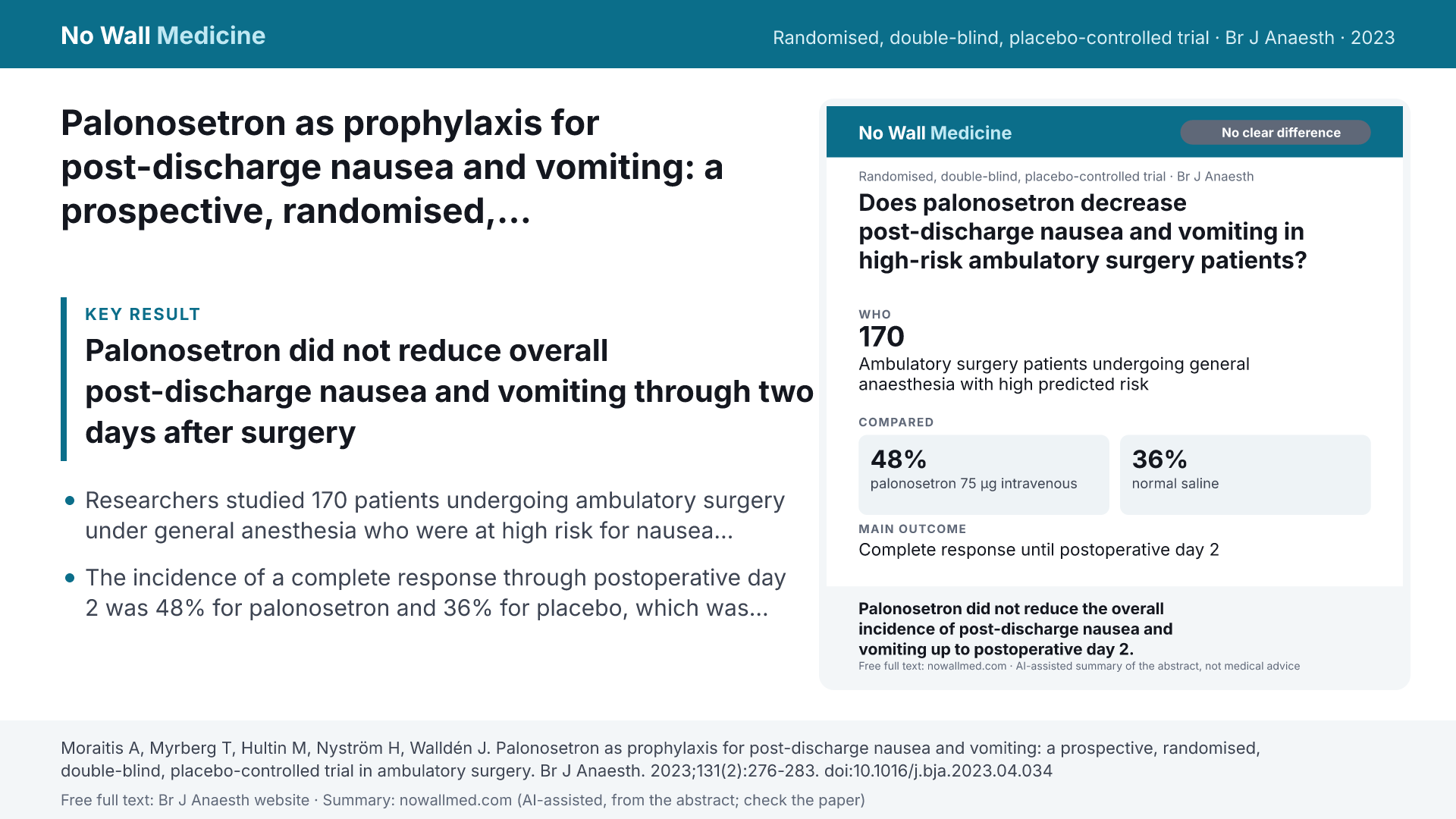
Key result: Palonosetron did not reduce overall post-discharge nausea and vomiting through two days after surgery
Randomised, double-blind, placebo-controlled trialNo clear difference
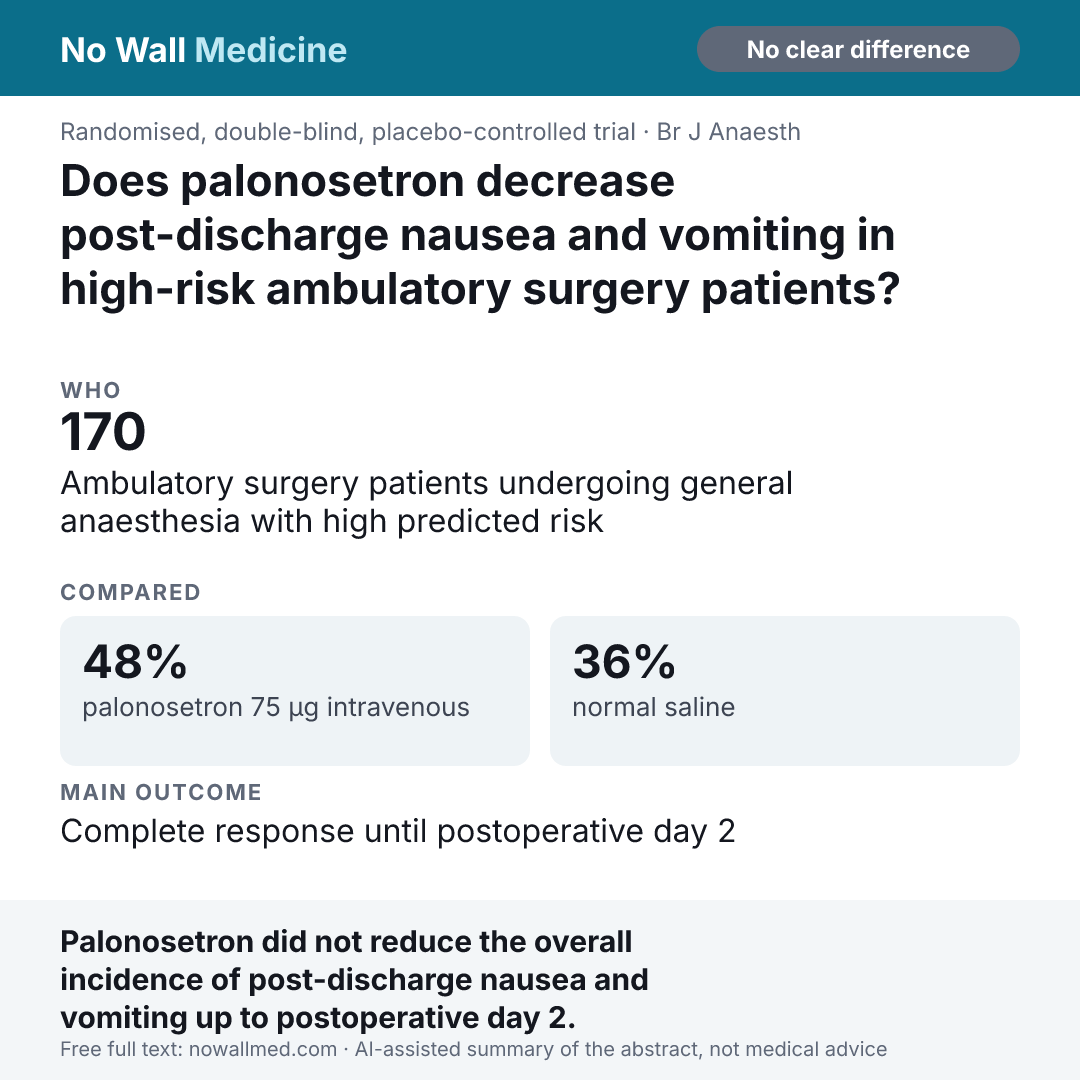
Does palonosetron decrease post-discharge nausea and vomiting in high-risk ambulatory surgery patients?
Who
170
Ambulatory surgery patients undergoing general anaesthesia with high predicted risk
Compared
48%palonosetron 75 μg intravenous (n=32)
36%normal saline (n=25)
Main outcome
Complete response until postoperative day 2
Result: odds ratio 1.69 (95% confidence interval: 0.85-3.37)
Bottom line: Palonosetron did not reduce the overall incidence of post-discharge nausea and vomiting up to postoperative day 2.
Br J Anaesth · 2023-05-26 · Save PNG
Key points
- Researchers studied 170 patients undergoing ambulatory surgery under general anesthesia who were at high risk for nausea and vomiting.
- The incidence of a complete response through postoperative day 2 was 48% for palonosetron and 36% for placebo, which was not statistically significant.
- Palonosetron was associated with a lower incidence of nausea and vomiting on postoperative day 1 (18% vs 34%) and day 2 (9% vs 27%).
Discussion prompts
- Would these patients look like yours? Who was left out?
- Is the main outcome one that matters to patients?
- Is the difference large enough to change what you do?
Cite: Moraitis A, Myrberg T, Hultin M, Nyström H, Walldén J. Palonosetron as prophylaxis for post-discharge nausea and vomiting: a prospective, randomised, double-blind, placebo-controlled trial in ambulatory surgery. Br J Anaesth. 2023;131(2):276-283. doi:10.1016/j.bja.2023.04.034
Free full text: Br J Anaesth website · Summary and visual abstract: nowallmed.com/a/palonosetron-as-prophylaxis-for-post-discharge-nausea-and-vomiting-a-hv4r0a/ (AI-assisted from the abstract; check the paper before relying on it).