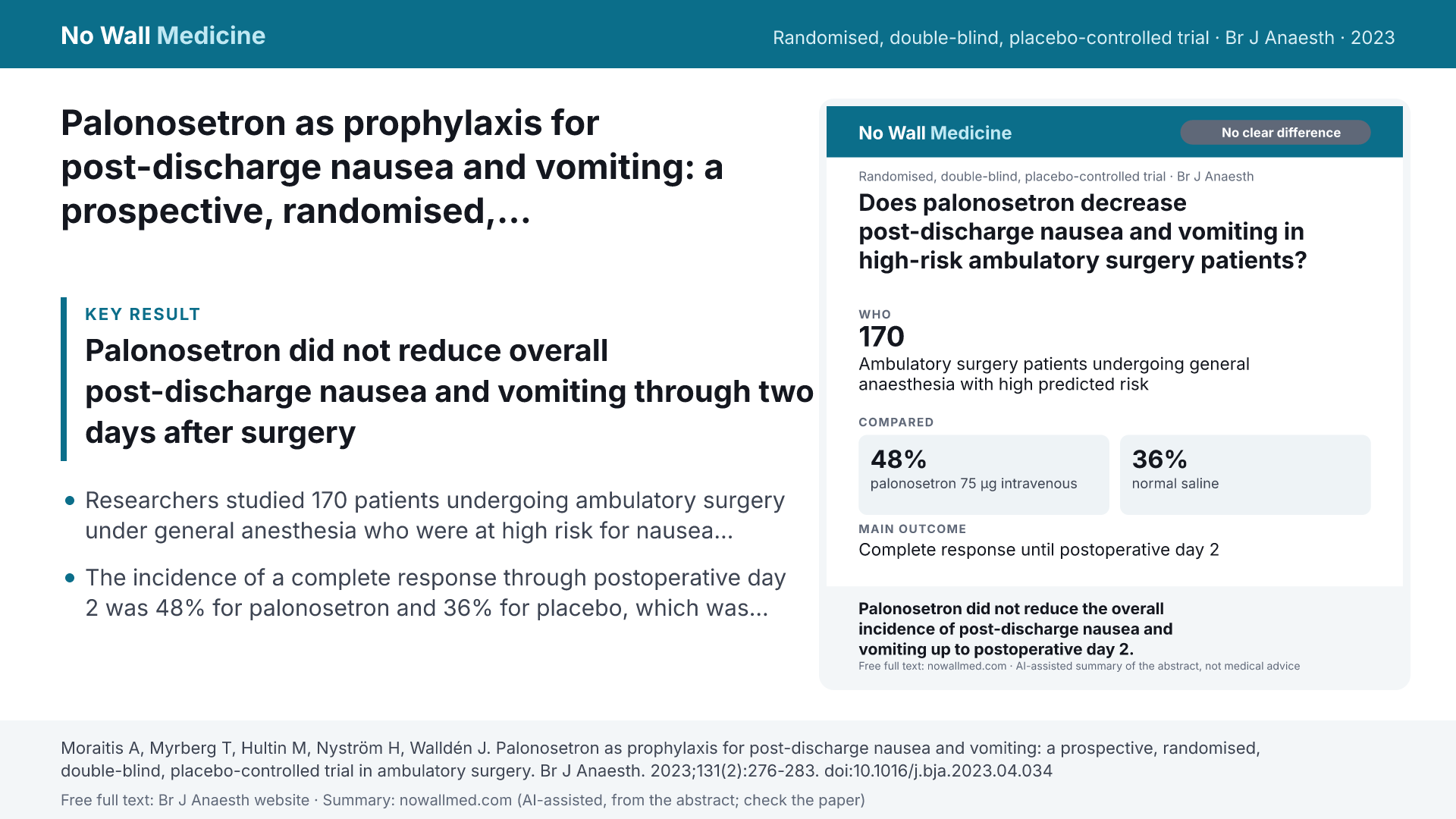
Palonosetron did not reduce overall post-discharge nausea and vomiting through two days after surgery
Palonosetron as prophylaxis for post-discharge nausea and vomiting: a prospective, randomised, double-blind, placebo-controlled trial in ambulatory surgery
Randomised, double-blind, placebo-controlled trialNo clear difference
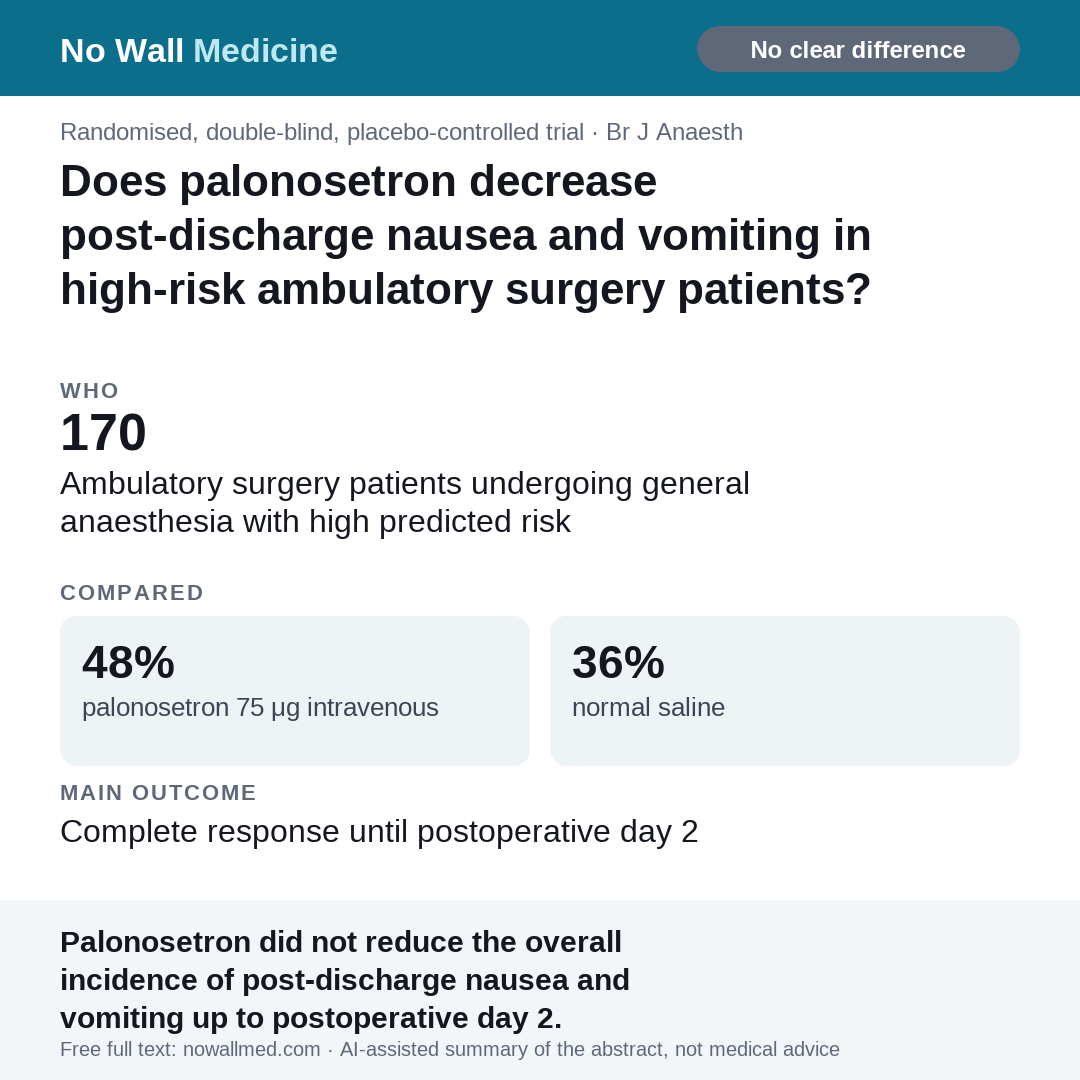
Does palonosetron decrease post-discharge nausea and vomiting in high-risk ambulatory surgery patients?
Who
170
Ambulatory surgery patients undergoing general anaesthesia with high predicted risk
Compared
48%palonosetron 75 μg intravenous (n=32)
36%normal saline (n=25)
Main outcome
Complete response until postoperative day 2
Result: odds ratio 1.69 (95% confidence interval: 0.85-3.37)
Bottom line: Palonosetron did not reduce the overall incidence of post-discharge nausea and vomiting up to postoperative day 2.
Br J Anaesth · 2023-05-26Download image
Clinical question: Does palonosetron decrease post-discharge nausea and vomiting in high-risk ambulatory surgery patients?
Why it matters: It was unknown if the long-acting anti-emetic palonosetron could decrease the incidence of post-discharge nausea and vomiting in high-risk ambulatory surgery patients.
Key points
- Researchers studied 170 patients undergoing ambulatory surgery under general anesthesia who were at high risk for nausea and vomiting.
- The incidence of a complete response through postoperative day 2 was 48% for palonosetron and 36% for placebo, which was not statistically significant.
- Palonosetron was associated with a lower incidence of nausea and vomiting on postoperative day 1 (18% vs 34%) and day 2 (9% vs 27%).
Headline and key points written with AI from the paper’s abstract, with every number checked against it. Read the paper before relying on them.
Was this summary helpful?
Subject terms
Cite this article
Moraitis A, Myrberg T, Hultin M, Nyström H, Walldén J. Palonosetron as prophylaxis for post-discharge nausea and vomiting: a prospective, randomised, double-blind, placebo-controlled trial in ambulatory surgery. Br J Anaesth. 2023. doi:10.1016/j.bja.2023.04.034
Spotted a mistake? Suggest a correction
Top studies every Monday
The week’s key trials and guidelines in your specialties, plus any topics you follow. By email, free.
Get the weekly digest