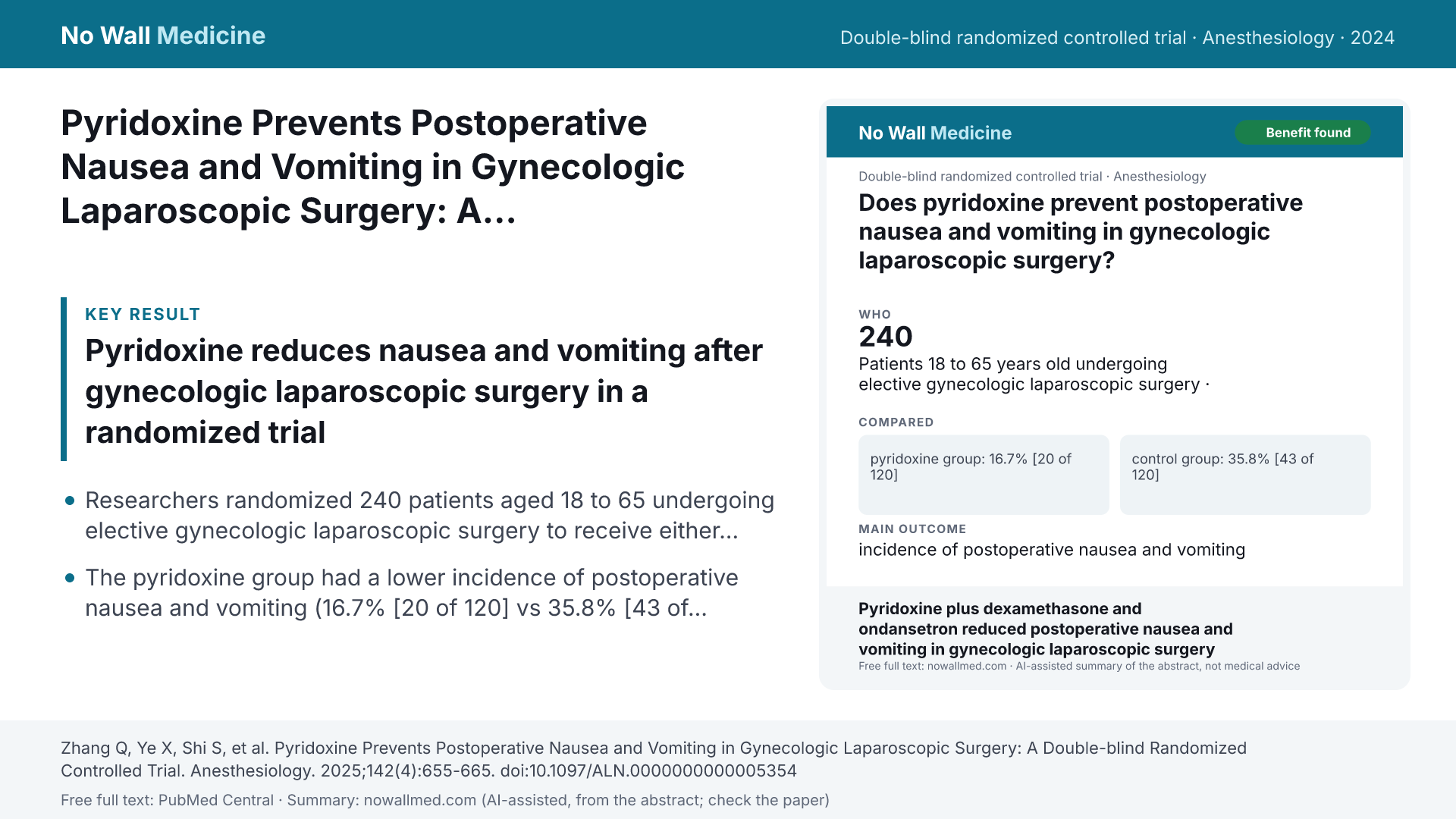
Pyridoxine reduces nausea and vomiting after gynecologic laparoscopic surgery in a randomized trial
Pyridoxine Prevents Postoperative Nausea and Vomiting in Gynecologic Laparoscopic Surgery: A Double-blind Randomized Controlled Trial
Double-blind randomized controlled trialBenefit found
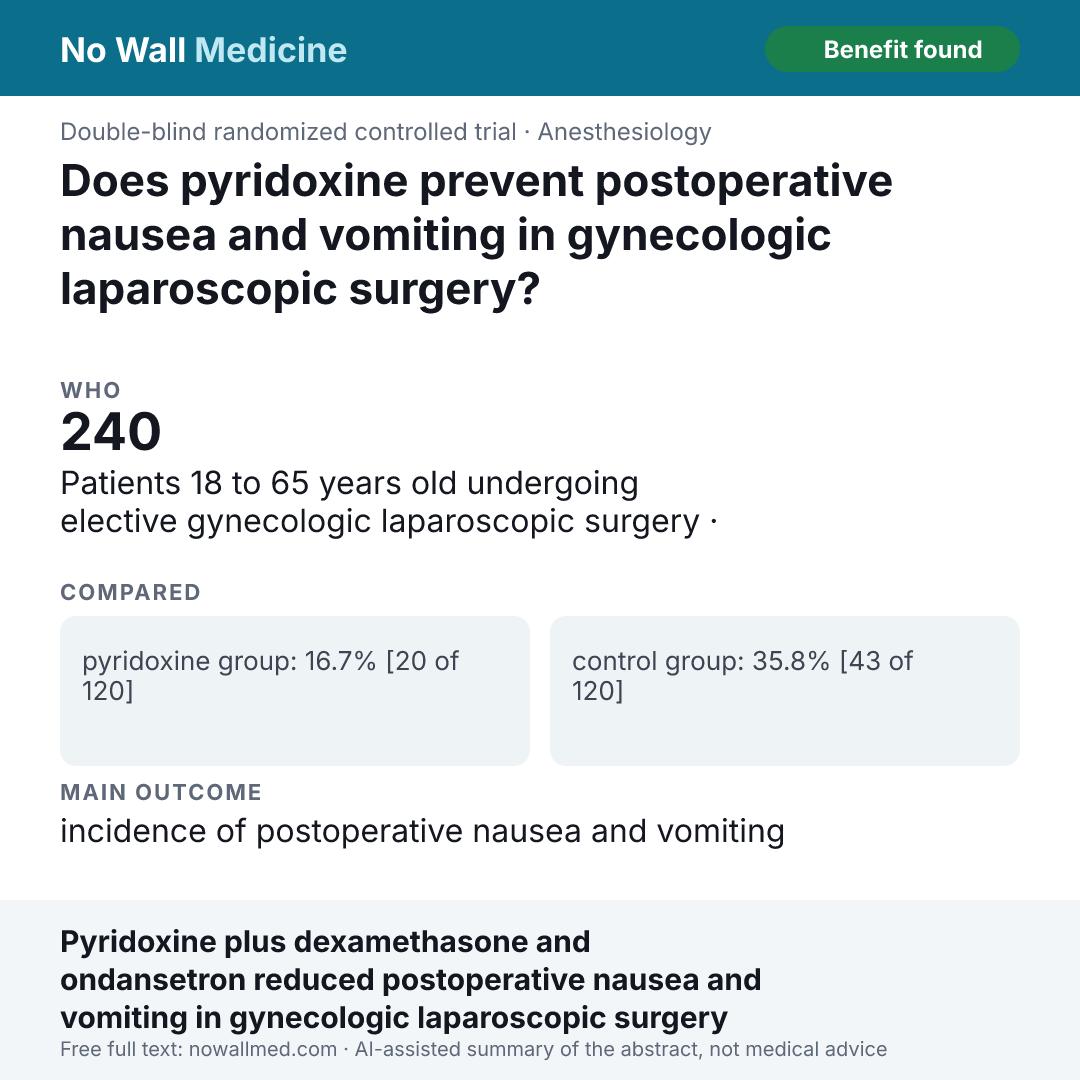
Does pyridoxine prevent postoperative nausea and vomiting in gynecologic laparoscopic surgery?
Who
240
Patients 18 to 65 years old undergoing elective gynecologic laparoscopic surgery · Single-center
Compared
pyridoxine group: 16.7% [20 of 120]
control group: 35.8% [43 of 120]
Main outcome
incidence of postoperative nausea and vomiting
Result: relative risk = 0.47 [95% CI, 0.29 to 0.74]
Bottom line: Pyridoxine plus dexamethasone and ondansetron reduced postoperative nausea and vomiting in gynecologic laparoscopic surgery patients.
Limitation: Findings need validation in multicenter studies in diverse populations to ensure generalizability.
Anesthesiology · 2024-12-27 · Save PNG
Clinical question: Does pyridoxine prevent postoperative nausea and vomiting in gynecologic laparoscopic surgery?
In absolute numbers
pyridoxine group: 16.7% · control group: 35.8% → a difference of 19.1 percentage points, so about 6 people would need the treatment for 1 more to benefit (number needed to treat) over the trial’s follow-up.
Worked out by us from the two group results above, not reported by the authors. Check the paper for the exact outcome and timing.
Key points
- Researchers randomized 240 patients aged 18 to 65 undergoing elective gynecologic laparoscopic surgery to receive either 0.2 g of pyridoxine (vitamin B6) or normal saline.
- The pyridoxine group had a lower incidence of postoperative nausea and vomiting (16.7% [20 of 120] vs 35.8% [43 of 120]) and postoperative nausea (12.5% [15 of 120] vs 35% [42 of 120]).
- No statistical differences were found regarding postoperative vomiting, pain, or levels of blood interleukin-6 and substance P.
Limitation the authors note: The authors state that these findings from this single-center trial need to be validated in multicenter studies in diverse populations to ensure generalizability.
Headline and key points written with AI from the paper’s abstract, with every number checked against it. Read the paper before relying on them.
Was this summary helpful?
Subject terms
Headline, design, result, key points, caveat and citation as plain text.
Cite this article
Zhang Q, Ye X, Shi S, et al. Pyridoxine Prevents Postoperative Nausea and Vomiting in Gynecologic Laparoscopic Surgery: A Double-blind Randomized Controlled Trial. Anesthesiology. 2025;142(4):655-665. doi:10.1097/ALN.0000000000005354
Spotted a mistake? Suggest a correction