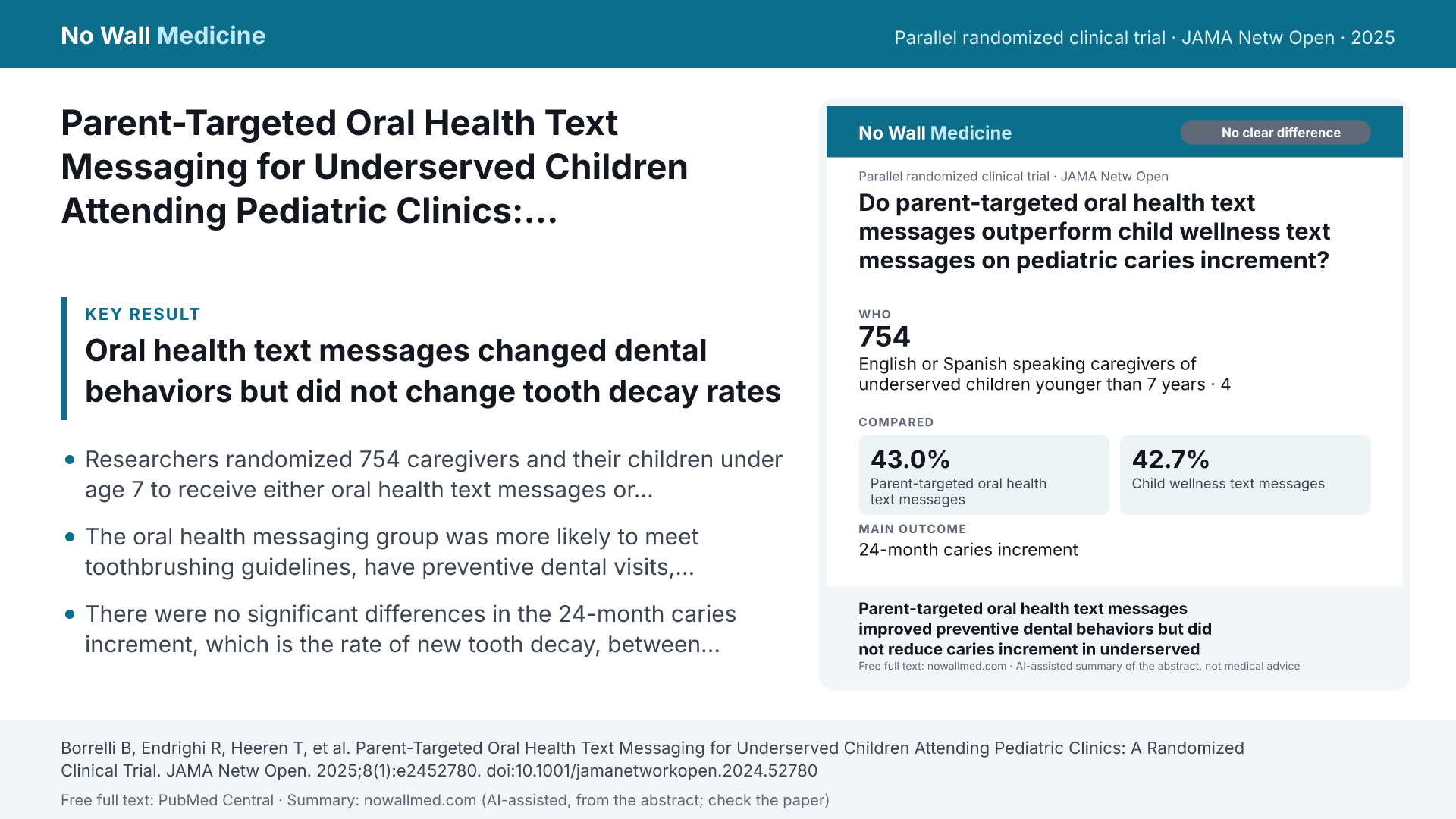
Oral health text messages changed dental behaviors but did not change tooth decay rates
Parent-Targeted Oral Health Text Messaging for Underserved Children Attending Pediatric Clinics: A Randomized Clinical Trial
Parallel randomized clinical trialNo clear difference
Do parent-targeted oral health text messages outperform child wellness text messages on pediatric caries increment?
Who
754
English or Spanish speaking caregivers of underserved children younger than 7 years · 4 pediatric medical clinic sites in Boston, Massachusetts
Compared
43.0%Parent-targeted oral health text messages
42.7%Child wellness text messages
Main outcome
24-month caries increment
Result: adjusted odds ratio 0.99 (95% CI 0.63-1.56)
Bottom line: Parent-targeted oral health text messages improved preventive dental behaviors but did not reduce caries increment in underserved children.
JAMA Netw Open · 2025-01-02Download image
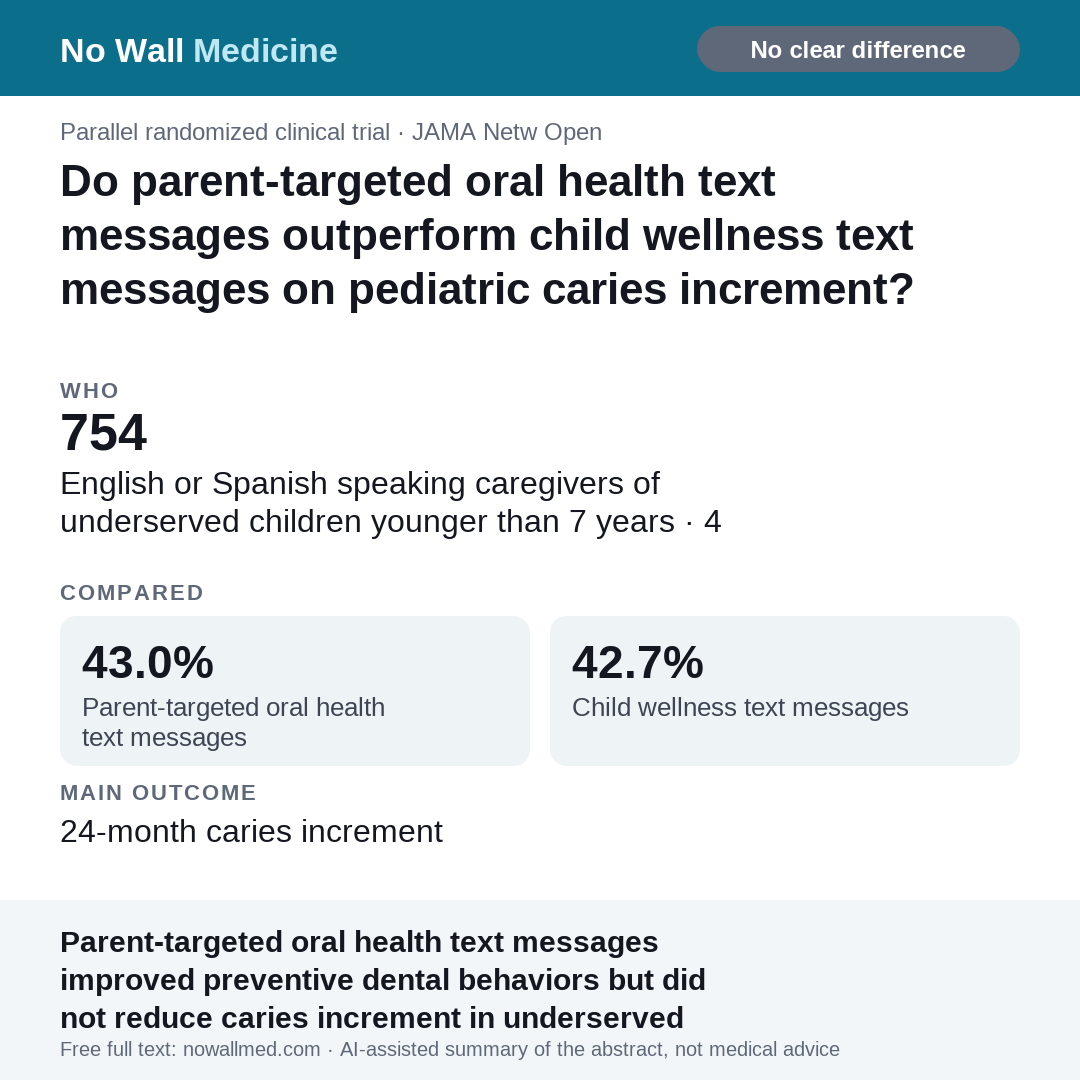
Clinical question: Do parent-targeted oral health text messages outperform child wellness text messages on pediatric caries increment?
Why it matters: It was unknown if sending text messages focused on oral health to parents would be more effective than general wellness messages at reducing tooth decay in underserved children.
Key points
- Researchers randomized 754 caregivers and their children under age 7 to receive either oral health text messages or general child wellness text messages.
- The oral health messaging group was more likely to meet toothbrushing guidelines, have preventive dental visits, and use fluoride toothpaste compared to the wellness group.
- There were no significant differences in the 24-month caries increment, which is the rate of new tooth decay, between the two groups (43.0% vs 42.7%).
Headline and key points written with AI from the paper’s abstract, with every number checked against it. Read the paper before relying on them.
Was this summary helpful?
Subject terms
Cite this article
Borrelli B, Endrighi R, Heeren T, et al. Parent-Targeted Oral Health Text Messaging for Underserved Children Attending Pediatric Clinics: A Randomized Clinical Trial. JAMA Netw Open. 2025. doi:10.1001/jamanetworkopen.2024.52780
Spotted a mistake? Suggest a correction