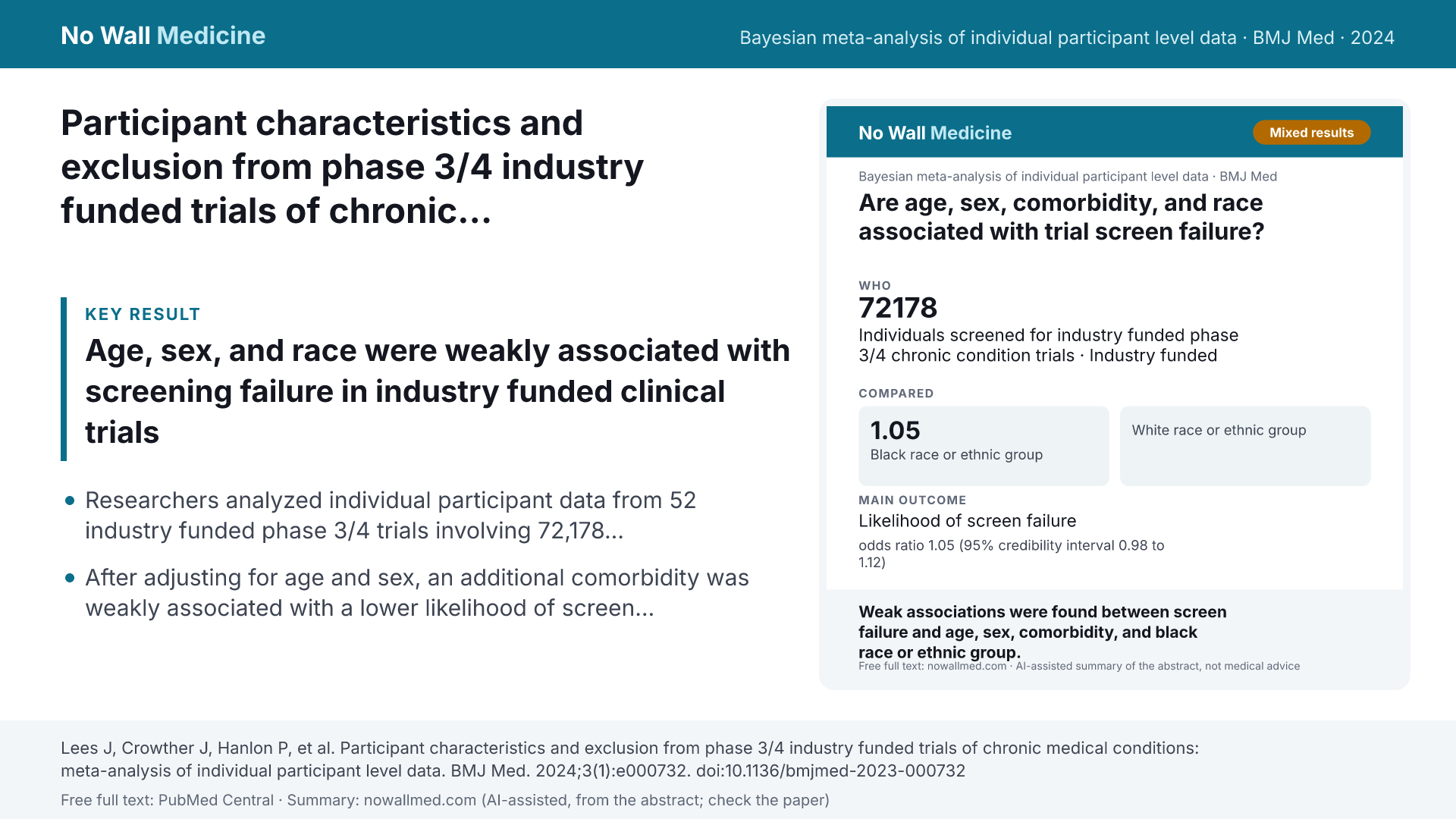
Age, sex, and race were weakly associated with screening failure in industry funded clinical trials
Participant characteristics and exclusion from phase 3/4 industry funded trials of chronic medical conditions: meta-analysis of individual participant level data
Bayesian meta-analysis of individual participant level dataMixed results
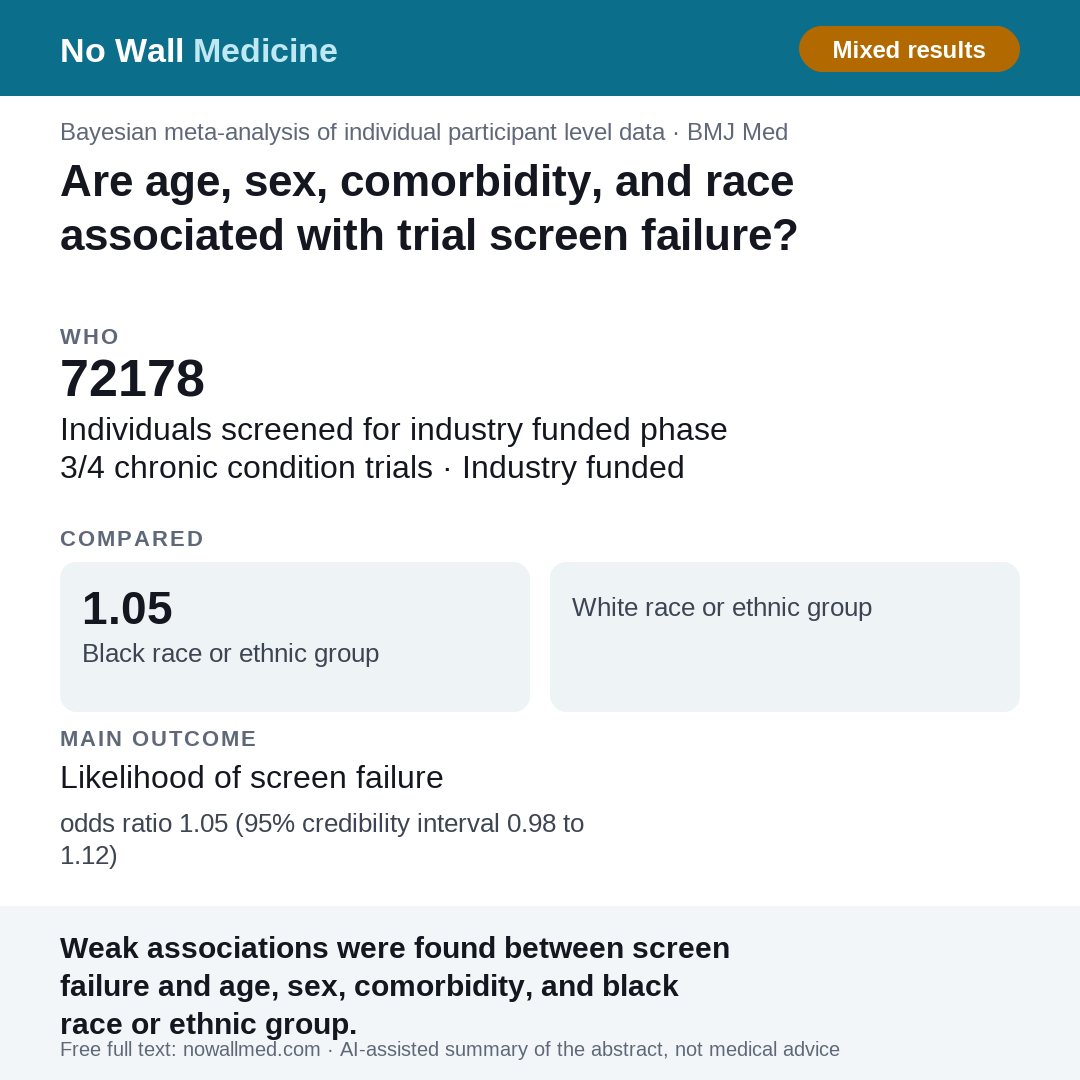
Are age, sex, comorbidity, and race associated with trial screen failure?
Who
72178
Individuals screened for industry funded phase 3/4 chronic condition trials · Industry funded phase 3/4 trials
Compared
1.05Black race or ethnic group (95% credibility interval 0.98 to 1.12)
White race or ethnic group
Main outcome
Likelihood of screen failure
Result: odds ratio 1.05 (95% credibility interval 0.98 to 1.12)
Bottom line: Weak associations were found between screen failure and age, sex, comorbidity, and black race or ethnic group.
Limitation: Uncertainty about the completeness or accuracy of data collection among participants who were not randomised.
BMJ Med · 2024-05-03Download image
Clinical question: Are age, sex, comorbidity, and race associated with trial screen failure?
Why it matters: It is unknown if characteristics like age, sex, race, or number of existing medical conditions influence whether people are excluded from clinical trials during the screening stage.
Key points
- Researchers analyzed individual participant data from 52 industry funded phase 3/4 trials involving 72,178 screened individuals, of whom 24,733 (34%) were excluded during screening.
- After adjusting for age and sex, an additional comorbidity was weakly associated with a lower likelihood of screen failure with an odds ratio of 0.97 (0.94 to 1.00).
- Black participants were slightly more likely to fail screening than white participants with an odds ratio of 1.04 (0.99 to 1.09) or 1.05 (0.98 to 1.12) after adjustments.
Limitation the authors note: The authors state that conclusions are limited by uncertainty about the completeness or accuracy of data collection among participants who were not randomized.
Headline and key points written with AI from the paper’s abstract, with every number checked against it. Read the paper before relying on them.
Was this summary helpful?
Abstract
Objectives
To assess whether age, sex, comorbidity count, and race and ethnic group are associated with the likelihood of trial participants not being enrolled in a trial for any reason (ie, screen failure). Design
Bayesian meta-analysis of individual participant level data. Setting
Industry funded phase 3/4 trials of chronic medical conditions. Participants
Participants were identified using individual participant level data to be in either the enrolled group or screen failure group. Data were available for 52 trials involving 72 178 screened individuals of whom 24 733 (34%) were excluded from the trial at the screening stage. Main outcome measures
For each trial, logistic regression models were constructed to assess likelihood of screen failure in people who had been invited to screening, and were regressed on age (per 10 year increment), sex (male v female), comorbidity count (per one additional comorbidity), and race or ethnic group. Trial level analyses were combined in Bayesian hierarchical models with pooling across condition. Results
In age and sex adjusted models across all trials, neither age nor sex was associated with increased odds of screen failure, although weak associations were detected after additionally adjusting for comorbidity (odds ratio of age, per 10 year increment was 1.02 (95% credibility interval 1.01 to 1.04) and male sex (0.95 (0.91 to 1.00)). Comorbidity count was weakly associated with screen failure, but in an unexpected direction (0.97 per additional comorbidity (0.94 to 1.00), adjusted for age and sex). People who self-reported as black seemed to be slightly more likely to fail screening than people reporting as white (1.04 (0.99 to 1.09)); a weak effect that seemed to persist after adjustment for age, sex, and comorbidity count (1.05 (0.98 to 1.12)). The between-trial heterogeneity was generally low, evidence of heterogeneity by sex was noted across conditions (variation in odds ratios on log scale of 0.01-0.13). Conclusions
Although the conclusions are limited by uncertainty about the completeness or accuracy of data collection among participants who were not randomised, we identified mostly weak associations with an increased likelihood of screen failure for age, sex, comorbidity count, and black race or ethnic group. Proportionate increases in screening these underserved populations may improve representation in trials. Trial registration number
PROSPERO CRD42018048202.
Abstract reproduced under the article’s CC BY licence.
Cite this article
Lees J, Crowther J, Hanlon P, Butterly EW, Wild SH, Mair F. Participant characteristics and exclusion from phase 3/4 industry funded trials of chronic medical conditions: meta-analysis of individual participant level data. BMJ Med. 2024. doi:10.1136/bmjmed-2023-000732
Spotted a mistake? Suggest a correction
Top studies every Monday
The week’s key trials and guidelines in your specialties, plus any topics you follow. By email, free.
Get the weekly digest