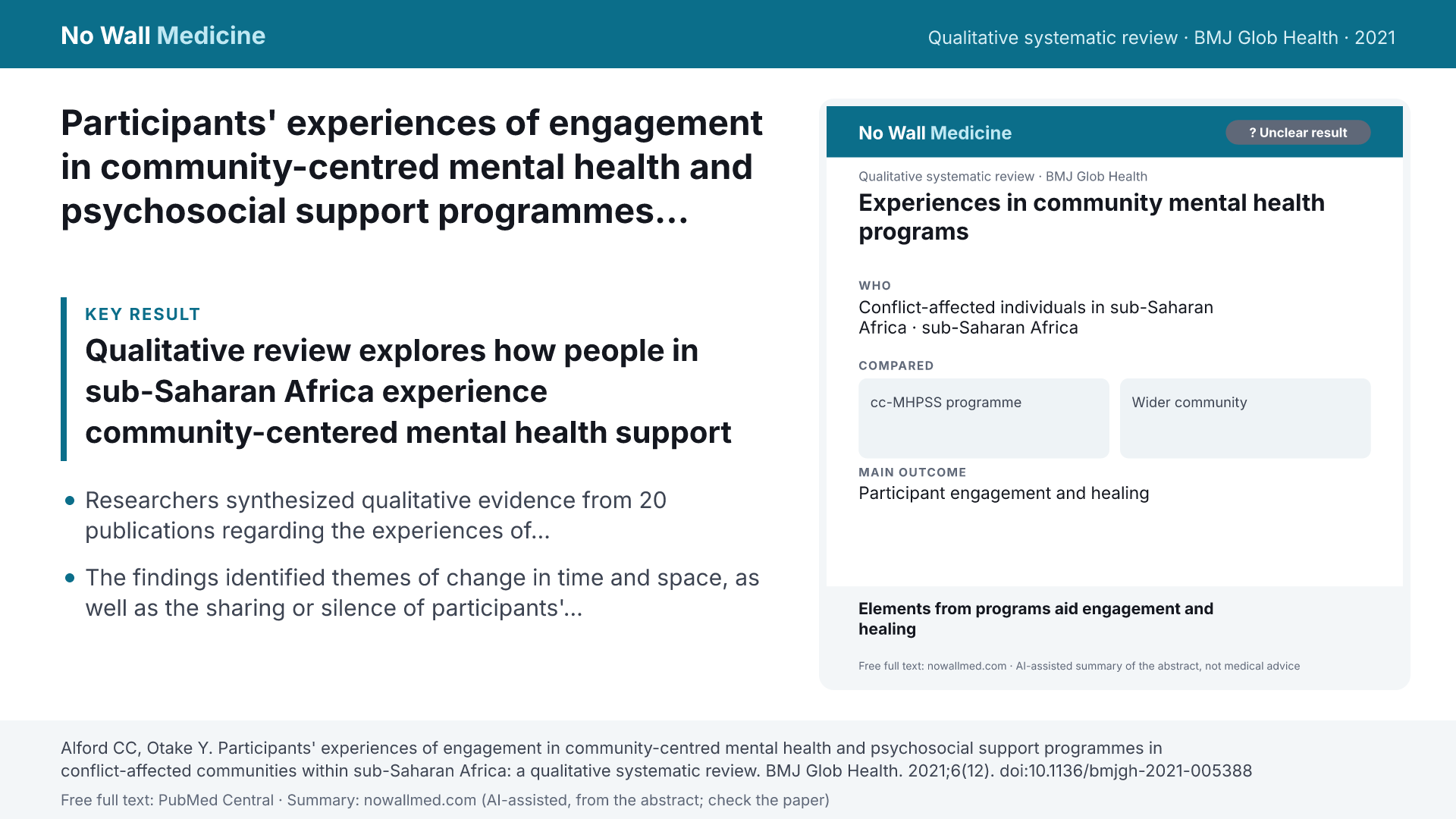
Qualitative review explores how people in sub-Saharan Africa experience community-centered mental health support
Participants' experiences of engagement in community-centred mental health and psychosocial support programmes in conflict-affected communities within sub-Saharan Africa: a qualitative systematic review
Qualitative systematic reviewUnclear result
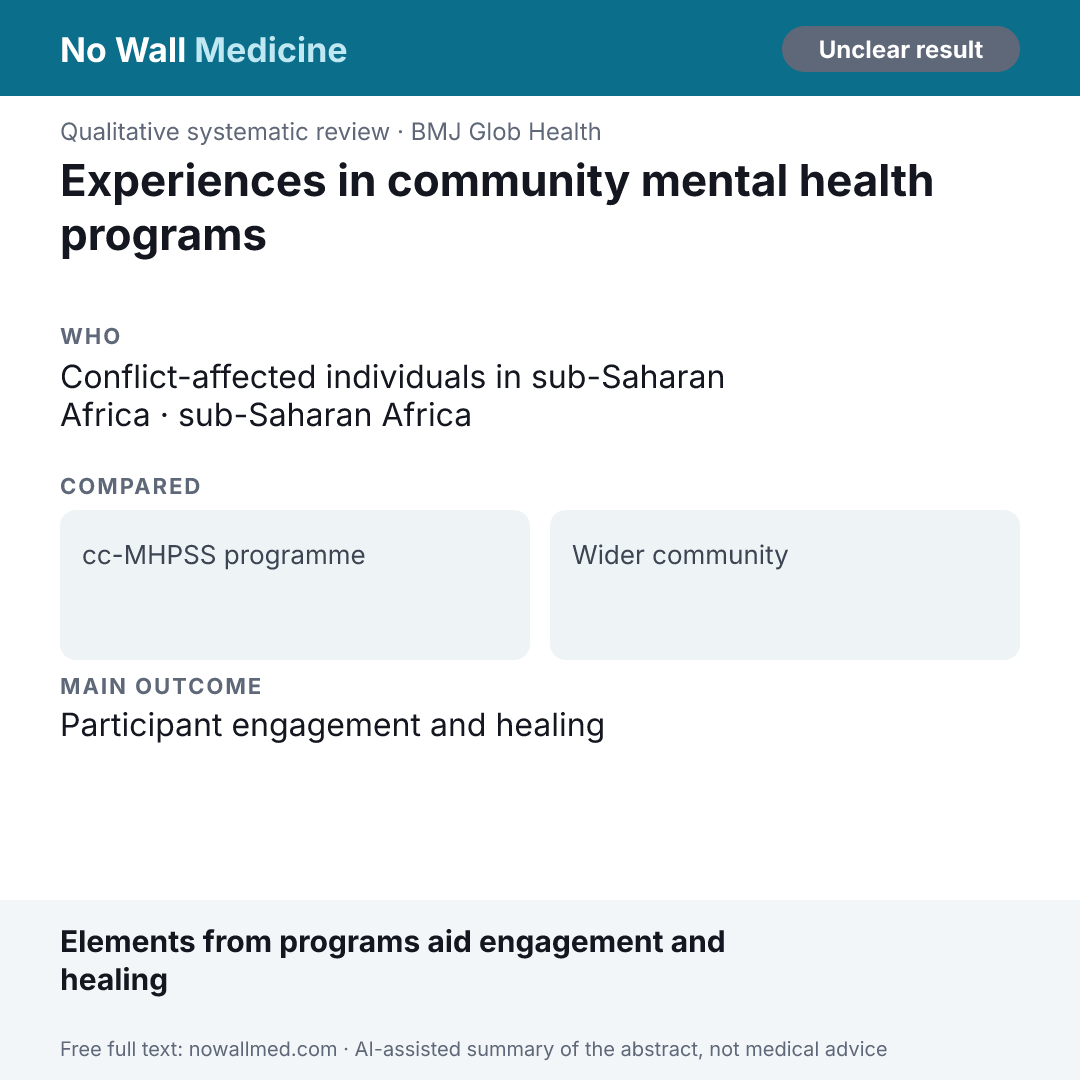
Experiences in community mental health programs
Who
Conflict-affected individuals in sub-Saharan Africa · sub-Saharan Africa
Compared
cc-MHPSS programme
Wider community
Main outcome
Participant engagement and healing
Bottom line: Elements from programs aid engagement and healing
BMJ Glob Health · 2021-12-10 · Save PNG
Key points
- Researchers synthesized qualitative evidence from 20 publications regarding the experiences of conflict-affected individuals engaging in community-centered mental health and psychosocial support programs.
- The findings identified themes of change in time and space, as well as the sharing or silence of participants' personal experiences.
- The transfer of elements between programs and the natural community was linked to participants' healing and their decision to disclose or not disclose experiences.
Headline and key points written with AI from the paper’s abstract, with every number checked against it. Read the paper before relying on them.
Was this summary helpful?
Abstract
Background
Sub-Saharan Africa (SSA) experienced a burden of organised violence within 18 low-income and middle-income countries and hosted over 33 million displaced persons in 2019. Community-centred mental health and psychosocial support (cc-MHPSS) programmes may provide insights to address the psychosocial well-being of conflict-affected individuals, though literature is mixed on community impact. This review aimed to synthesise qualitative evidence to understand the kind of experiences conflict-affected participants have and how these experiences occur during cc-MHPSS programme engagement in SSA. Methods
We searched Global Health, MEDLINE, Psychological Information Database, Embase Classic+Embase, Social Policy and Practice, Web of Science, Africa-Wide Information, PubMed and Global Index Medicus databases. Eligible publications qualitatively reported on conflict-affected participants' experiences of engagement in cc-MHPSS programmes. Data were extracted to summarise publication characteristics. The results were synthesised using a thematic synthesis analysis. Results
The search yielded 953 records, of which 20 publications were included in the review. Included publications were located in Rwanda (n=8), the Democratic Republic of the Congo (n=3), Mozambique (n=3), Sierra Leone (n=1), Ghana (n=1), Uganda (n=1), Zimbabwe (n=1) and South Sudan (n=1); one publication included three countries (Sierra Leone, Liberia and Uganda). Findings include the themes of (1) the experience of change in time and space, and (2) the sharing and silence of participants' experiences. Findings demonstrate that elements transferred by participants from a cc-MHPSS programme to a natural community, and vice versa, contribute to participants' healing. Elements' transfer, or non-transfer, was often related to participants' disclosure, or non-disclosure, of experiences. Discussion
Findings suggest that there are elements from a cc-MHPSS programme and a wider community which aid participant engagement and work therapeutically. More rigorous research is needed concerning how participants experience change during cc-MHPSS programme engagement in proximity to their relationship with the wider community. Prospero registration number
CRD42020197300.
Abstract reproduced under the article’s CC BY NC licence.
Subject terms
Headline, design, result, key points, caveat and citation as plain text.
Cite this article
Alford CC, Otake Y. Participants' experiences of engagement in community-centred mental health and psychosocial support programmes in conflict-affected communities within sub-Saharan Africa: a qualitative systematic review. BMJ Glob Health. 2021;6(12). doi:10.1136/bmjgh-2021-005388
Spotted a mistake? Suggest a correction