Passive digital health technologies show promise for Alzheimer's disease screening
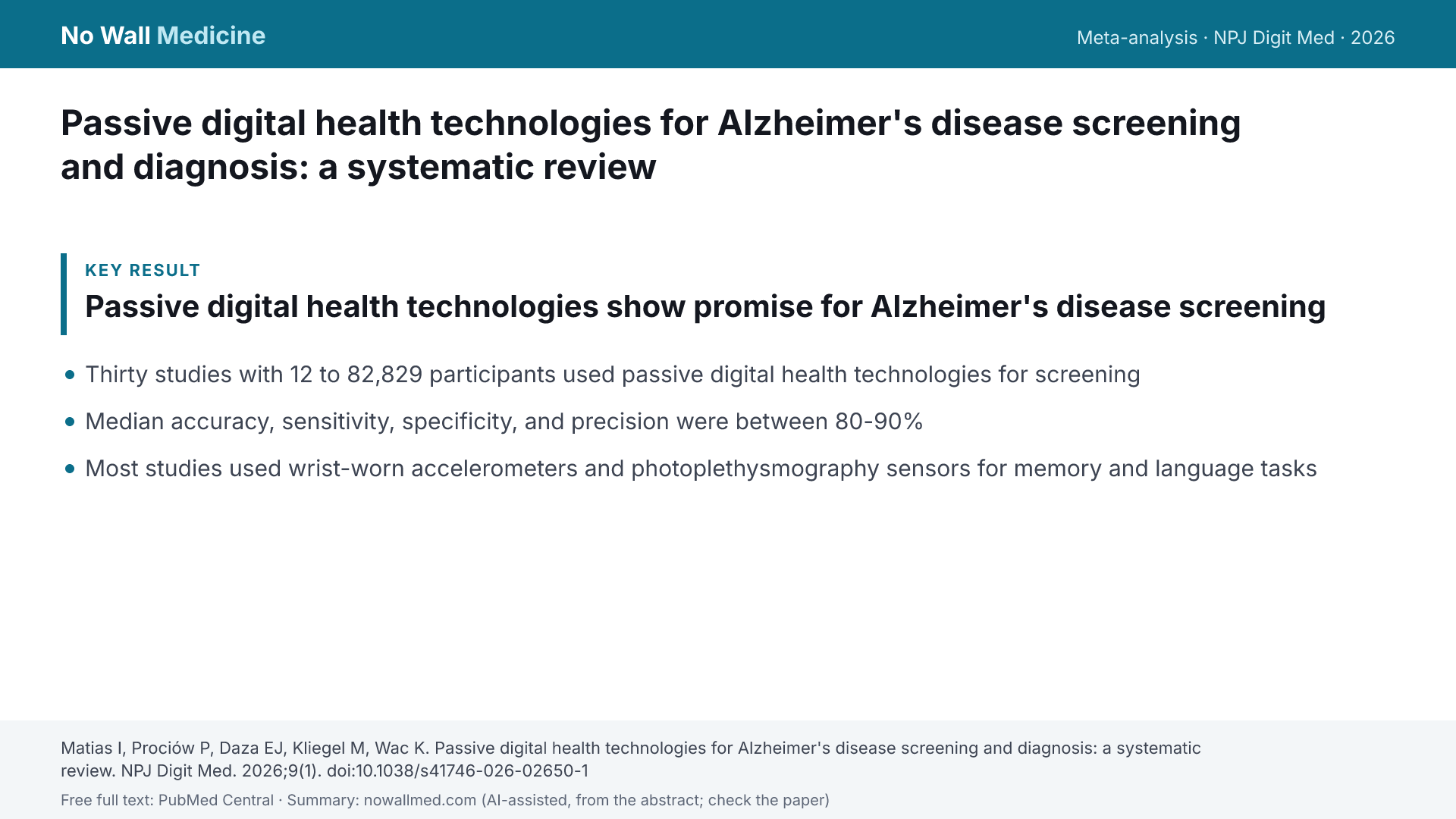
Passive digital health technologies for Alzheimer's disease screening and diagnosis: a systematic review
Systematic reviewBenefit found
Can passive digital health technologies screen and diagnose Alzheimer's disease and related dementias?
Who
Individuals for Alzheimer's disease and related dementias screening or diagnosis · Six major databases
Compared
Passive digital health technologies: median accuracy, sensitivity, specificity, and precision between 80-90%
F1-score and AUC: medians approaching 78%
Main outcome
Accuracy, sensitivity, specificity, precision, F1-score, and area under the curve
Bottom line: Passive digital health technologies show promise as low-burden triage tools for population-level Alzheimer's disease and related dementias screening.
NPJ Digit Med · 2026-04-25Download image
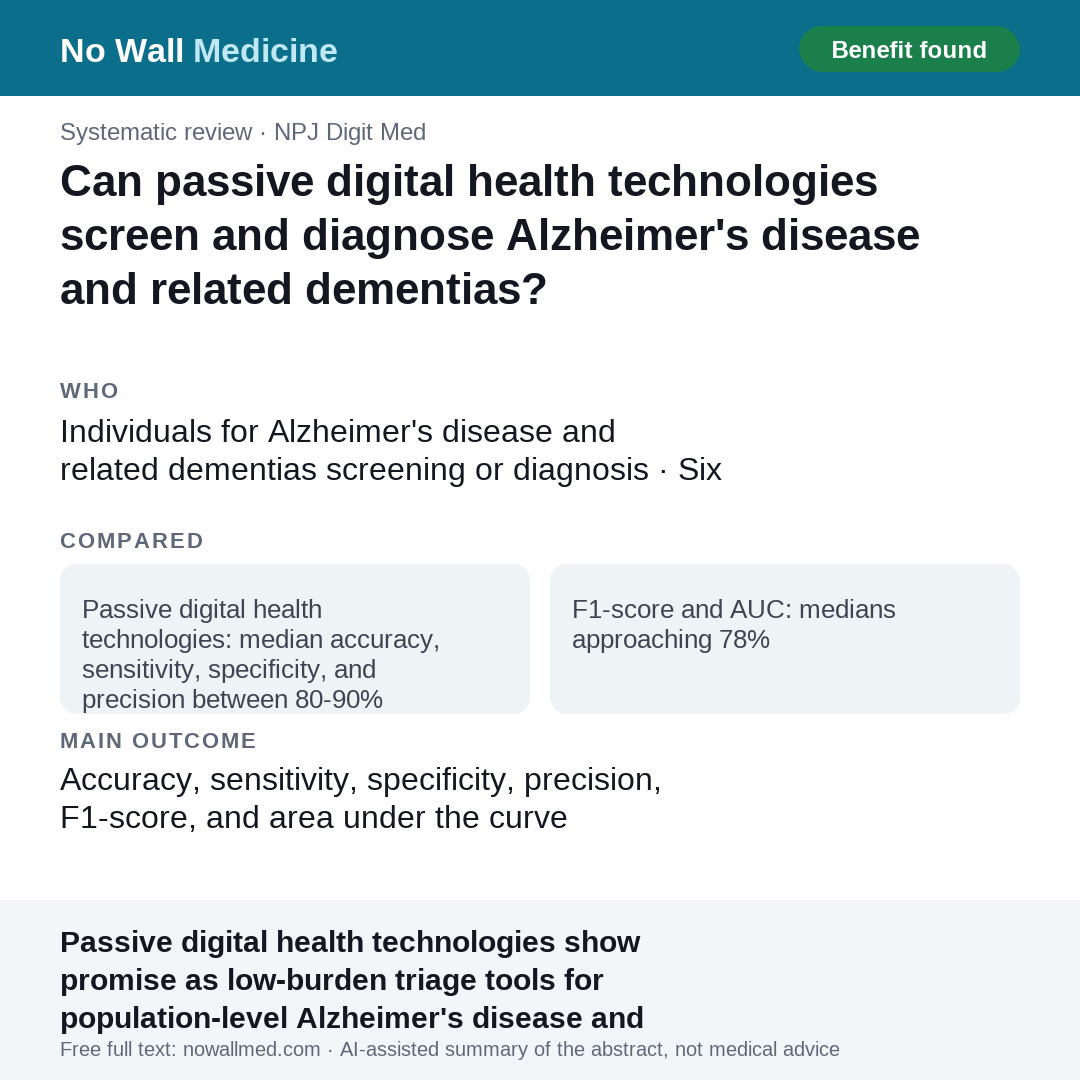
Clinical question: Can passive digital health technologies screen and diagnose Alzheimer's disease and related dementias?
Why it matters: Doctors need better tools for early detection of Alzheimer's disease and related dementias
Key points
- Thirty studies with 12 to 82,829 participants used passive digital health technologies for screening.
- Median accuracy, sensitivity, specificity, and precision were between 80-90%.
- Most studies used wrist-worn accelerometers and photoplethysmography sensors for memory and language tasks.
Headline and key points written with AI from the paper’s abstract, with every number checked against it. Read the paper before relying on them.
Was this summary helpful?
Cite this article
Matias I, Prociów P, Daza EJ, Kliegel M, Wac K. Passive digital health technologies for Alzheimer's disease screening and diagnosis: a systematic review. NPJ Digit Med. 2026. doi:10.1038/s41746-026-02650-1
Spotted a mistake? Suggest a correction