Passive digital health technologies for Alzheimer's disease screening and diagnosis: a systematic review
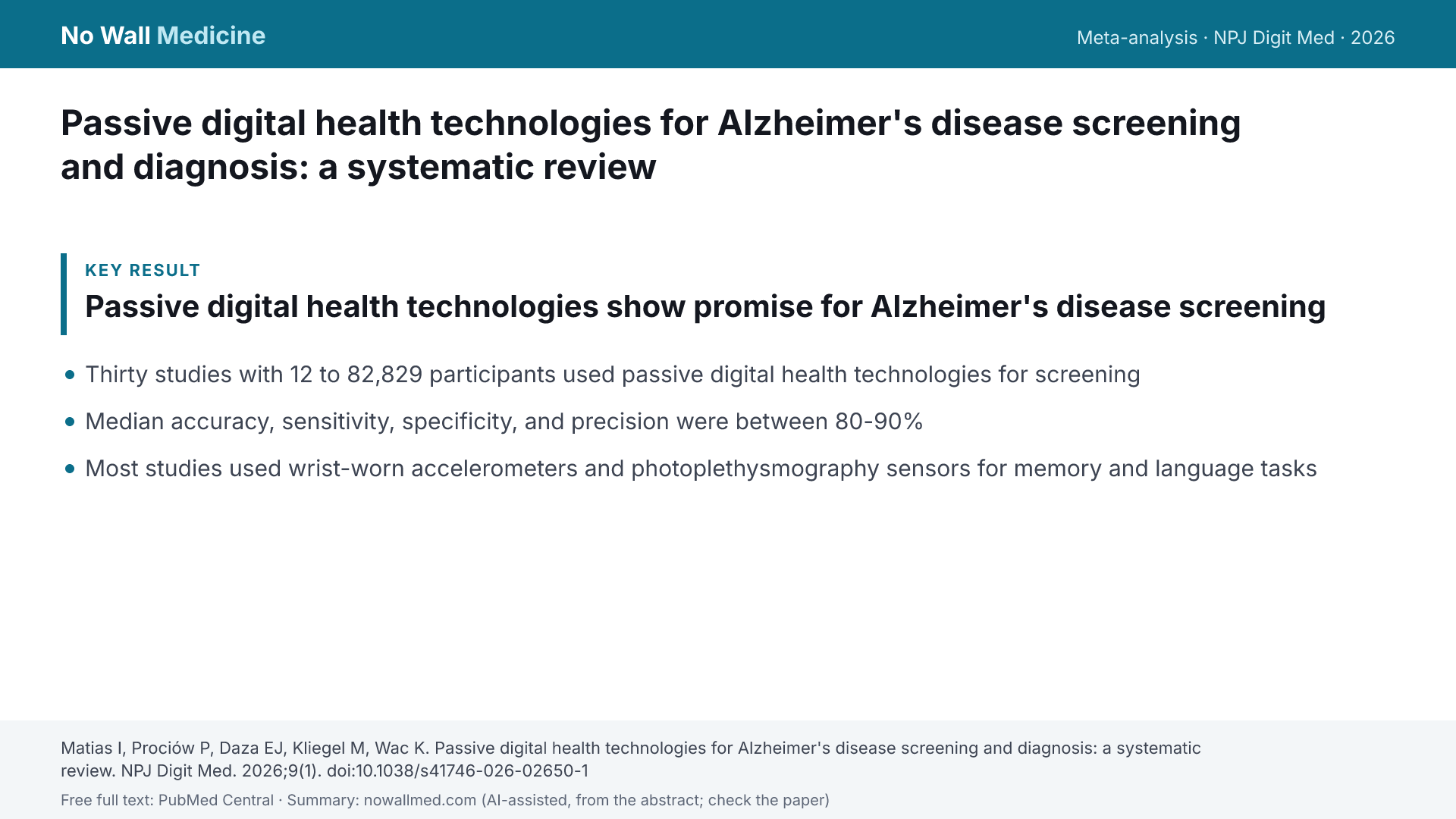
Key result: Passive digital health technologies show promise for Alzheimer's disease screening
Key points
- Thirty studies with 12 to 82,829 participants used passive digital health technologies for screening.
- Median accuracy, sensitivity, specificity, and precision were between 80-90%.
- Most studies used wrist-worn accelerometers and photoplethysmography sensors for memory and language tasks.
Why it matters: Doctors need better tools for early detection of Alzheimer's disease and related dementias
Discussion prompts
- Would these patients look like yours? Who was left out?
- Is the main outcome one that matters to patients?
- Is the difference large enough to change what you do?
Cite: Matias I, Prociów P, Daza EJ, Kliegel M, Wac K. Passive digital health technologies for Alzheimer's disease screening and diagnosis: a systematic review. NPJ Digit Med. 2026;9(1). doi:10.1038/s41746-026-02650-1
Free full text: PubMed Central · Summary and visual abstract: nowallmed.com/a/passive-digital-health-technologies-for-alzheimer-s-disease-screening-1sti953/ (AI-assisted from the abstract; check the paper before relying on it).