Patellar resurfacing showed similar clinical results to no resurfacing in total knee replacement
Patellar resurfacing in total knee replacement: 20-year clinical and economic results of a large multicentre, randomised controlled trial in the UK
Pragmatic, multicentre, open-label randomized controlled trialMixed results
Does patellar resurfacing during total knee replacement improve clinical and economic outcomes?
Who
1715
Adult patients aged 18 years or older undergoing primary total knee replacement · United Kingdom
Compared
0.76Patellar resurfacing (95% CI -0.08 to 1.59)
No resurfacing
Main outcome
Oxford Knee Score
Result: marginal difference 0.76 (95% CI -0.08 to 1.59)
Bottom line: Patellar resurfacing showed no significant difference in Oxford Knee Score but resulted in significantly higher quality-adjusted life-years.
Limitation: Only 132 participants in resurfacing and 110 in non-resurfacing provided 20-year outcome data.
Funded by: UK National Institute for Health and Care Research
Lancet · 2026-06-17Download image
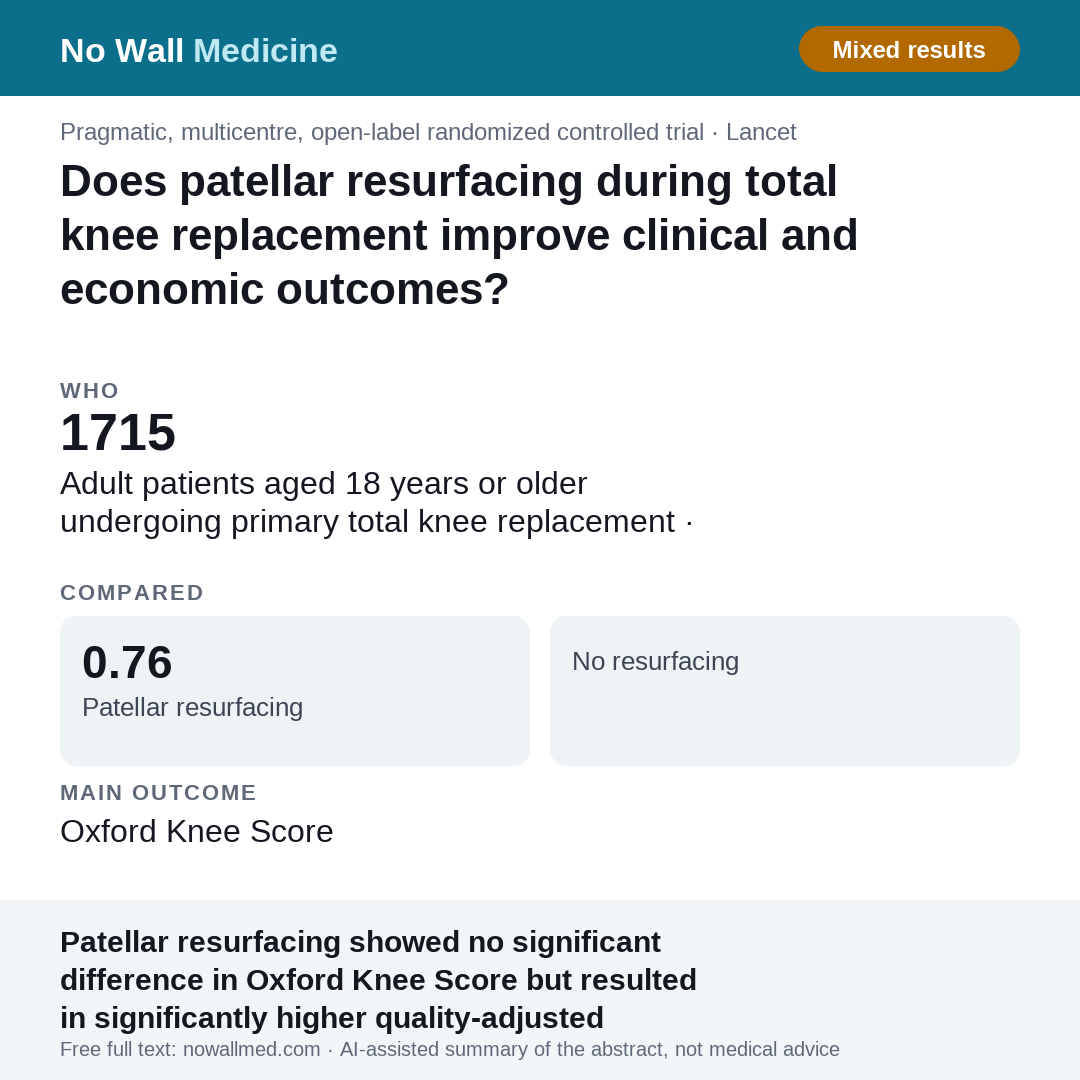
Clinical question: Does patellar resurfacing during total knee replacement improve clinical and economic outcomes?
Why it matters: Doctors have had limited evidence on the long-term benefits of patellar resurfacing during total knee replacement
Key points
- 1715 participants were randomly assigned to patellar resurfacing or no resurfacing during total knee replacement.
- The marginal difference in Oxford Knee Score over 20 years was 0·76 in favour of patellar resurfacing, but not statistically significant.
- The resurfaced group had significantly more quality-adjusted life-years than the non-resurfaced group at 20 years.
Limitation the authors note: The analysis included marginal differences with earlier data for participants who died or had missing 20-year data
Headline and key points written with AI from the paper’s abstract, with every number checked against it. Read the paper before relying on them.
Abstract
Background
There is conflicting evidence regarding the merits of patellar resurfacing during total knee replacement (TKR), as previous randomised controlled trials (RCTs) have been under-powered and with follow-up of ten years or less. Methods
A pragmatic, multicentre, open-label RCT was initiated in 1999 in the UK. Within a partial-factorial design, participants were randomly allocated to receive or not receive patellar resurfacing during primary TKR and were followed up for 20 years. Adult (aged ≥18 years) patients due to have a primary TKR under the care of a collaborating surgeon were eligible. Participants were allocated (1:1) using an automated telephone service stratified by surgeon, with minimisation according to the patients' age (<60 years, 60-79 years, ≥80 years), sex, and location of d isease. The primary outcome measure was the Oxford Knee Score (OKS), analysed using repeated measures mixed-effects linear regression analysis with marginal differences reported. Secondary measures included the 12-Item Short Form Health Survey (SF-12), the European Quality of Life 5-Dimensions 3-Levels (EQ-5D-3L), costs, cost-effectiveness, and subsequent knee surgery. This trial is registered with ISRCTN Registry, ISRCTN45837371. Findings
Between April 8, 1999, and Jan 13, 2003, 1715 participants (955 female and 760 male; mean age 70 years [SD 8], mean BMI 29·7 kg/m2) were randomly assigned: 861 to patellar resurfacing and 854 to no resurfacing. At the 20-year follow-up, 132 participants in the patellar resurfacing group and 110 participants in the non-resurfacing group provided outcome data, although marginal differences included earlier data for participants who died or had missing 20-year data. The marginal difference in OKS over the whole 20-year follow-up was 0·76 (95% CI -0·08 to 1·59; p=0·076) in favour of patellar resurfacing. During the 20-year follow-up period, although not significant, differences in OKS, SF-12, and EQ-5D-3L, readmissions, minor or intermediate operations, patella-related operations, major operations, and complications all favoured patellar resurfacing. At 20 years, the resurfaced group accrued significantly more quality-adjusted life-years (QALYs) than the non-resurfaced group (7·295 vs 6·884; difference 0·380, 95% CI 0·061 to 0·700; p=0·020). However, QALY differences were smaller in a sensitivity analysis assuming no difference in mortality (7·209 vs 6·964; difference 0·183, 95% CI -0·034 to 0·400; p=0·10). The cost of readmissions was non-significantly lower in the resurfaced group and offset the higher cost of primary TKR; therefore, overall 20-year health-care costs per participant were similar (£10 825 vs £10 889; difference -£6, 95% CI -£721 to £708; p=0·99). Interpretation
There was no significant difference in primary outcome (OKS) or other clinical endpoints. However, as clinical differences tend to support patellar resurfacing, the resurfacing group had significantly higher QALYs. There was no difference in costs over the 20-year period, and patellar resurfacing had a 99% probability of being cost-effective at any threshold above £10 000 per QALY gained. The evidence is therefore weighted towards resurfacing being the approach of first choice. Funding
UK National Institute for Health and Care Research Health Technology Assessment Programme.
Abstract reproduced under the article’s CC BY licence.
Topics
Cite this article
Murray DW, Hudson J, Dakin H, MacLennan G, Little M, Gray A. Patellar resurfacing in total knee replacement: 20-year clinical and economic results of a large multicentre, randomised controlled trial in the UK. Lancet. 2026. doi:10.1016/S0140-6736(26)00652-5
Spotted a mistake? Suggest a correction