Pathogen-Specific Effects of Probiotics in Children With Acute Gastroenteritis Seeking Emergency Care: A Randomized Trial
Multicenter randomized, placebo controlled trialsNo clear difference
Do probiotics exert pathogen-specific effects in children with acute gastroenteritis?
Who
1565
Children 3-48 months with acute gastroenteritis · Pediatric emergency departments in Canada and the United States
Compared
Probiotic
Placebo
Main outcome
Post-intervention moderate-to-severe disease
Bottom line: Probiotics did not result in less severe disease compared to placebo across common etiologic pathogens in children.
Clin Infect Dis · 2021-10-02Download image
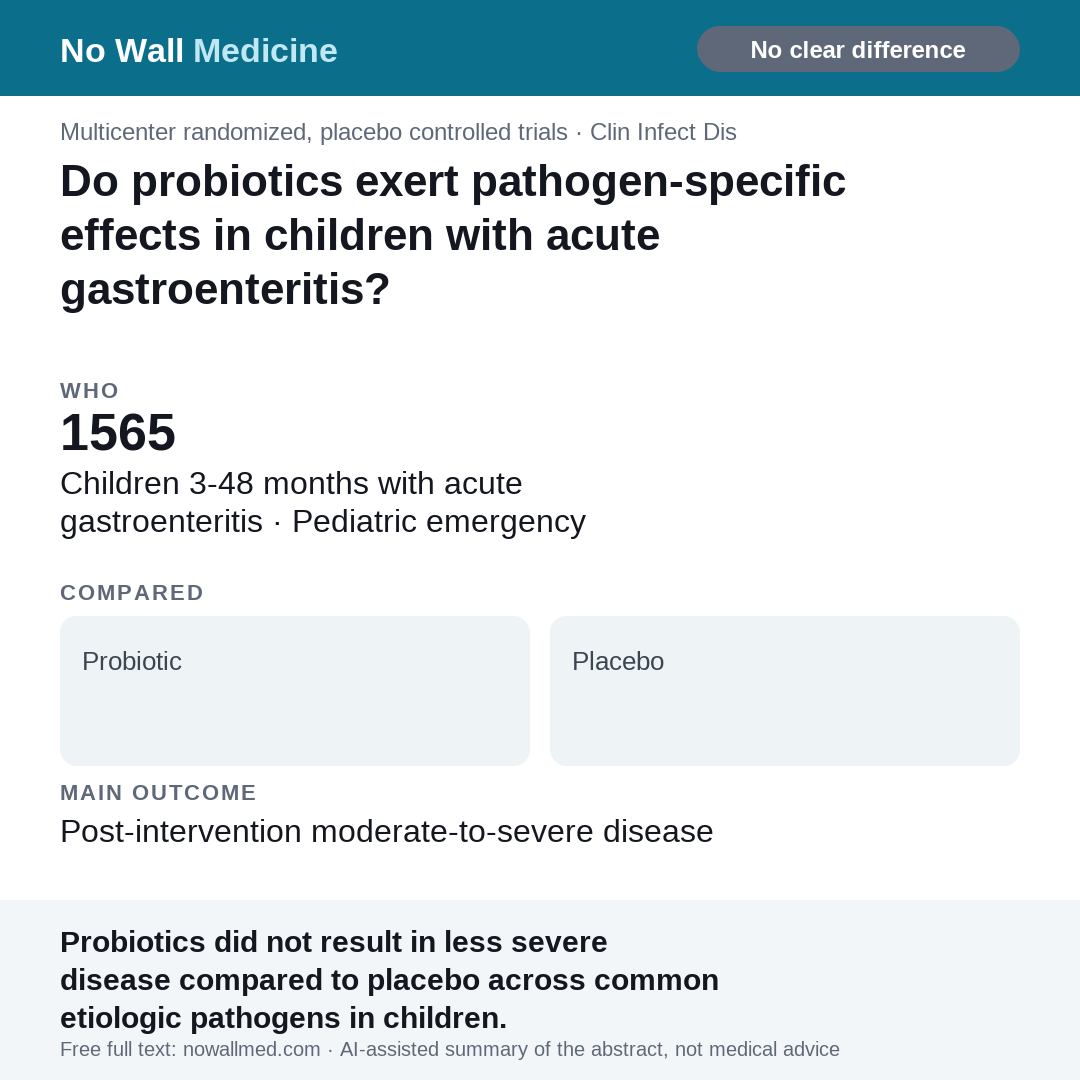
Clinical question: Do probiotics exert pathogen-specific effects in children with acute gastroenteritis?
Abstract
Background
It is unknown if probiotics exert pathogen-specific effects in children with diarrhea secondary to acute gastroenteritis. Methods
Analysis of patient-level data from 2 multicenter randomized, placebo controlled trials conducted in pediatric emergency departments in Canada and the United States. Participants were 3-48 months with >3 diarrheal episodes in the preceding 24 hours and were symptomatic for <72 hours and <7 days in the Canadian and US studies, respectively. Participants received either placebo or a probiotic preparation (Canada-Lactobacillus rhamnosus R0011/Lactobacillus helveticus R0052; US-L. rhamnosus GG). The primary outcome was post-intervention moderate-to-severe disease (ie, ≥9 on the Modified Vesikari Scale [MVS] score). Results
Pathogens were identified in specimens from 59.3% of children (928/1565). No pathogen groups were less likely to experience an MVS score ≥9 based on treatment allocation (test for interaction = 0.35). No differences between groups were identified for adenovirus (adjusted relative risk [aRR]: 1.42; 95% confidence interval [CI]: .62, 3.23), norovirus (aRR: 0.98; 95% CI: .56, 1.74), rotavirus (aRR: 0.86; 95% CI: .43, 1.71) or bacteria (aRR: 1.19; 95% CI: .41, 3.43). At pathogen-group and among individual pathogens there were no differences in diarrhea duration or the total number of diarrheal stools between treatment groups, regardless of intervention allocation or among probiotic sub-groups. Among adenovirus-infected children, those administered the L. rhamnosus R0011/L. helveticus R0052 product experienced fewer diarrheal episodes (aRR: 0.65; 95% CI: .47, .90). Conclusions
Neither probiotic product resulted in less severe disease compared to placebo across a range of the most common etiologic pathogens. The preponderance of evidence does not support the notion that there are pathogen specific benefits associated with probiotic use in children with acute gastroenteritis. Clinical trials registration
NCT01773967 and NCT01853124.
Subject terms
Cite this article
Freedman SB, Finkelstein Y, Pang XL, Chui L, Tarr PI, VanBuren JM. Pathogen-Specific Effects of Probiotics in Children With Acute Gastroenteritis Seeking Emergency Care: A Randomized Trial. Clin Infect Dis. 2021. doi:10.1093/cid/ciab876
Spotted a mistake? Suggest a correction
Top studies every Monday
The week’s key trials and guidelines in your specialties, plus any topics you follow. By email, free.
Get the weekly digest