Probiotic use did not change stool antibody levels in children with gastroenteritis
Probiotic stool secretory immunoglobulin A modulation in children with gastroenteritis: a randomized clinical trial
Randomized, double-blinded, placebo-controlled ancillary studyNo clear difference
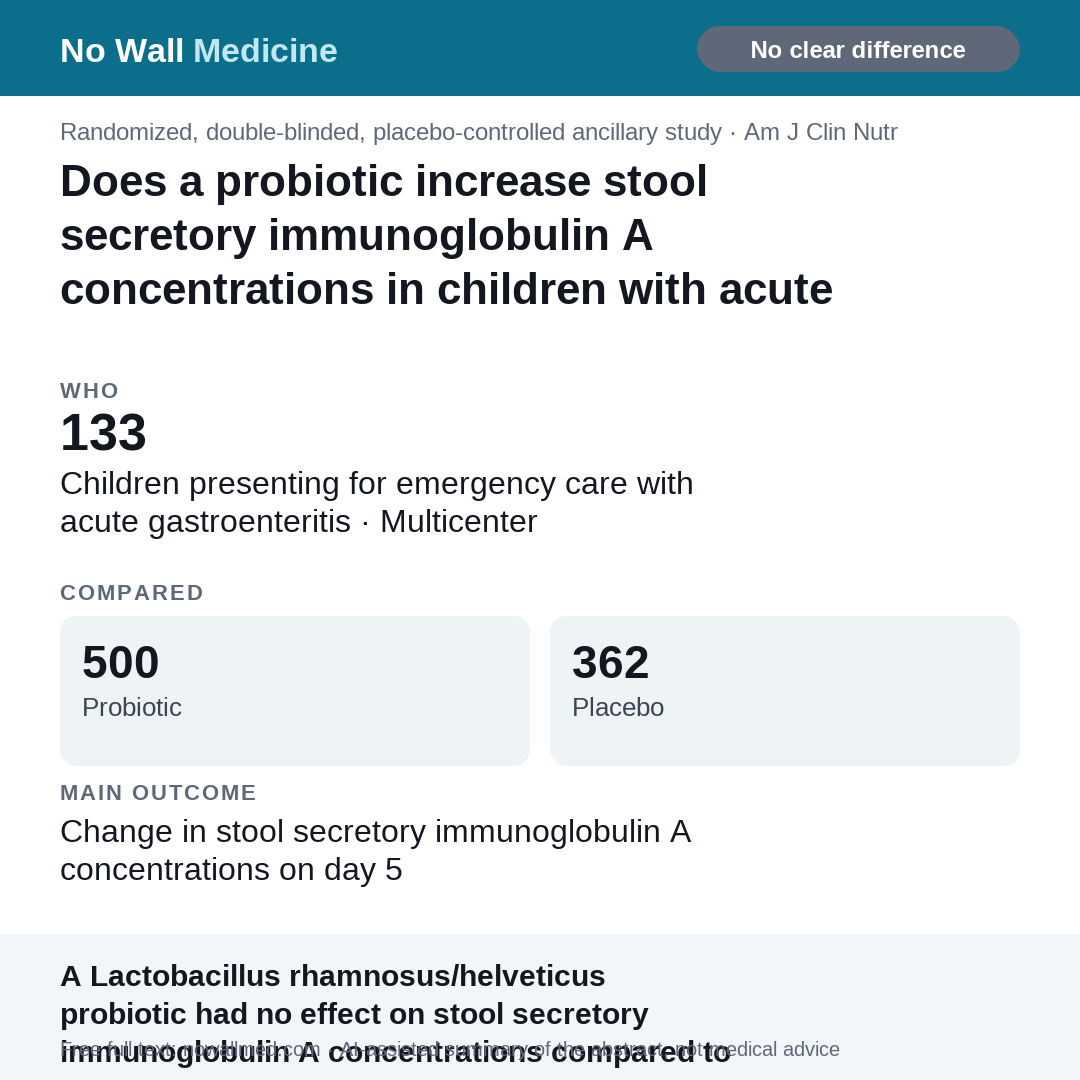
Does a probiotic increase stool secretory immunoglobulin A concentrations in children with acute gastroenteritis?
Who
133
Children presenting for emergency care with acute gastroenteritis · Multicenter
Compared
500Probiotic (-1135, 2362)
362Placebo (-1122, 4256)
Main outcome
Change in stool secretory immunoglobulin A concentrations on day 5
Result: β: -0.24 (-0.65, 0.18)
Bottom line: A Lactobacillus rhamnosus/helveticus probiotic had no effect on stool secretory immunoglobulin A concentrations compared to placebo.
Am J Clin Nutr · 2021-07-16Download image
Clinical question: Does a probiotic increase stool secretory immunoglobulin A concentrations in children with acute gastroenteritis?
Why it matters: It was unknown if probiotics provided immunomodulatory benefits by changing secretory immunoglobulin A concentrations in children with acute gastroenteritis.
Key points
- Researchers studied 133 children with acute gastroenteritis who received either a 5-day course of Lactobacillus rhamnosus/helveticus probiotics or a placebo.
- Median stool secretory immunoglobulin A, an antibody that protects mucosal surfaces, did not differ between the probiotic and placebo groups at day 0, day 5, or day 28.
- The change in antibody concentrations from day 0 to day 5 showed no difference between the probiotic group and the placebo group (P = 0.77).
Headline and key points written with AI from the paper’s abstract, with every number checked against it. Read the paper before relying on them.
Was this summary helpful?
Subject terms
Cite this article
Freedman SB, Horne R, Johnson-Henry K, Xie J, Williamson-Urquhart S, Chui L. Probiotic stool secretory immunoglobulin A modulation in children with gastroenteritis: a randomized clinical trial. Am J Clin Nutr. 2021. doi:10.1093/ajcn/nqaa369
Spotted a mistake? Suggest a correction
Top studies every Monday
The week’s key trials and guidelines in your specialties, plus any topics you follow. By email, free.
Get the weekly digest