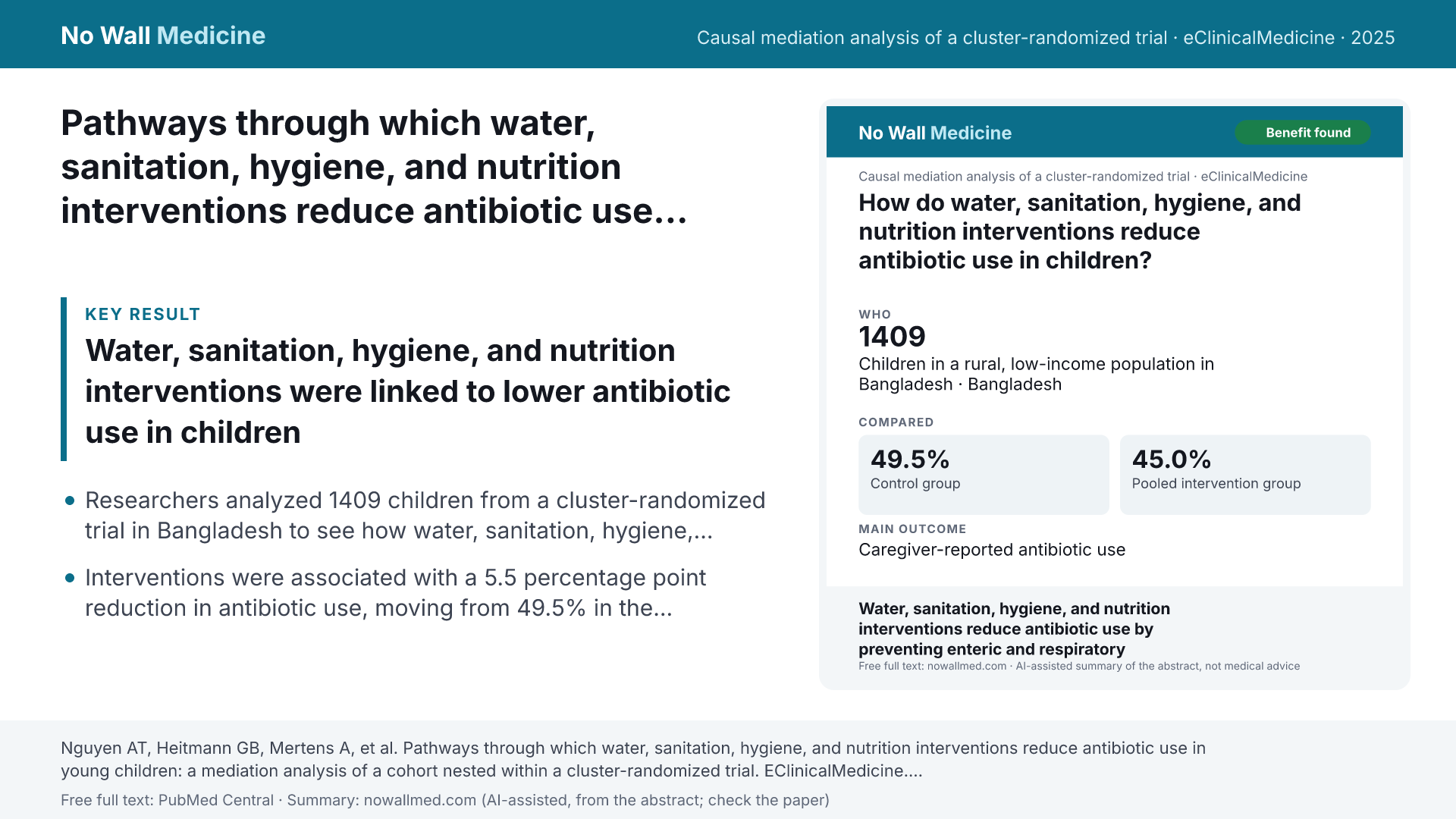
Water, sanitation, hygiene, and nutrition interventions were linked to lower antibiotic use in children
Pathways through which water, sanitation, hygiene, and nutrition interventions reduce antibiotic use in young children: a mediation analysis of a cohort nested within a cluster-randomized trial
Causal mediation analysis of a cluster-randomized trialBenefit found
How do water, sanitation, hygiene, and nutrition interventions reduce antibiotic use in children?
Who
1409
Children in a rural, low-income population in Bangladesh · Bangladesh
Compared
49.5%Control group (95% CI 45.9%, 53.0%)
45.0%Pooled intervention group (95% CI 42.7%, 47.2%)
Main outcome
Caregiver-reported antibiotic use
Result: 5.5 percentage points (95% CI 1.2, 9.9)
Bottom line: Water, sanitation, hygiene, and nutrition interventions reduce antibiotic use by preventing enteric and respiratory infections.
Funded by: Bill & Melinda Gates Foundation, National Institute of Allergy and Infectious Diseases
eClinicalMedicine · 2025-03-06Download image
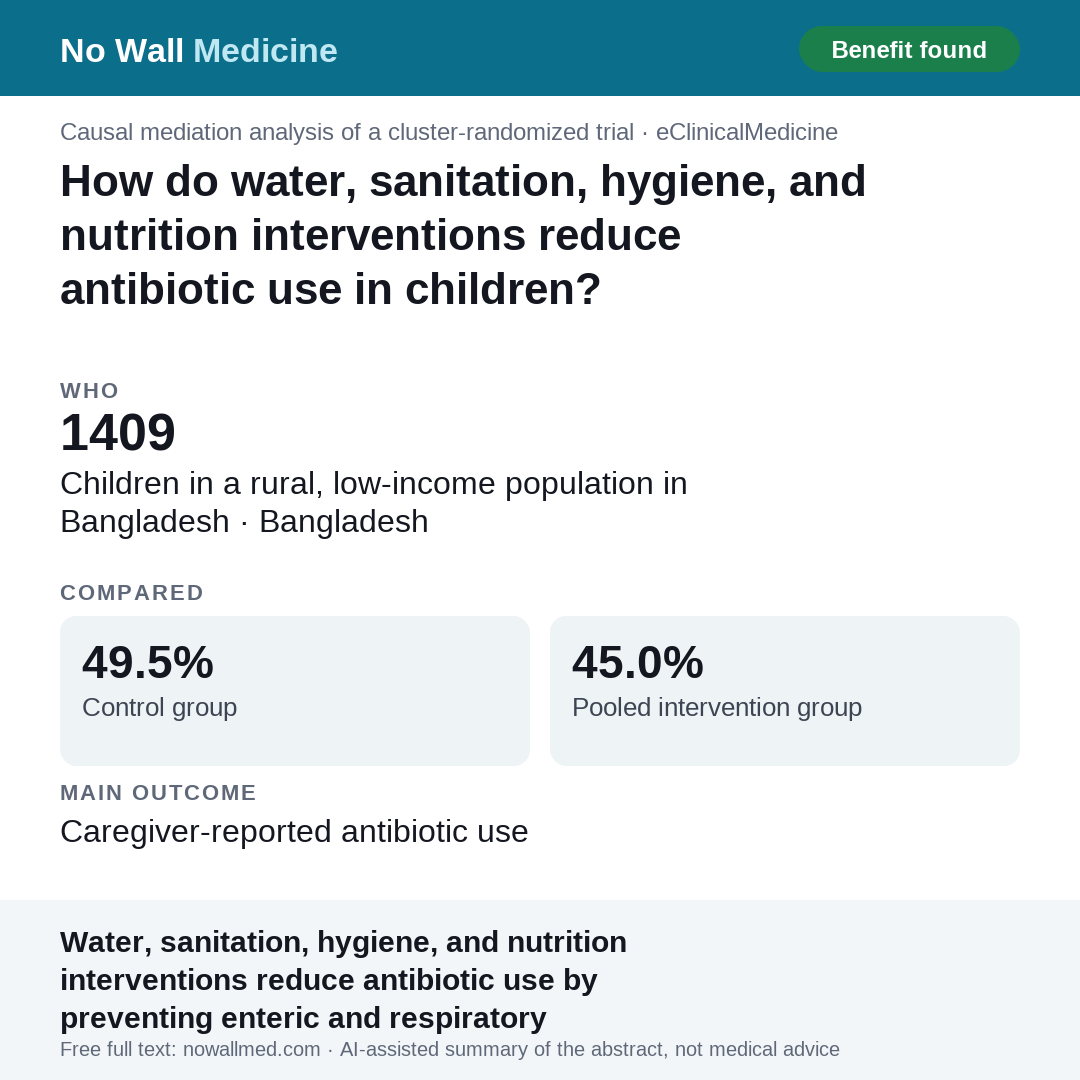
Clinical question: How do water, sanitation, hygiene, and nutrition interventions reduce antibiotic use in children?
Why it matters: The specific mechanism through which water, sanitation, hygiene, and nutrition interventions reduce antibiotic use in young children has not been investigated.
In absolute numbers
Control group: 49.5% · Pooled intervention group: 45% → a difference of 4.5 percentage points, so about 23 people would need the treatment for 1 more to benefit (number needed to treat) over the trial’s follow-up.
Worked out by us from the two group results above, not reported by the authors. Check the paper for the exact outcome and timing.
Key points
- Researchers analyzed 1409 children from a cluster-randomized trial in Bangladesh to see how water, sanitation, hygiene, and nutrition interventions affected antibiotic use.
- Interventions were associated with a 5.5 percentage point reduction in antibiotic use, moving from 49.5% in the control group to 45.0% in the pooled intervention group.
- The reduction in antibiotic use was linked to lower rates of diarrhea, acute respiratory infections with fever, and the prevalence of enteric viruses.
Headline and key points written with AI from the paper’s abstract, with every number checked against it. Read the paper before relying on them.
Was this summary helpful?
Cite this article
Nguyen AT, Heitmann GB, Mertens A, Ashraf S, Rahman MZ, Ali S. Pathways through which water, sanitation, hygiene, and nutrition interventions reduce antibiotic use in young children: a mediation analysis of a cohort nested within a cluster-randomized trial. eClinicalMedicine. 2025. doi:10.1016/j.eclinm.2025.103147
Spotted a mistake? Suggest a correction