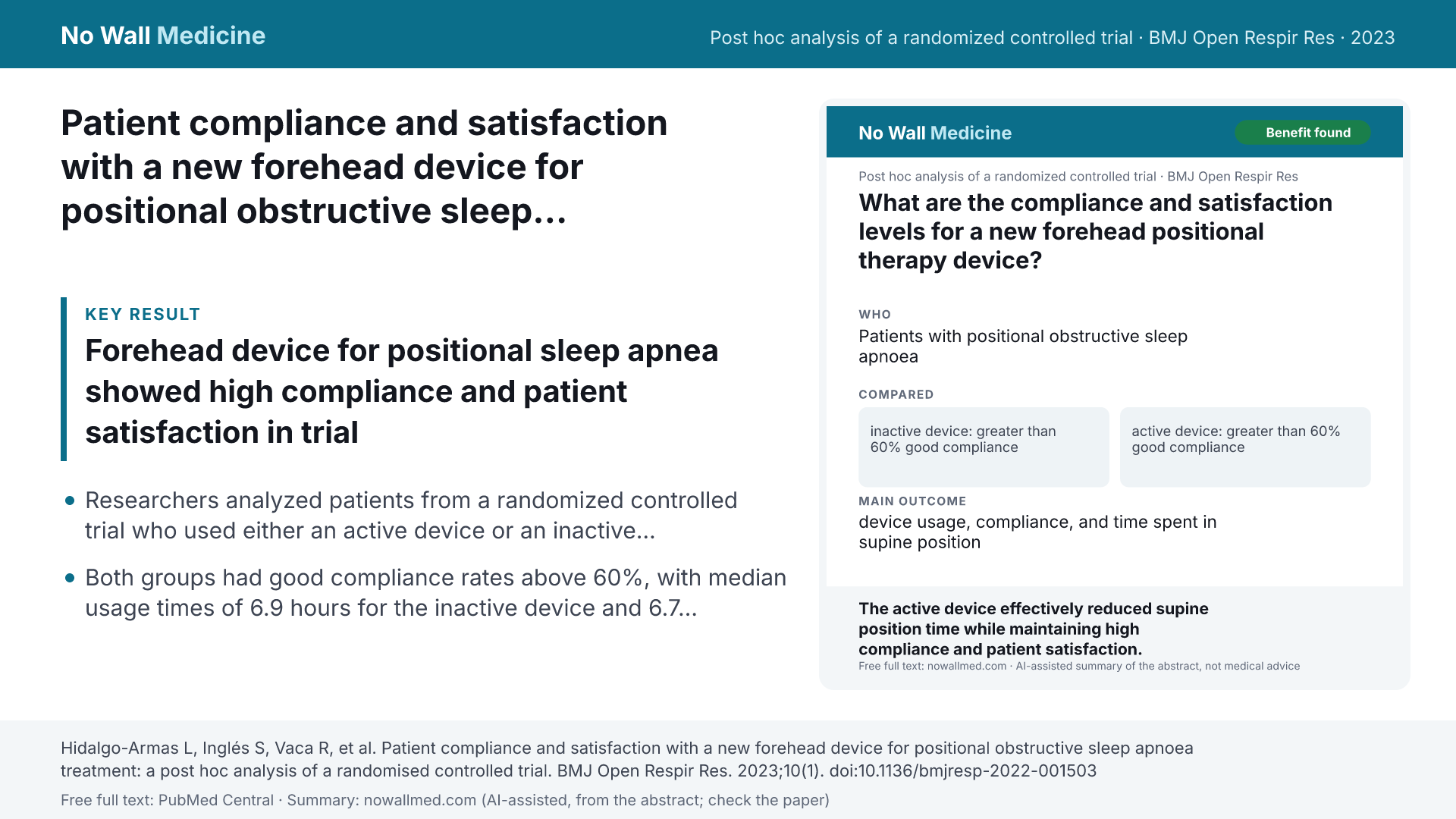
Patient compliance and satisfaction with a new forehead device for positional obstructive sleep apnoea treatment: a post hoc analysis of a randomised controlled trial
Key result: Forehead device for positional sleep apnea showed high compliance and patient satisfaction in trial
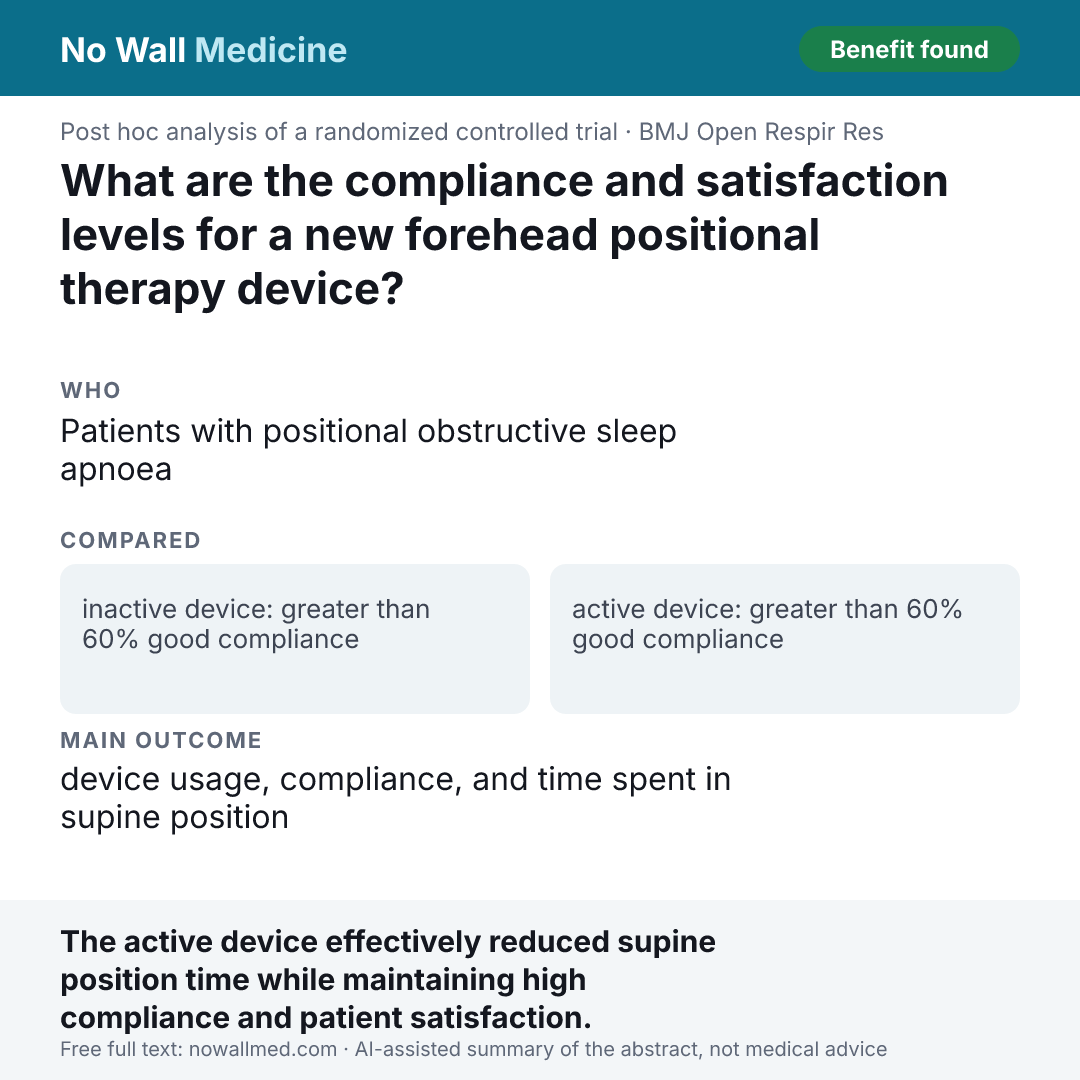
Post hoc analysis of a randomized controlled trialBenefit found
What are the compliance and satisfaction levels for a new forehead positional therapy device?
Who
Patients with positional obstructive sleep apnoea
Compared
inactive device: greater than 60% good compliance
active device: greater than 60% good compliance
Main outcome
device usage, compliance, and time spent in supine position
Bottom line: The active device effectively reduced supine position time while maintaining high compliance and patient satisfaction.
BMJ Open Respir Res · 2023-06-23 · Save PNG
Key points
- Researchers analyzed patients from a randomized controlled trial who used either an active device or an inactive device for 3 months to treat positional obstructive sleep apnea.
- Both groups had good compliance rates above 60%, with median usage times of 6.9 hours for the inactive device and 6.7 hours for the active device.
- The active device was associated with a lower median time spent in the supine position (lying on the back) at 2.9% compared to 12.4% for the inactive device.
Discussion prompts
- Would these patients look like yours? Who was left out?
- Is the main outcome one that matters to patients?
- Is the difference large enough to change what you do?
Cite: Hidalgo-Armas L, Inglés S, Vaca R, et al. Patient compliance and satisfaction with a new forehead device for positional obstructive sleep apnoea treatment: a post hoc analysis of a randomised controlled trial. BMJ Open Respir Res. 2023;10(1). doi:10.1136/bmjresp-2022-001503
Free full text: PubMed Central · Summary and visual abstract: nowallmed.com/a/patient-compliance-and-satisfaction-with-a-new-forehead-device-for-ypq1t6/ (AI-assisted from the abstract; check the paper before relying on it).