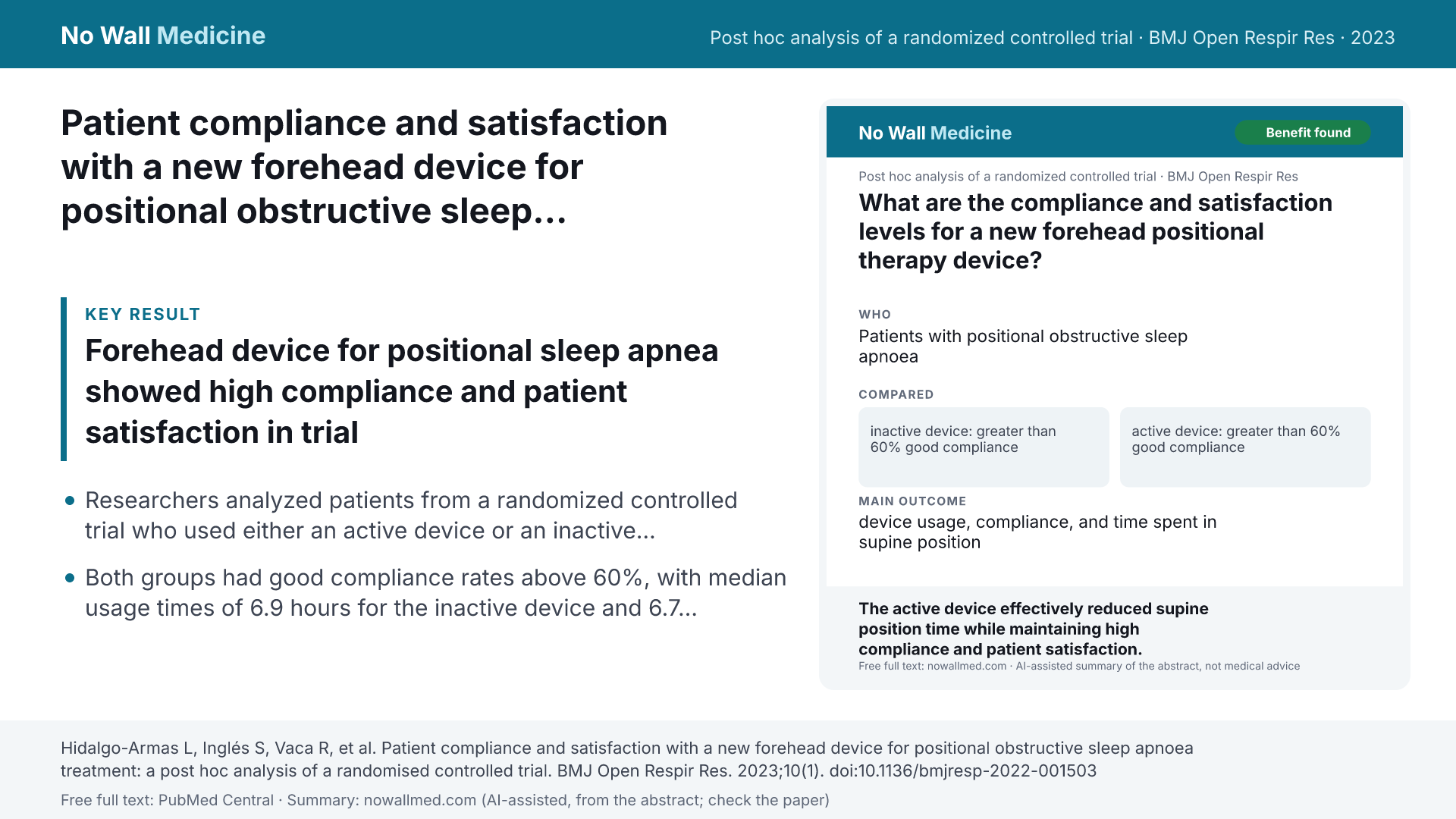
Forehead device for positional sleep apnea showed high compliance and patient satisfaction in trial
Patient compliance and satisfaction with a new forehead device for positional obstructive sleep apnoea treatment: a post hoc analysis of a randomised controlled trial
Post hoc analysis of a randomized controlled trialBenefit found
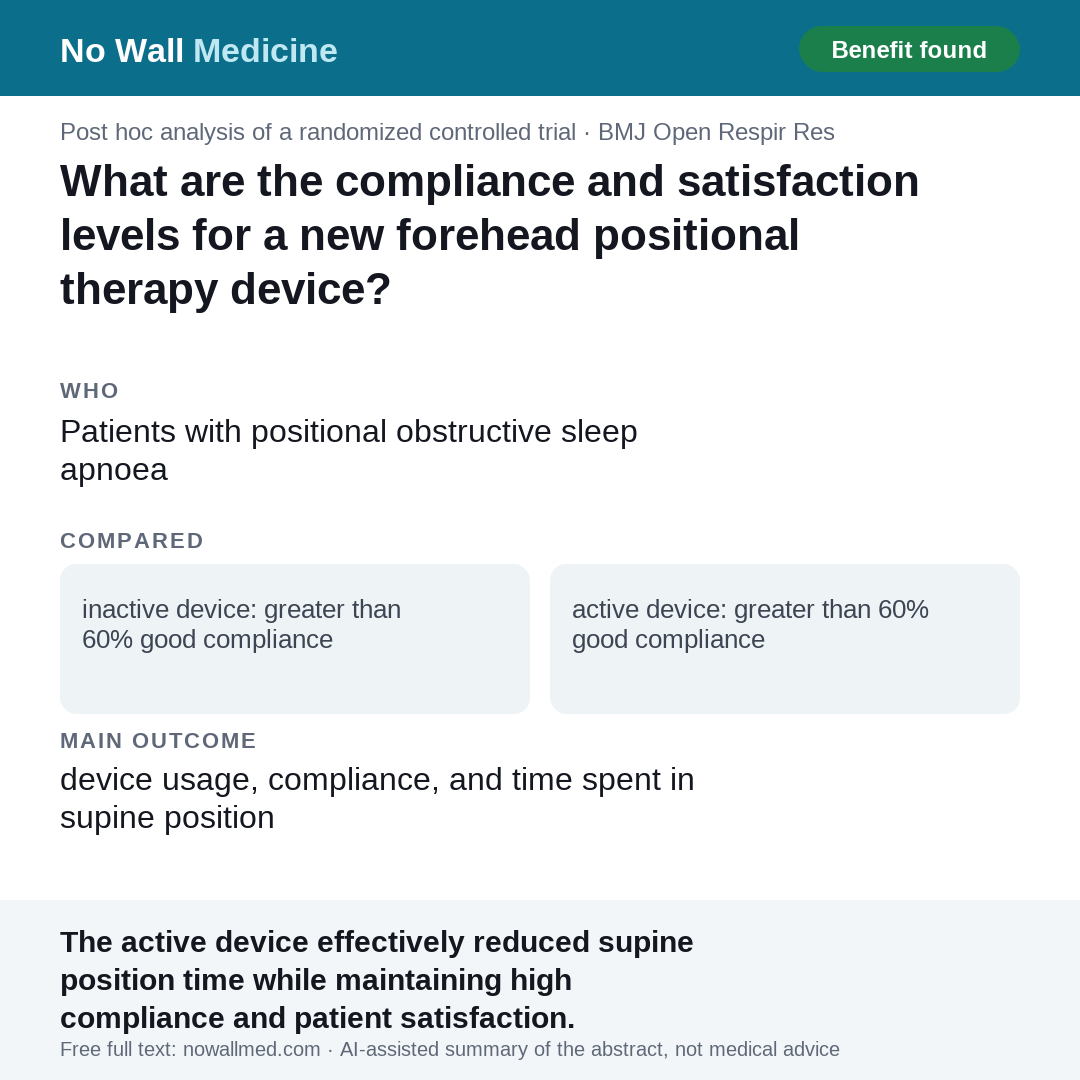
What are the compliance and satisfaction levels for a new forehead positional therapy device?
Who
Patients with positional obstructive sleep apnoea
Compared
inactive device: greater than 60% good compliance
active device: greater than 60% good compliance
Main outcome
device usage, compliance, and time spent in supine position
Bottom line: The active device effectively reduced supine position time while maintaining high compliance and patient satisfaction.
BMJ Open Respir Res · 2023-06-23Download image
Clinical question: What are the compliance and satisfaction levels for a new forehead positional therapy device?
Why it matters: It was unknown how patients would comply with and feel about using a new forehead-based device for treating positional obstructive sleep apnea.
Key points
- Researchers analyzed patients from a randomized controlled trial who used either an active device or an inactive device for 3 months to treat positional obstructive sleep apnea.
- Both groups had good compliance rates above 60%, with median usage times of 6.9 hours for the inactive device and 6.7 hours for the active device.
- The active device was associated with a lower median time spent in the supine position (lying on the back) at 2.9% compared to 12.4% for the inactive device.
Headline and key points written with AI from the paper’s abstract, with every number checked against it. Read the paper before relying on them.
Was this summary helpful?
Abstract
Background
The influence of body position in obstructive sleep apnoea patients is well known. A positional therapy device placed at the forehead has proven to be effective in reducing the severity of positional obstructive sleep apnoea (POSA) symptoms. The aim of the study was to evaluate patients' therapy compliance and satisfaction in the short term and mid-term. Methods
A post hoc analysis of a randomised controlled trial was conducted using an inactive device (ID) or an active device (AD) for 3 months. The primary outcomes were device usage and the percentage of patients with good compliance (defined as device use for more than 4 hours per night and more than 70% of nights per week). Secondary outcomes included time spent with head in the supine position, patient satisfaction and side effects. Results
The median duration of using the device was 6.9 hours in the ID group and 6.7 hours in the AD group (p=0.309), and the durations were similar throughout the follow-up period and from the first day of use. The percentage of patients with good compliance was similar and greater than 60% in both groups. The median time spent with head in the supine position was significantly lower in the AD group (2.9%) than in the ID group (12.4%) since the first day of treatment. Both groups showed satisfaction scores values above 8.5 (out of 10) in all items, while side effects were scarcely reported. Conclusion
High device compliance was achieved in POSA patients, both in terms of device usage time and percentage of days used. Patients were highly satisfied, and the device effectively reduced the time spent with the head in the supine position from the first day of use.
Abstract reproduced under the article’s CC BY NC licence.
Subject terms
Cite this article
Hidalgo-Armas L, Inglés S, Vaca R, Cordero-Guevara J, Durán-Carro J, Ullate J. Patient compliance and satisfaction with a new forehead device for positional obstructive sleep apnoea treatment: a post hoc analysis of a randomised controlled trial. BMJ Open Respir Res. 2023. doi:10.1136/bmjresp-2022-001503
Spotted a mistake? Suggest a correction
Top studies every Monday
The week’s key trials and guidelines in your specialties, plus any topics you follow. By email, free.
Get the weekly digest