Certain physiological traits were associated with lower long-term continuous positive airway pressure use in patients
Physiological Traits and Adherence to Sleep Apnea Therapy in Individuals with Coronary Artery Disease
Randomized trial analysisMixed results
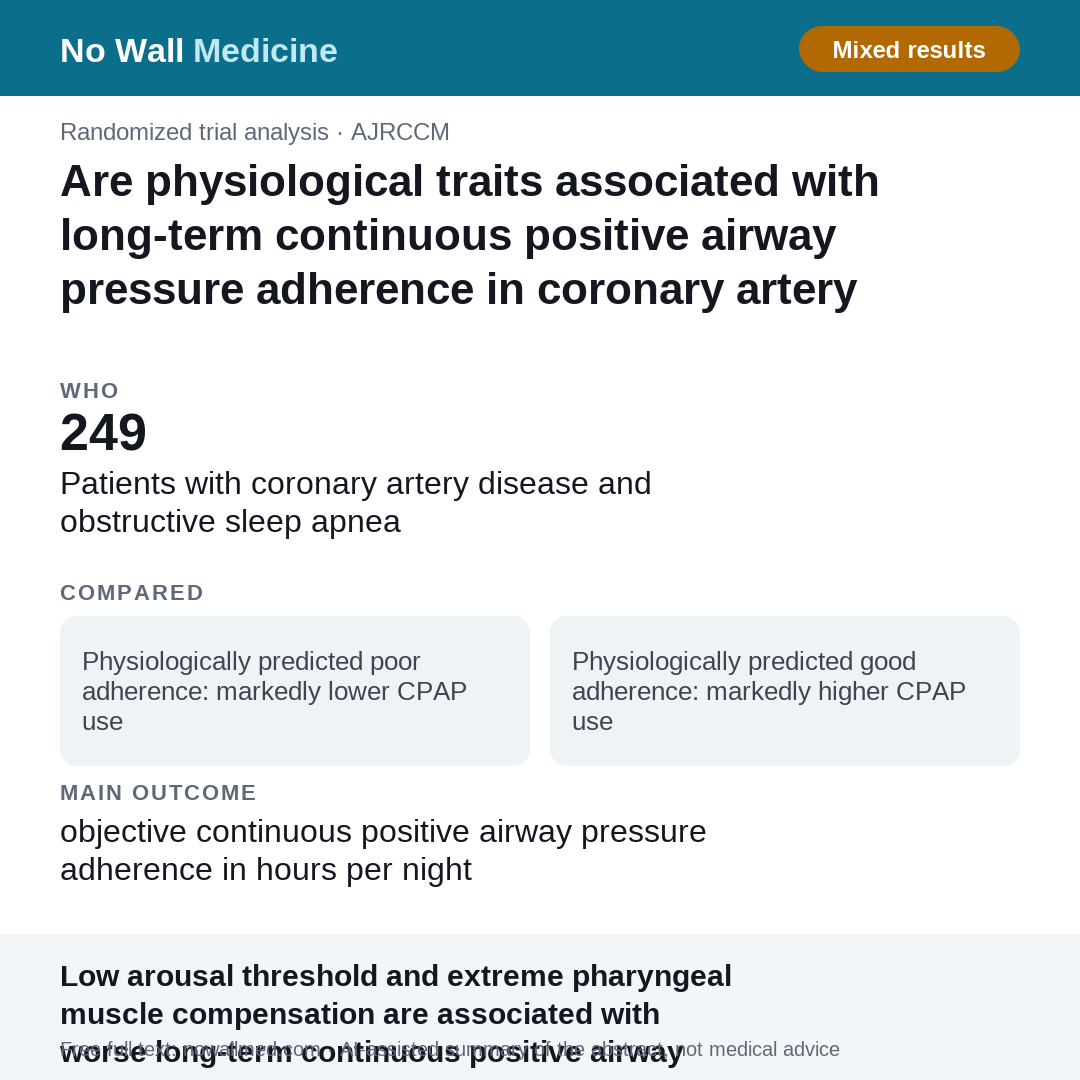
Are physiological traits associated with long-term continuous positive airway pressure adherence in coronary artery disease?
Who
249
Patients with coronary artery disease and obstructive sleep apnea
Compared
Physiologically predicted poor adherence: markedly lower CPAP use
Physiologically predicted good adherence: markedly higher CPAP use
Main outcome
objective continuous positive airway pressure adherence in hours per night
Result: group differences of 2.0-3.2 h/night (P < 0.003)
Bottom line: Low arousal threshold and extreme pharyngeal muscle compensation are associated with worse long-term continuous positive airway pressure adherence.
AJRCCM · 2021-06-23Download image
Clinical question: Are physiological traits associated with long-term continuous positive airway pressure adherence in coronary artery disease?
Why it matters: It is unknown whether physiological traits that cause obstructive sleep apnea are associated with long-term adherence to continuous positive airway pressure therapy in patients with coronary artery disease.
Key points
- Researchers analyzed 249 patients with coronary artery disease and obstructive sleep apnea to measure how physiological traits related to continuous positive airway pressure adherence over 2 years.
- A lower arousal threshold was associated with worse adherence, and both high and low pharyngeal muscle compensation were associated with lower adherence.
- Median continuous positive airway pressure use declined from 3.2 (1.0-5.8) h/night to 3.0 (0.0-5.6) h/night over the 24 month period.
Headline and key points written with AI from the paper’s abstract, with every number checked against it. Read the paper before relying on them.
Was this summary helpful?
Subject terms
Cite this article
Zinchuk AV, Chu JH, Liang J, Celik Y, Op de Beeck S, Redeker NS. Physiological Traits and Adherence to Sleep Apnea Therapy in Individuals with Coronary Artery Disease. AJRCCM. 2021. doi:10.1164/rccm.202101-0055OC
Spotted a mistake? Suggest a correction
Top studies every Monday
The week’s key trials and guidelines in your specialties, plus any topics you follow. By email, free.
Get the weekly digest