Peer support via automated phone system increased satisfaction and machine use for sleep apnea patients
Peer-Driven Intervention for Care Coordination and Adherence Promotion for Obstructive Sleep Apnea: A Randomized, Parallel-Group Clinical Trial
Randomized, parallel-group, controlled trialBenefit found
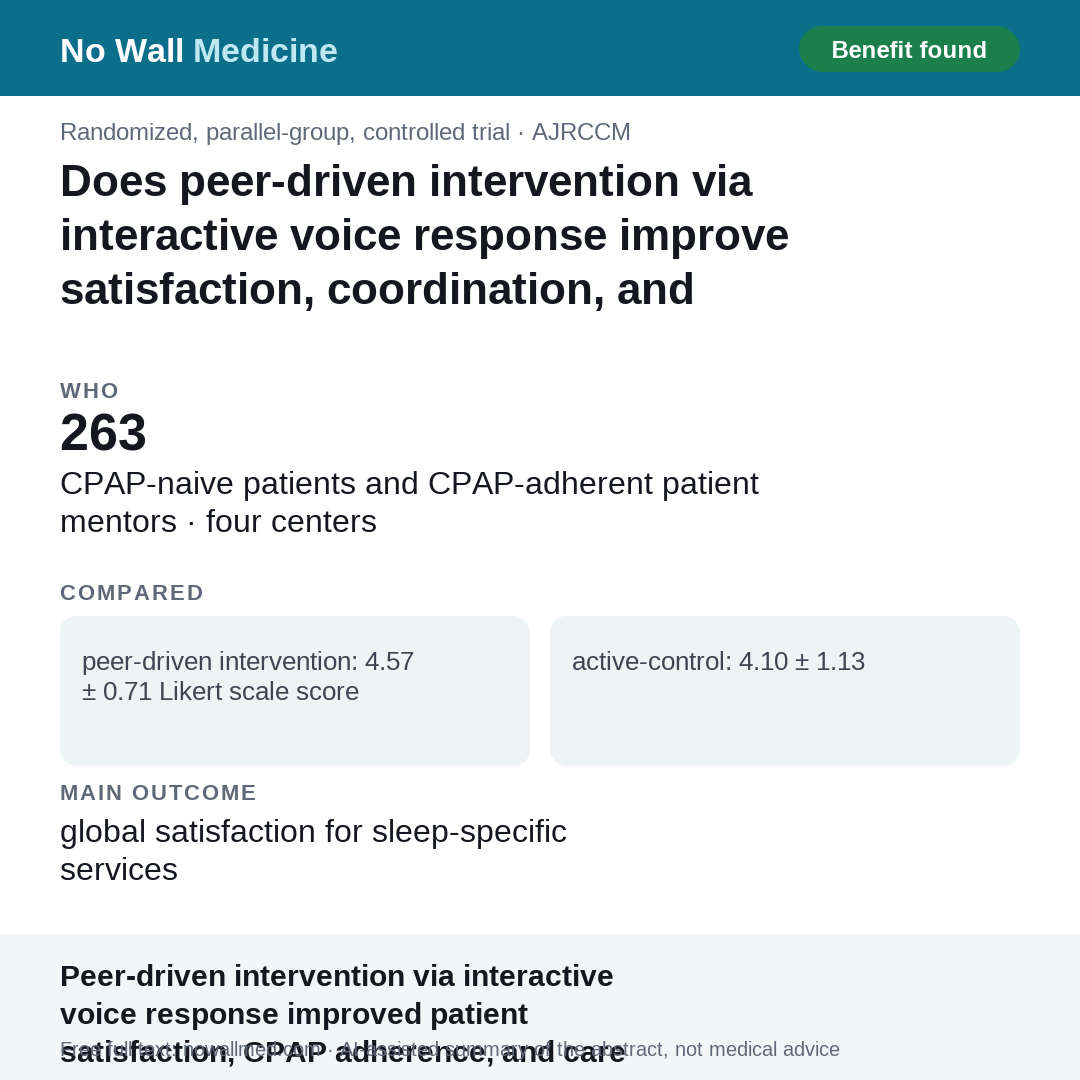
Does peer-driven intervention via interactive voice response improve satisfaction, coordination, and adherence?
Who
263
CPAP-naive patients and CPAP-adherent patient mentors · four centers
Compared
peer-driven intervention: 4.57 ± 0.71 Likert scale score
active-control: 4.10 ± 1.13
Main outcome
global satisfaction for sleep-specific services
Bottom line: Peer-driven intervention via interactive voice response improved patient satisfaction, CPAP adherence, and care coordination.
AJRCCM · 2024-10-23Download image
Clinical question: Does peer-driven intervention via interactive voice response improve satisfaction, coordination, and adherence?
Why it matters: Poor adherence to continuous positive airway pressure therapy is common and linked to worse patient outcomes and experiences.
Key points
- Researchers conducted a 6-month randomized trial with 263 patients with obstructive sleep apnea to compare a peer-driven automated phone system against an active control.
- The intervention group had higher satisfaction scores (4.57 ± 0.71) than the control group (4.10 ± 1.13) and used continuous positive airway pressure machines more (4.5 ± 0.2 h/night) versus the control (3.7 ± 0.2 h/night).
- The peer-driven group also showed higher scores for care coordination and chronic illness care, though consumer assessment of healthcare provider and systems ratings showed no difference.
Headline and key points written with AI from the paper’s abstract, with every number checked against it. Read the paper before relying on them.
Topics
Cite this article
Parthasarathy S, Wendel C, Grandner MA, Haynes PL, Guerra S, Combs D. Peer-Driven Intervention for Care Coordination and Adherence Promotion for Obstructive Sleep Apnea: A Randomized, Parallel-Group Clinical Trial. AJRCCM. 2024. doi:10.1164/rccm.202309-1594OC
Spotted a mistake? Suggest a correction
Top studies every Monday
The week’s key trials and guidelines in your specialties, by email. Free.
Get the weekly digest