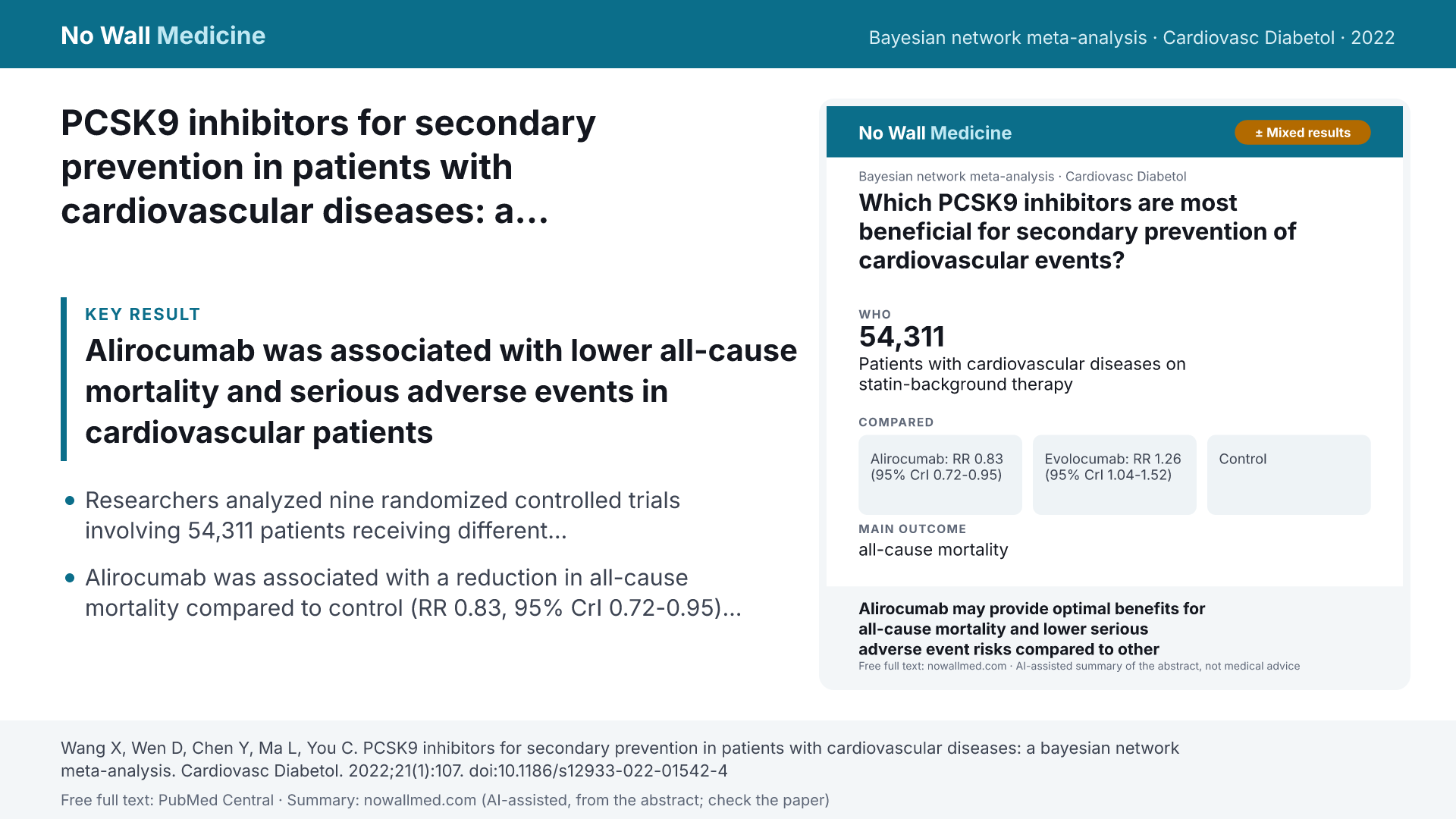
Alirocumab was associated with lower all-cause mortality and serious adverse events in cardiovascular patients
PCSK9 inhibitors for secondary prevention in patients with cardiovascular diseases: a bayesian network meta-analysis
Bayesian network meta-analysisMixed results
Which PCSK9 inhibitors are most beneficial for secondary prevention of cardiovascular events?
Who
54,311
Patients with cardiovascular diseases on statin-background therapy
Compared
Alirocumab: RR 0.83 (95% CrI 0.72-0.95)
Evolocumab: RR 1.26 (95% CrI 1.04-1.52)
Control
Main outcome
all-cause mortality
Result: RR 0.83 (95% CrI 0.72-0.95) for alirocumab vs control
Bottom line: Alirocumab may provide optimal benefits for all-cause mortality and lower serious adverse event risks compared to other agents.
Limitation: Further head-to-head trials with longer follow-up and high methodologic quality are warranted.
Cardiovasc Diabetol · 2022-06-15 · Save PNG
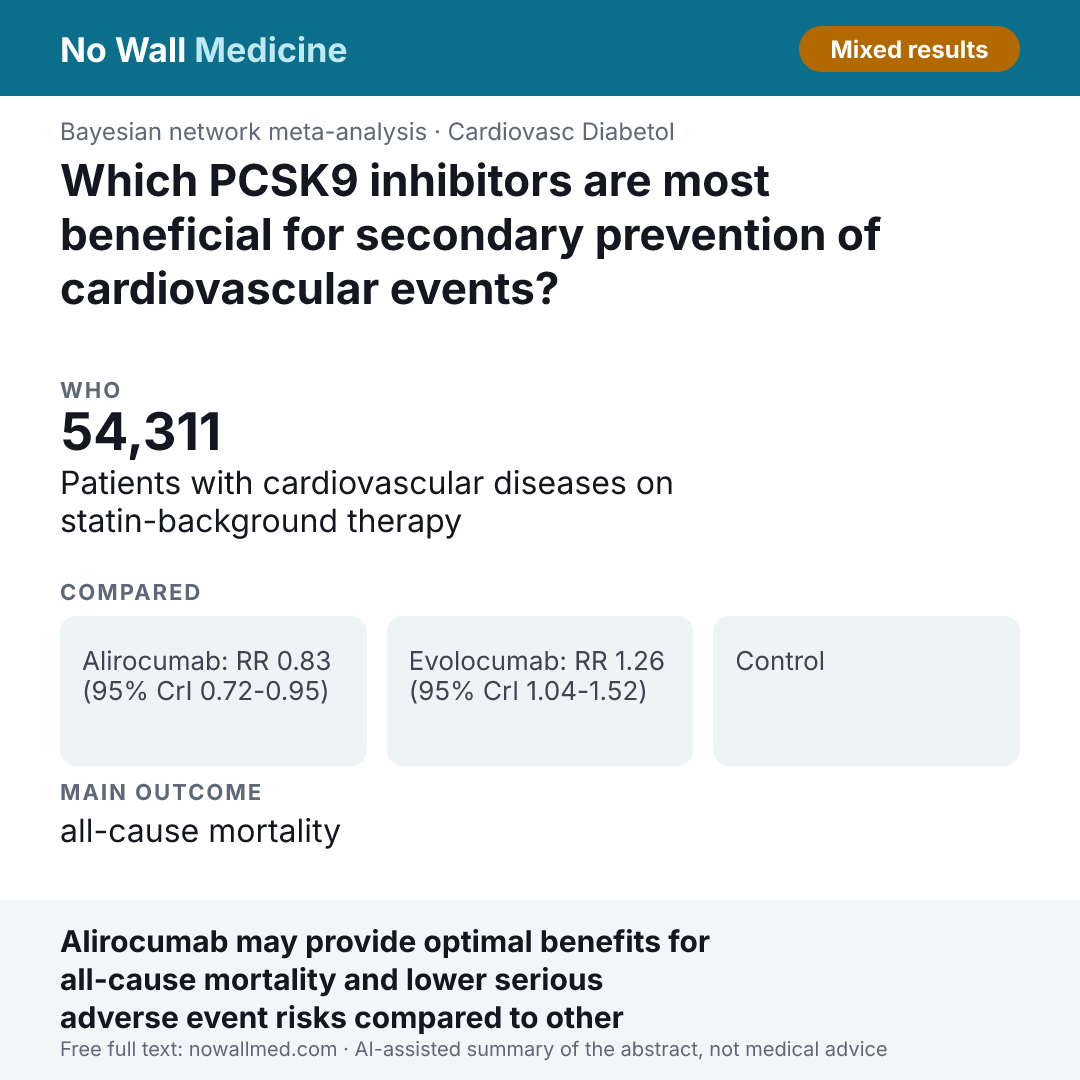
Clinical question: Which PCSK9 inhibitors are most beneficial for secondary prevention of cardiovascular events?
Why it matters: The optimal Proprotein Convertase Subtilisin/Kexin Type 9 inhibitor for secondary prevention in high-risk cardiovascular patients is currently unknown.
Key points
- Researchers analyzed nine randomized controlled trials involving 54,311 patients receiving different Proprotein Convertase Subtilisin/Kexin Type 9 inhibitors for secondary prevention of cardiovascular events.
- Alirocumab was associated with a reduction in all-cause mortality compared to control (RR 0.83, 95% CrI 0.72-0.95) and a lower risk of serious adverse events (RR 0.94, 95% CrI 0.90-0.99).
- Evolocumab was associated with increased all-cause mortality compared to alirocumab (RR 1.26, 95% CrI 1.04-1.52).
Headline and key points written with AI from the paper’s abstract, with every number checked against it. Read the paper before relying on them.
Was this summary helpful?
Subject terms
Headline, design, result, key points, caveat and citation as plain text.
Cite this article
Wang X, Wen D, Chen Y, Ma L, You C. PCSK9 inhibitors for secondary prevention in patients with cardiovascular diseases: a bayesian network meta-analysis. Cardiovasc Diabetol. 2022;21(1):107. doi:10.1186/s12933-022-01542-4
Spotted a mistake? Suggest a correction