Pelvic nerve monitoring was associated with better urinary function after rectal cancer surgery
Pelvic Intraoperative Neuromonitoring Prevents Dysfunction in Patients With Rectal Cancer: Results From a Multicenter, Randomized, Controlled Clinical Trial of a NEUROmonitoring System (NEUROS)
Randomized, controlled, multicenter clinical trialBenefit found
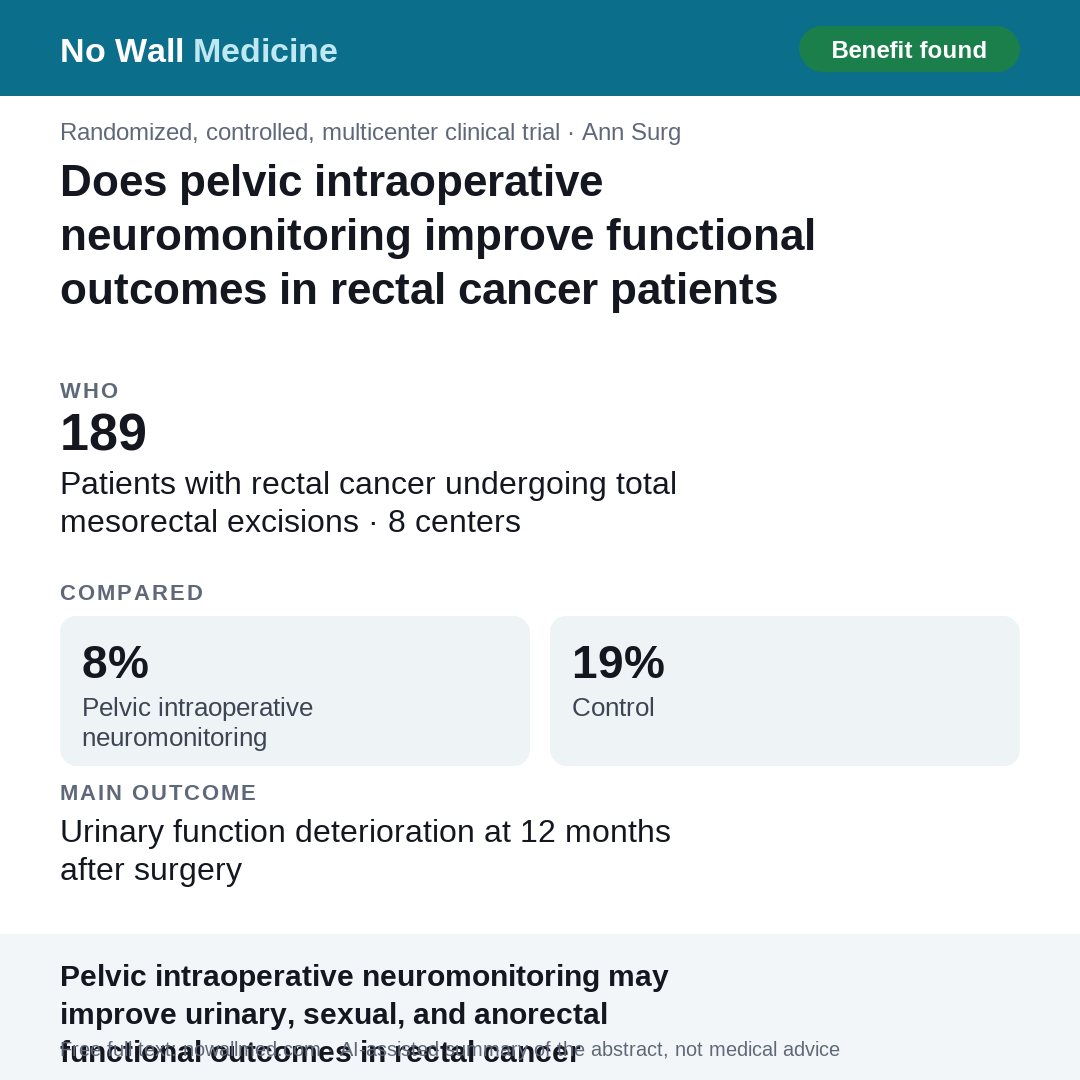
Does pelvic intraoperative neuromonitoring improve functional outcomes in rectal cancer patients undergoing total mesorectal excision?
Who
189
Patients with rectal cancer undergoing total mesorectal excisions · 8 centers
Compared
8%Pelvic intraoperative neuromonitoring
19%Control
Main outcome
Urinary function deterioration at 12 months after surgery
Result: 95% confidence interval, 12.4-94.4; P =0.0382
Bottom line: Pelvic intraoperative neuromonitoring may improve urinary, sexual, and anorectal functional outcomes in rectal cancer patients.
Ann Surg · 2022-09-30Download image
Clinical question: Does pelvic intraoperative neuromonitoring improve functional outcomes in rectal cancer patients undergoing total mesorectal excision?
Why it matters: High-level evidence is required to clarify whether pelvic intraoperative neuromonitoring improves urogenital and ano-rectal functional outcomes after rectal cancer surgery.
Key points
- Researchers conducted a multicenter randomized trial of 189 patients undergoing total mesorectal excision for rectal cancer.
- The use of pelvic intraoperative neuromonitoring was associated with an 8% rate of urinary deterioration compared to 19% in the control group.
- Pelvic nerve monitoring was also associated with better sexual and ano-rectal function, though serious adverse event rates were 41% in the monitoring group and 54% in the control group.
Headline and key points written with AI from the paper’s abstract, with every number checked against it. Read the paper before relying on them.
Was this summary helpful?
Subject terms
Cite this article
Kneist W, Ghadimi M, Runkel N, Moesta T, Coerper S, Benecke C. Pelvic Intraoperative Neuromonitoring Prevents Dysfunction in Patients With Rectal Cancer: Results From a Multicenter, Randomized, Controlled Clinical Trial of a NEUROmonitoring System (NEUROS). Ann Surg. 2022. doi:10.1097/SLA.0000000000005676
Spotted a mistake? Suggest a correction
Top studies every Monday
The week’s key trials and guidelines in your specialties, plus any topics you follow. By email, free.
Get the weekly digest