Deep learning algorithms show high accuracy for detecting and segmenting thyroid nodules in medical imaging
Performance Evaluation of Deep Learning for the Detection and Segmentation of Thyroid Nodules: Systematic Review and Meta-Analysis
Systematic review and meta-analysisBenefit found
How well do deep learning algorithms perform in thyroid nodule detection and segmentation?
Who
41
Thyroid nodules in 41 eligible studies
Compared
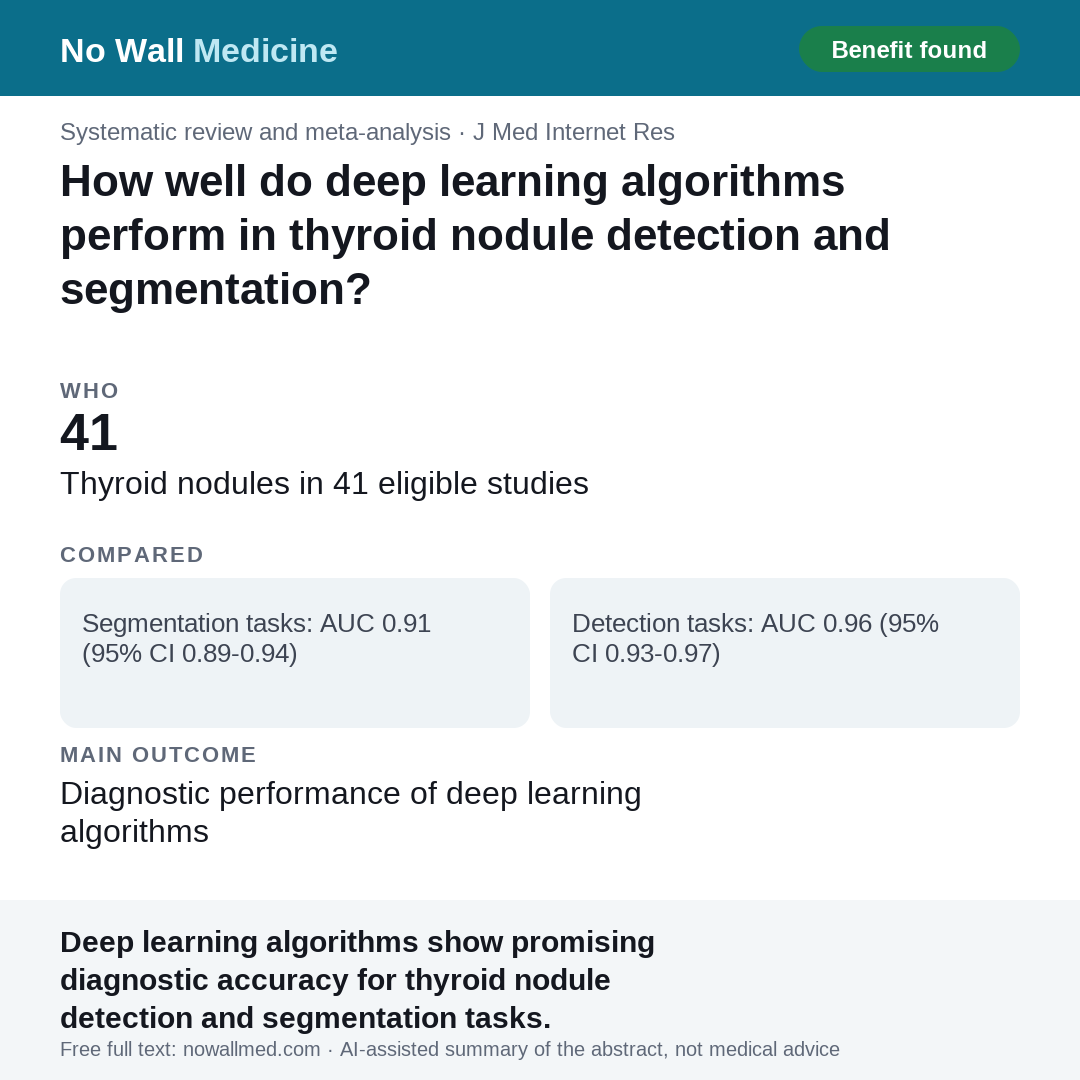
Segmentation tasks: AUC 0.91 (95% CI 0.89-0.94)
Detection tasks: AUC 0.96 (95% CI 0.93-0.97)
Main outcome
Diagnostic performance of deep learning algorithms
Bottom line: Deep learning algorithms show promising diagnostic accuracy for thyroid nodule detection and segmentation tasks.
Limitation: Suboptimal methodological design, inconsistent image quality, and insufficient external validation.
J Med Internet Res · 2025-08-14Download image
Clinical question: How well do deep learning algorithms perform in thyroid nodule detection and segmentation?
Why it matters: Existing studies on deep learning for thyroid nodule diagnosis show substantial heterogeneity and lack a comprehensive systematic evidence-based assessment.
Key points
- Researchers analyzed 41 studies to evaluate deep learning algorithms for the detection and segmentation of thyroid nodules.
- For segmentation tasks, the pooled sensitivity was 82%, specificity was 95%, and the area under the receiver operating characteristic curve was 0.91.
- For detection tasks, the pooled sensitivity was 91%, specificity was 89%, and the area under the receiver operating characteristic curve was 0.96.
Limitation the authors note: Current studies are limited by suboptimal methodological design, inconsistent image quality across datasets, and insufficient external validation.
Headline and key points written with AI from the paper’s abstract, with every number checked against it. Read the paper before relying on them.
Topics
Cite this article
Ni J, You Y, Wu X, Chen X, Wang J, Li Y. Performance Evaluation of Deep Learning for the Detection and Segmentation of Thyroid Nodules: Systematic Review and Meta-Analysis. J Med Internet Res. 2025. doi:10.2196/73516
Spotted a mistake? Suggest a correction