Multi-cancer early detection test performance measured across three annual screening rounds in the NHS-Galleri trial
Performance of a multi-cancer early detection test in the randomized controlled NHS-Galleri trial
Randomized controlled trialMixed results
What is the performance of a multi-cancer early detection test in population screening?
Who
142250
Participants aged 50-77 years · National Health Service setting
Compared
Intervention arm: 937 participants had multi-cancer early detection-detected primary cancers
Control arm
Main outcome
Secondary test performance endpoints among evaluable intervention arm participants
Bottom line: The multi-cancer early detection test showed varying sensitivity and positive predictive values across three annual screening rounds.
Nat Med · 2026-09-22Download image
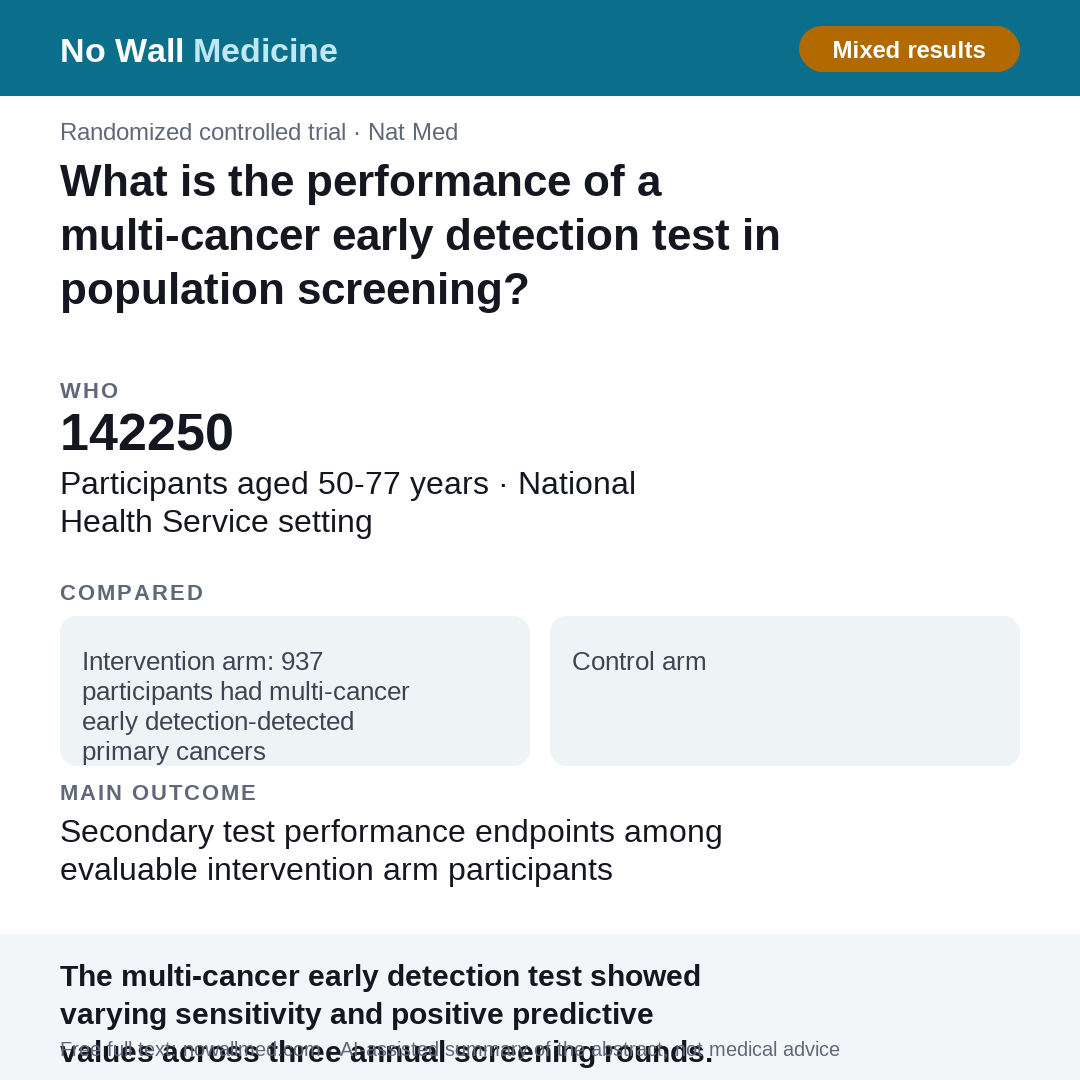
Clinical question: What is the performance of a multi-cancer early detection test in population screening?
Why it matters: Researchers sought to describe the performance of a multi-cancer early detection test when added to standard care in a population screening setting.
Key points
- Researchers studied 142,250 participants aged 50-77 years who were randomized to receive either a multi-cancer early detection test or usual care.
- Across three rounds, the test returned positive results for 1.03%, 0.80%, and 0.90% of participants, with 937 participants having detected primary cancers.
- The test showed an episode sensitivity for all cancers ranging from 26.7% to 37.2% and a cancer signal origin accuracy between 91.1% and 93.6%.
Headline and key points written with AI from the paper’s abstract, with every number checked against it. Read the paper before relying on them.
Topics
Spotted a mistake? Suggest a correction