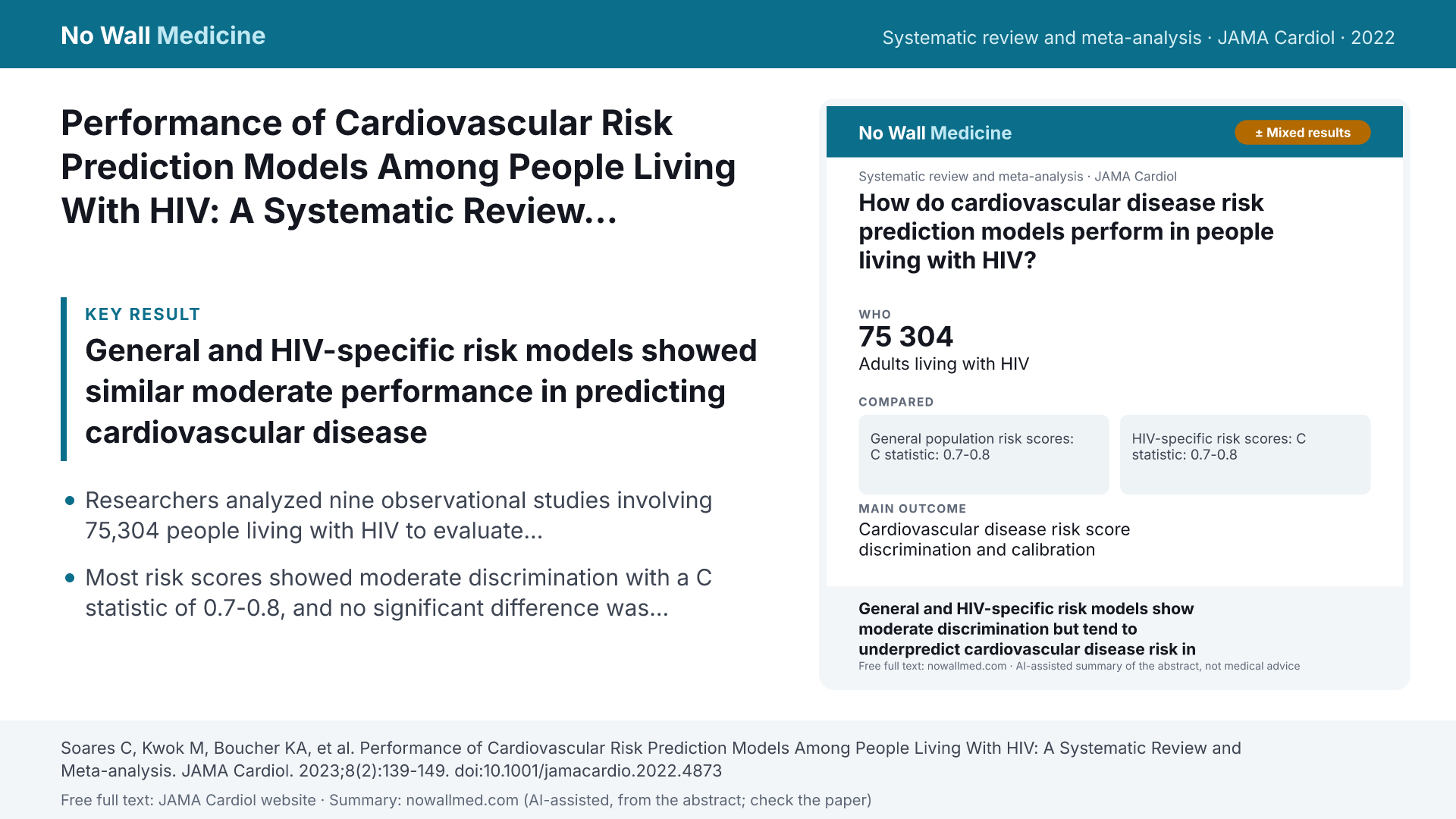
General and HIV-specific risk models showed similar moderate performance in predicting cardiovascular disease
Performance of Cardiovascular Risk Prediction Models Among People Living With HIV: A Systematic Review and Meta-analysis
Systematic review and meta-analysisMixed results
How do cardiovascular disease risk prediction models perform in people living with HIV?
Who
75 304
Adults living with HIV
Compared
General population risk scores: C statistic: 0.7-0.8
HIV-specific risk scores: C statistic: 0.7-0.8
Main outcome
Cardiovascular disease risk score discrimination and calibration
Bottom line: General and HIV-specific risk models show moderate discrimination but tend to underpredict cardiovascular disease risk in people living with HIV.
JAMA Cardiol · 2022-12-29Download image
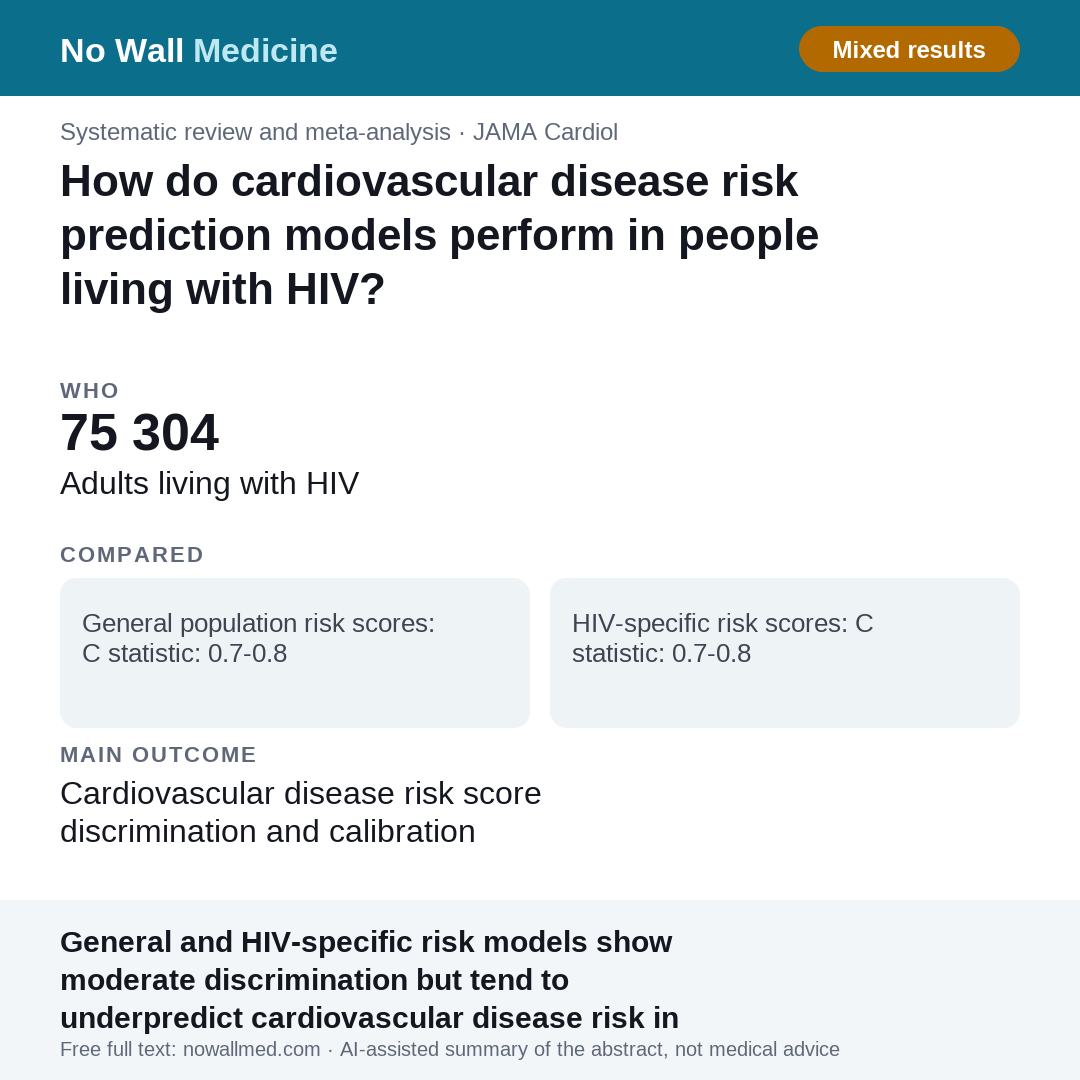
Clinical question: How do cardiovascular disease risk prediction models perform in people living with HIV?
Why it matters: It was unknown how well various cardiovascular disease risk prediction models perform specifically in people living with HIV.
Key points
- Researchers analyzed nine observational studies involving 75,304 people living with HIV to evaluate cardiovascular disease risk prediction scores.
- Most risk scores showed moderate discrimination with a C statistic of 0.7-0.8, and no significant difference was found between general and HIV-specific models.
- Most models tended to underpredict cardiovascular disease risk, though the Framingham Risk Score and Pooled Cohort Equation 10-year scores were better calibrated.
Limitation the authors note: There was substantial heterogeneity across the studies, and only a few studies contributed data for each risk score.
Headline and key points written with AI from the paper’s abstract, with every number checked against it. Read the paper before relying on them.
Was this summary helpful?
Subject terms
Cite this article
Soares C, Kwok M, Boucher KA, et al. Performance of Cardiovascular Risk Prediction Models Among People Living With HIV: A Systematic Review and Meta-analysis. JAMA Cardiol. 2022. doi:10.1001/jamacardio.2022.4873
Spotted a mistake? Suggest a correction