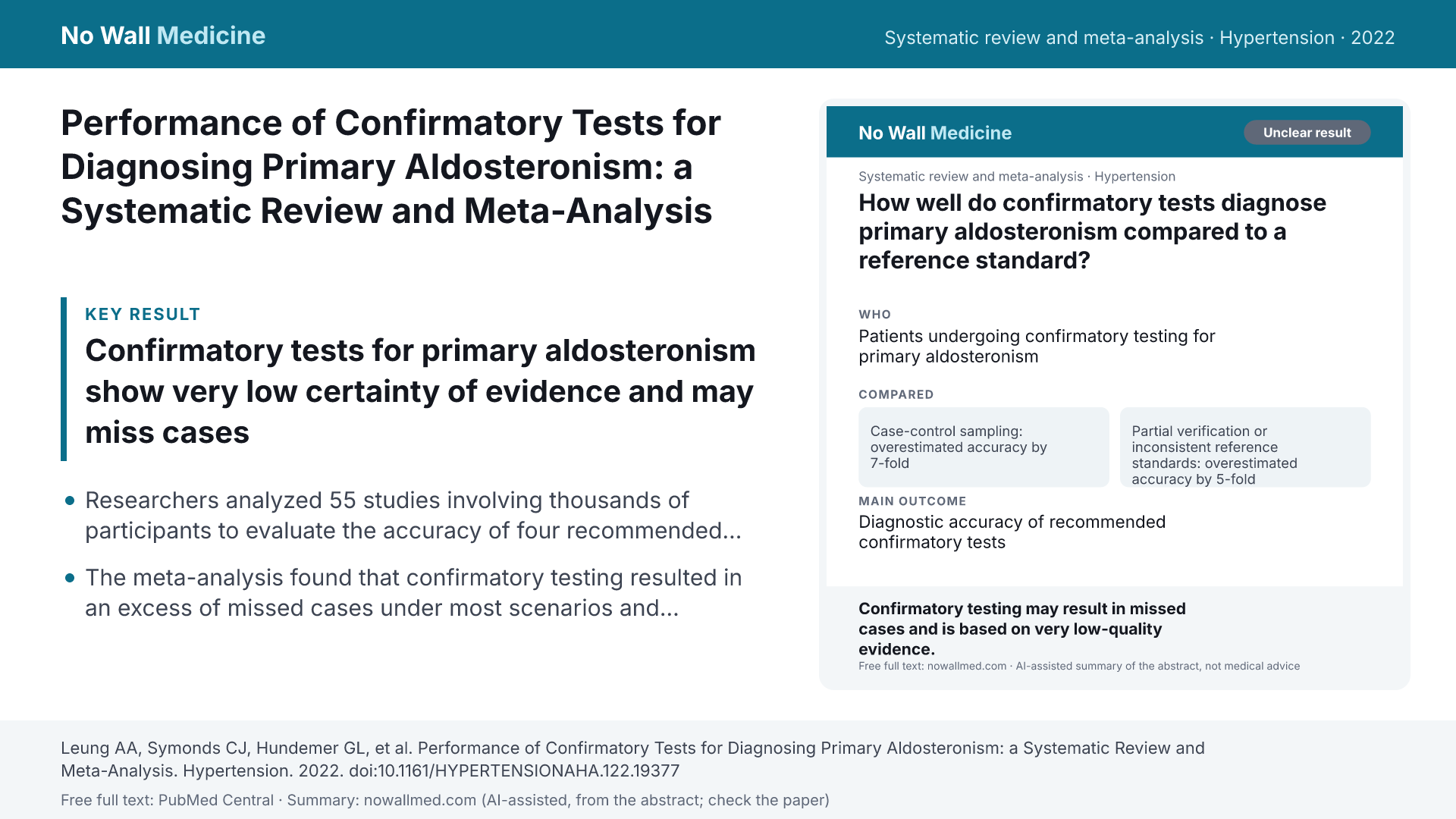
Confirmatory tests for primary aldosteronism show very low certainty of evidence and may miss cases
Performance of Confirmatory Tests for Diagnosing Primary Aldosteronism: a Systematic Review and Meta-Analysis
Systematic review and meta-analysisUnclear result
How well do confirmatory tests diagnose primary aldosteronism compared to a reference standard?
Who
Patients undergoing confirmatory testing for primary aldosteronism
Compared
Case-control sampling: overestimated accuracy by 7-fold
Partial verification or inconsistent reference standards: overestimated accuracy by 5-fold
Main outcome
Diagnostic accuracy of recommended confirmatory tests
Result: relative diagnostic odds ratio 7.26 (95% CI 2.46-21.43)
Bottom line: Confirmatory testing may result in missed cases and is based on very low-quality evidence.
Limitation: High risk of bias and very low certainty of evidence across studies.
Hypertension · 2022-06-02Download image
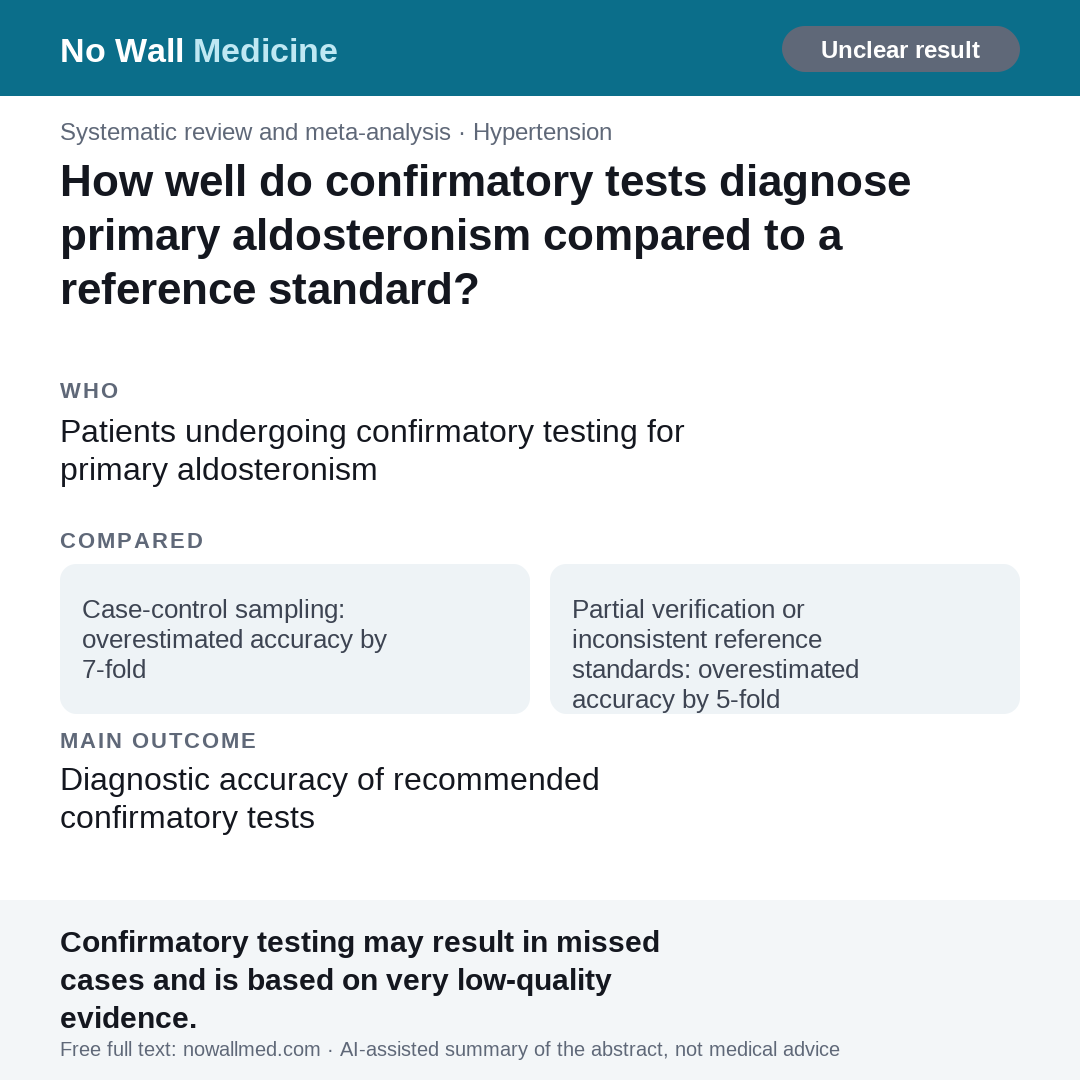
Clinical question: How well do confirmatory tests diagnose primary aldosteronism compared to a reference standard?
Why it matters: The supporting evidence for using recommended confirmatory tests to diagnose primary aldosteronism is currently unclear.
Key points
- Researchers analyzed 55 studies involving thousands of participants to evaluate the accuracy of four recommended tests for primary aldosteronism, a condition of hormone overproduction.
- The meta-analysis found that confirmatory testing resulted in an excess of missed cases under most scenarios and the certainty of evidence was very low.
- Studies using case-control sampling overestimated accuracy by 7.26 times, while those using partial verification overestimated accuracy by 5.12 times.
Limitation the authors note: The risk of bias was high in more than half of the studies across all domains.
Headline and key points written with AI from the paper’s abstract, with every number checked against it. Read the paper before relying on them.
Was this summary helpful?
Subject terms
Cite this article
Leung AA, Symonds CJ, Hundemer GL, et al. Performance of Confirmatory Tests for Diagnosing Primary Aldosteronism: a Systematic Review and Meta-Analysis. Hypertension. 2022. doi:10.1161/HYPERTENSIONAHA.122.19377
Spotted a mistake? Suggest a correction