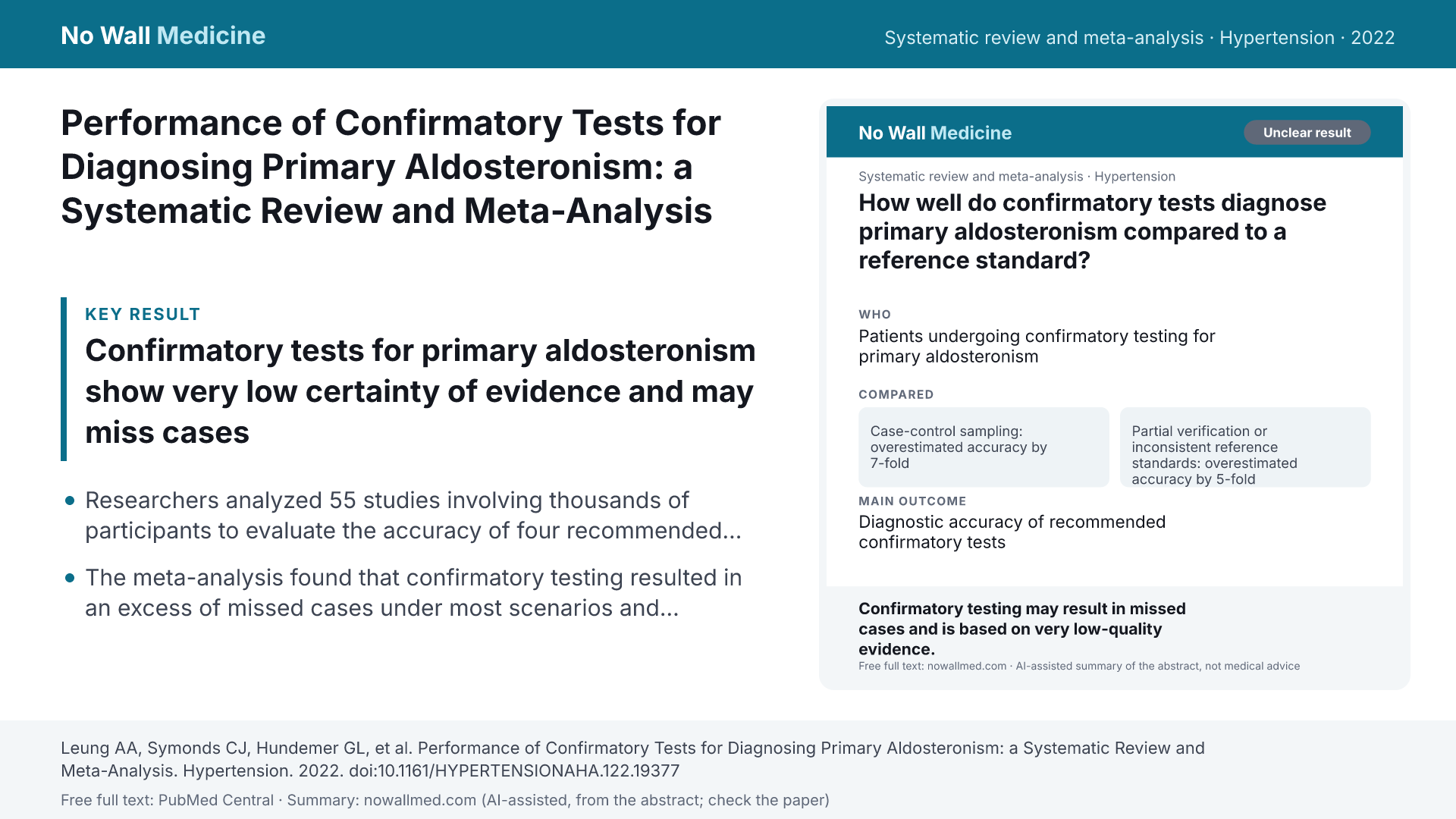
Performance of Confirmatory Tests for Diagnosing Primary Aldosteronism: a Systematic Review and Meta-Analysis
Key result: Confirmatory tests for primary aldosteronism show very low certainty of evidence and may miss cases
Key points
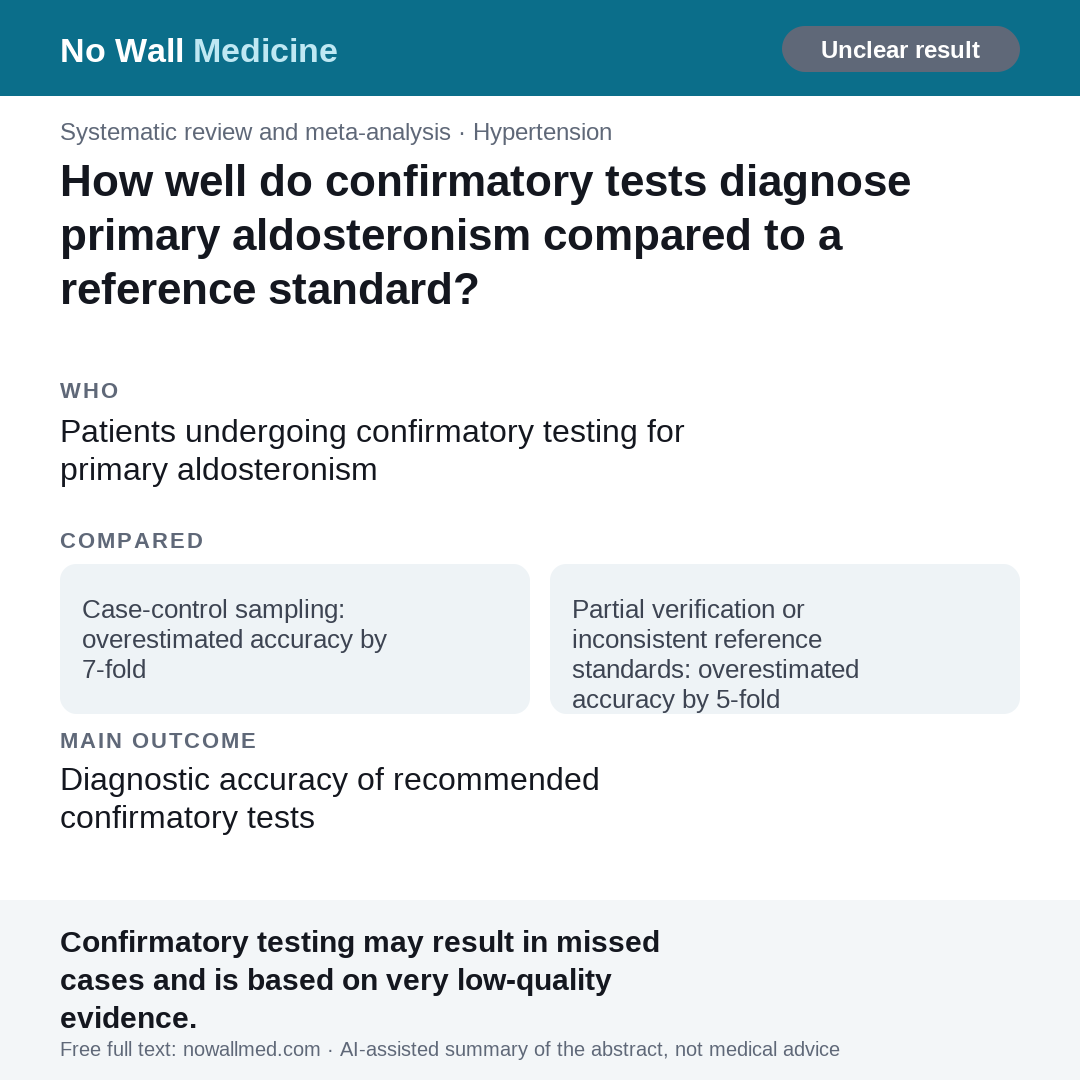
- Researchers analyzed 55 studies involving thousands of participants to evaluate the accuracy of four recommended tests for primary aldosteronism, a condition of hormone overproduction.
- The meta-analysis found that confirmatory testing resulted in an excess of missed cases under most scenarios and the certainty of evidence was very low.
- Studies using case-control sampling overestimated accuracy by 7.26 times, while those using partial verification overestimated accuracy by 5.12 times.
Why it matters: The supporting evidence for using recommended confirmatory tests to diagnose primary aldosteronism is currently unclear.
Limitation the authors note: The risk of bias was high in more than half of the studies across all domains.
Discussion prompts
- Would these patients look like yours? Who was left out?
- Is the main outcome one that matters to patients?
- Is the difference large enough to change what you do?
Cite: Leung AA, Symonds CJ, Hundemer GL, et al. Performance of Confirmatory Tests for Diagnosing Primary Aldosteronism: a Systematic Review and Meta-Analysis. Hypertension. 2022. doi:10.1161/HYPERTENSIONAHA.122.19377
Free full text: PubMed Central · Summary and visual abstract: nowallmed.com/a/performance-of-confirmatory-tests-for-diagnosing-primary-1gb68jo/ (AI-assisted from the abstract; check the paper before relying on it).