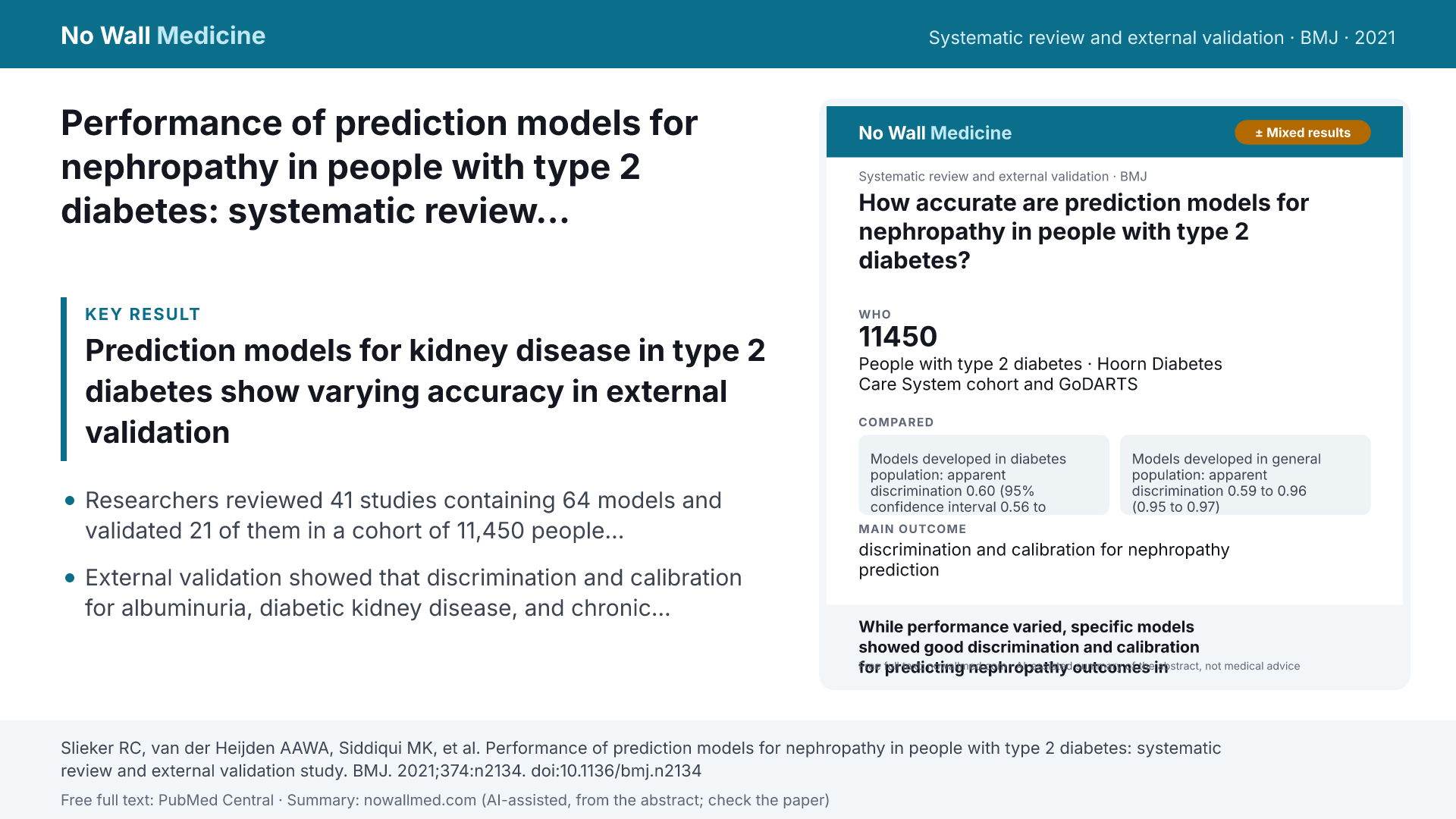
Prediction models for kidney disease in type 2 diabetes show varying accuracy in external validation
Performance of prediction models for nephropathy in people with type 2 diabetes: systematic review and external validation study
Systematic review and external validationMixed results
How accurate are prediction models for nephropathy in people with type 2 diabetes?
Who
11450
People with type 2 diabetes · Hoorn Diabetes Care System cohort and GoDARTS
Compared
Models developed in diabetes population: apparent discrimination 0.60 (95% confidence interval 0.56 to 0.64) to 0.99
Models developed in general population: apparent discrimination 0.59 to 0.96 (0.95 to 0.97)
Main outcome
discrimination and calibration for nephropathy prediction
Bottom line: While performance varied, specific models showed good discrimination and calibration for predicting nephropathy outcomes in clinical settings.
BMJ · 2021-09-28Download image
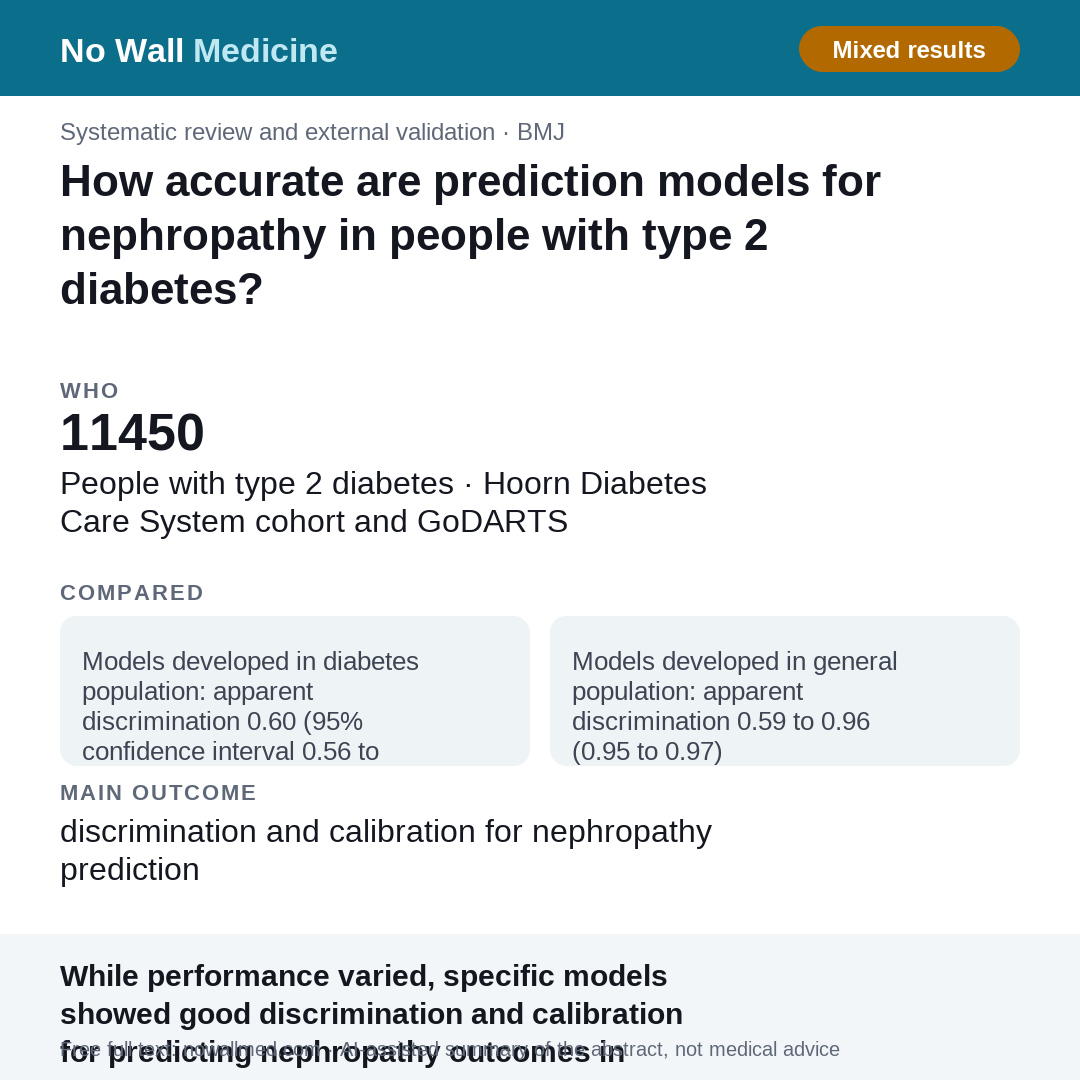
Clinical question: How accurate are prediction models for nephropathy in people with type 2 diabetes?
Why it matters: It was unknown how accurately existing prognostic models for kidney disease in people with type 2 diabetes perform when applied to different patient groups.
Key points
- Researchers reviewed 41 studies containing 64 models and validated 21 of them in a cohort of 11,450 people with diabetes.
- External validation showed that discrimination and calibration for albuminuria, diabetic kidney disease, and chronic kidney disease varied across different time periods and models.
- At least two models for each outcome achieved C statistics >0.8, which indicates excellent discrimination for predicting kidney-related risks.
Headline and key points written with AI from the paper’s abstract, with every number checked against it. Read the paper before relying on them.
Was this summary helpful?
Abstract
Objectives
To identify and assess the quality and accuracy of prognostic models for nephropathy and to validate these models in external cohorts of people with type 2 diabetes. Design
Systematic review and external validation. Data sources
PubMed and Embase. Eligibility criteria
Studies describing the development of a model to predict the risk of nephropathy, applicable to people with type 2 diabetes. Methods
Screening, data extraction, and risk of bias assessment were done in duplicate. Eligible models were externally validated in the Hoorn Diabetes Care System (DCS) cohort (n=11 450) for the same outcomes for which they were developed. Risks of nephropathy were calculated and compared with observed risk over 2, 5, and 10 years of follow-up. Model performance was assessed based on intercept adjusted calibration and discrimination (Harrell's C statistic). Results
41 studies included in the systematic review reported 64 models, 46 of which were developed in a population with diabetes and 18 in the general population including diabetes as a predictor. The predicted outcomes included albuminuria, diabetic kidney disease, chronic kidney disease (general population), and end stage renal disease. The reported apparent discrimination of the 46 models varied considerably across the different predicted outcomes, from 0.60 (95% confidence interval 0.56 to 0.64) to 0.99 (not available) for the models developed in a diabetes population and from 0.59 (not available) to 0.96 (0.95 to 0.97) for the models developed in the general population. Calibration was reported in 31 of the 41 studies, and the models were generally well calibrated. 21 of the 64 retrieved models were externally validated in the Hoorn DCS cohort for predicting risk of albuminuria, diabetic kidney disease, and chronic kidney disease, with considerable variation in performance across prediction horizons and models. For all three outcomes, however, at least two models had C statistics >0.8, indicating excellent discrimination. In a secondary external validation in GoDARTS (Genetics of Diabetes Audit and Research in Tayside Scotland), models developed for diabetic kidney disease outperformed those for chronic kidney disease. Models were generally well calibrated across all three prediction horizons. Conclusions
This study identified multiple prediction models to predict albuminuria, diabetic kidney disease, chronic kidney disease, and end stage renal disease. In the external validation, discrimination and calibration for albuminuria, diabetic kidney disease, and chronic kidney disease varied considerably across prediction horizons and models. For each outcome, however, specific models showed good discrimination and calibration across the three prediction horizons, with clinically accessible predictors, making them applicable in a clinical setting. Systematic review registration
PROSPERO CRD42020192831.
Abstract reproduced under the article’s CC BY NC licence.
Subject terms
Cite this article
Slieker RC, van der Heijden AAWA, Siddiqui MK, Langendoen-Gort M, Nijpels G, Herings R. Performance of prediction models for nephropathy in people with type 2 diabetes: systematic review and external validation study. BMJ. 2021. doi:10.1136/bmj.n2134
Spotted a mistake? Suggest a correction