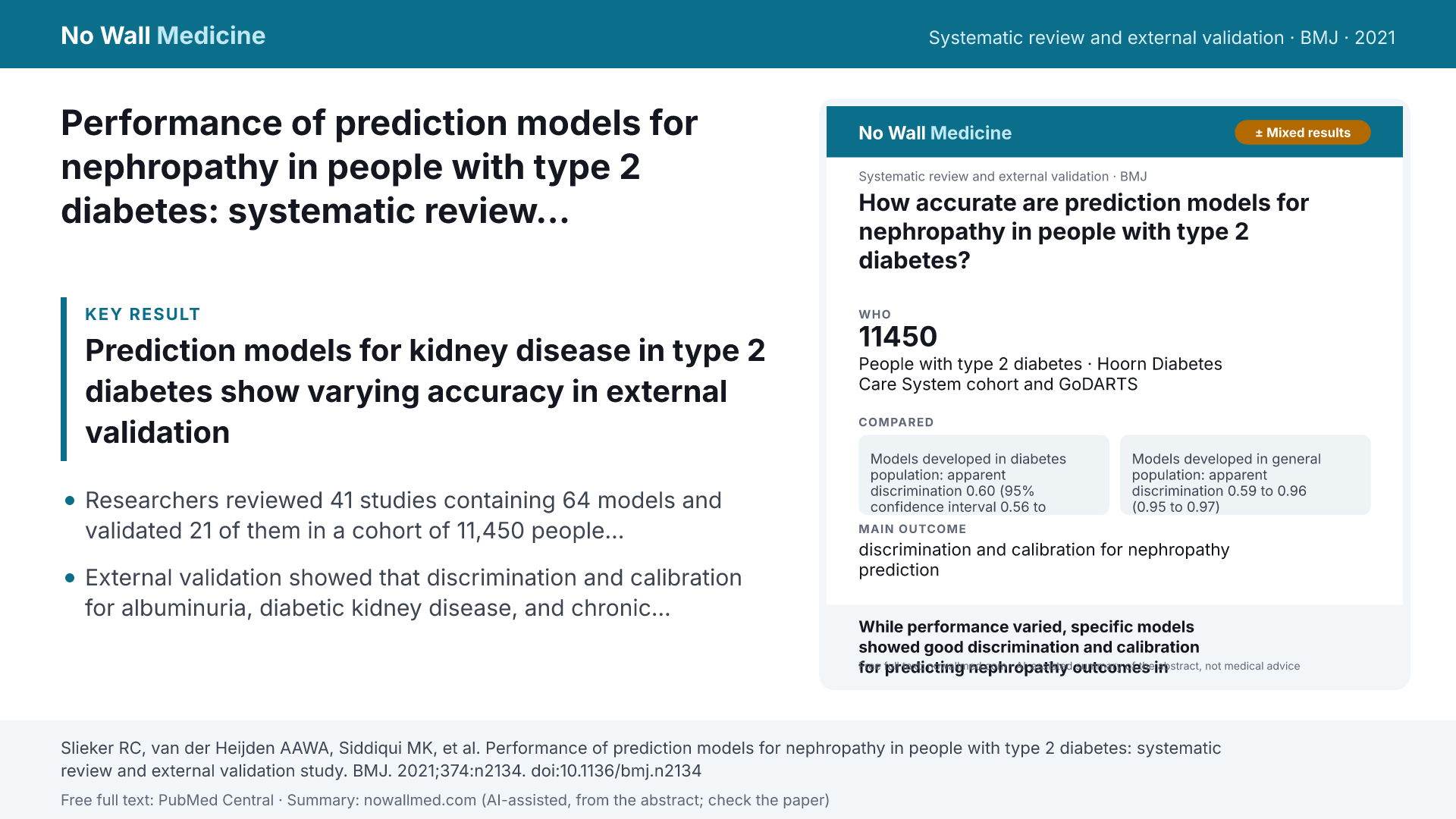
Performance of prediction models for nephropathy in people with type 2 diabetes: systematic review and external validation study
Key result: Prediction models for kidney disease in type 2 diabetes show varying accuracy in external validation
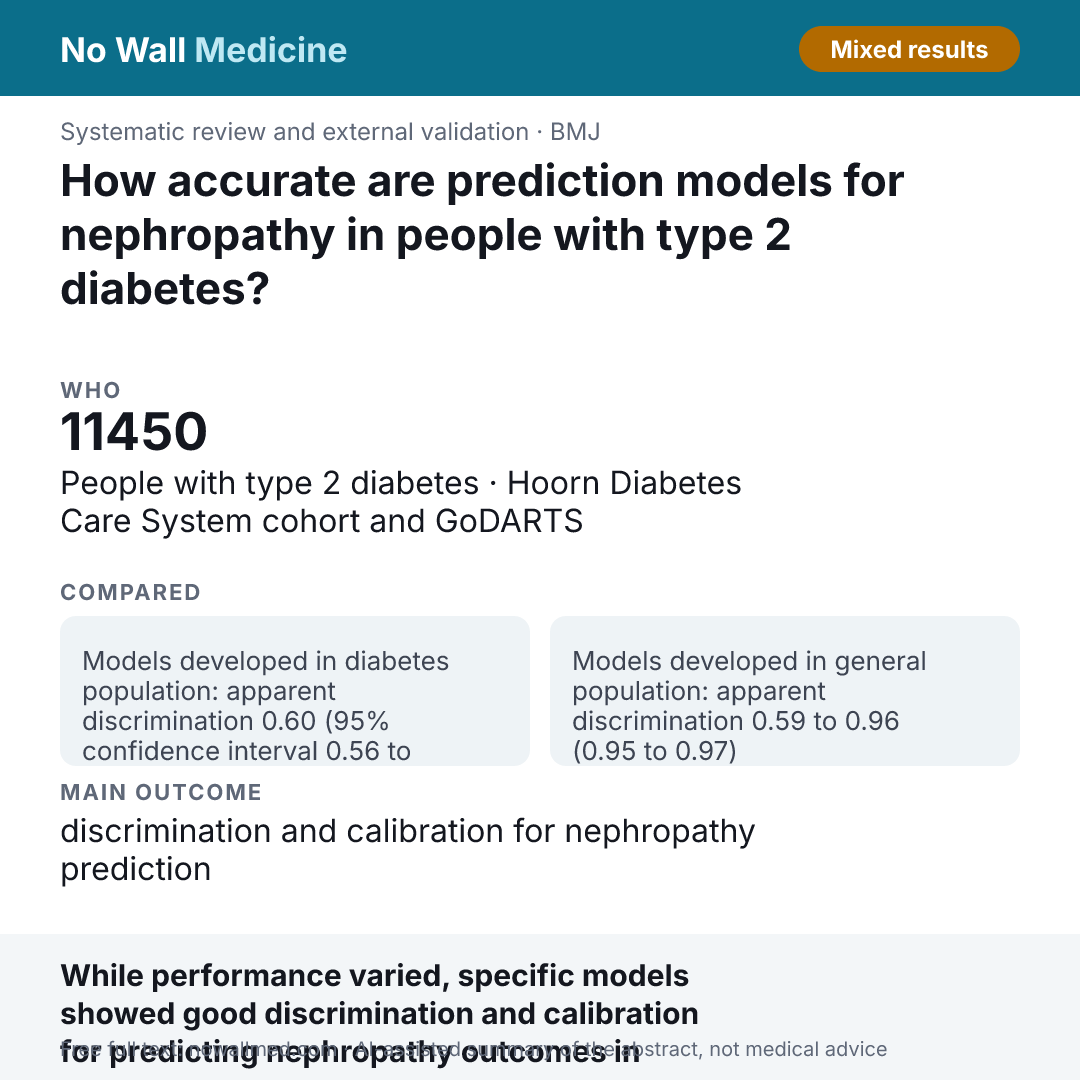
Systematic review and external validationMixed results
How accurate are prediction models for nephropathy in people with type 2 diabetes?
Who
11450
People with type 2 diabetes · Hoorn Diabetes Care System cohort and GoDARTS
Compared
Models developed in diabetes population: apparent discrimination 0.60 (95% confidence interval 0.56 to 0.64) to 0.99
Models developed in general population: apparent discrimination 0.59 to 0.96 (0.95 to 0.97)
Main outcome
discrimination and calibration for nephropathy prediction
Bottom line: While performance varied, specific models showed good discrimination and calibration for predicting nephropathy outcomes in clinical settings.
BMJ · 2021-09-28 · Save PNG
Key points
- Researchers reviewed 41 studies containing 64 models and validated 21 of them in a cohort of 11,450 people with diabetes.
- External validation showed that discrimination and calibration for albuminuria, diabetic kidney disease, and chronic kidney disease varied across different time periods and models.
- At least two models for each outcome achieved C statistics >0.8, which indicates excellent discrimination for predicting kidney-related risks.
Discussion prompts
- Would these patients look like yours? Who was left out?
- Is the main outcome one that matters to patients?
- Is the difference large enough to change what you do?
Cite: Slieker RC, van der Heijden AAWA, Siddiqui MK, et al. Performance of prediction models for nephropathy in people with type 2 diabetes: systematic review and external validation study. BMJ. 2021;374:n2134. doi:10.1136/bmj.n2134
Free full text: PubMed Central · Summary and visual abstract: nowallmed.com/a/performance-of-prediction-models-for-nephropathy-in-people-with-type-1jwexnp/ (AI-assisted from the abstract; check the paper before relying on it).