Perineural invasion in prostate cancer specimens is linked to higher recurrence and lower survival
Perineural Invasion in Radical Prostatectomy Specimens and Its Association with Biochemical Recurrence and Survival in Prostate Cancer: A Systematic Review and Meta-analysis
Systematic review and meta-analysisHarm found
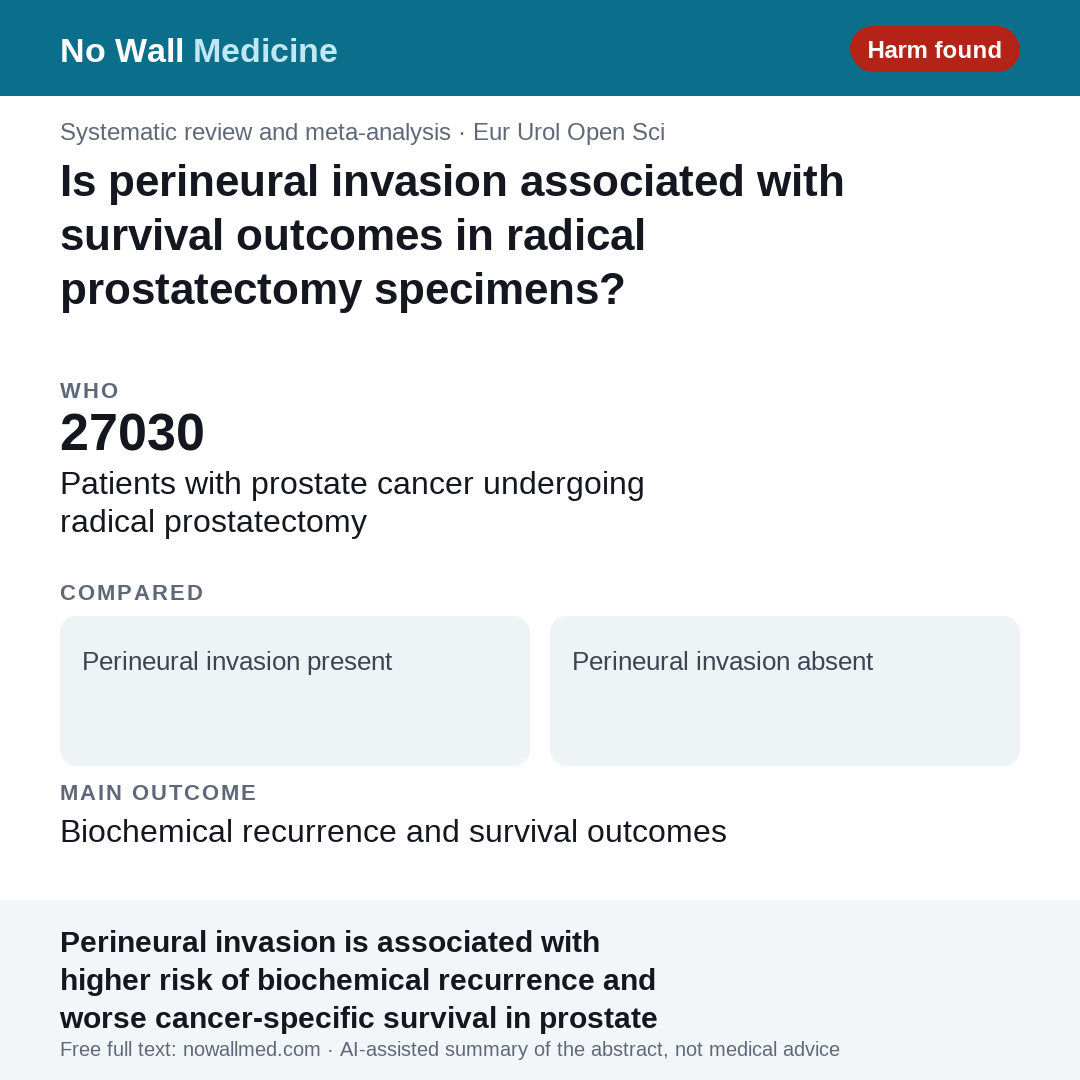
Is perineural invasion associated with survival outcomes in radical prostatectomy specimens?
Who
27030
Patients with prostate cancer undergoing radical prostatectomy
Compared
Perineural invasion present
Perineural invasion absent
Main outcome
Biochemical recurrence and survival outcomes
Result: hazard ratio 1.40 (95% CI 1.28-1.52)
Bottom line: Perineural invasion is associated with higher risk of biochemical recurrence and worse cancer-specific survival in prostate cancer.
Limitation: Reliance on predominantly retrospective studies with small samples and high risk of bias.
Eur Urol Open Sci · 2026-02-12Download image
Clinical question: Is perineural invasion associated with survival outcomes in radical prostatectomy specimens?
Why it matters: Researchers sought to evaluate how the presence of cancer cells around nerves in prostate removal specimens relates to survival and recurrence outcomes.
Key points
- Researchers analyzed 58 studies involving 27,030 patients to evaluate how cancer cells surrounding nerves affect outcomes after prostate removal surgery.
- Perineural invasion was associated with biochemical recurrence, which is a rise in cancer markers in the blood, with a pooled hazard ratio of 1.40.
- The presence of cancer cells around nerves was also linked to worse cancer-specific survival, though the association with disease-free survival was not statistically significant.
Limitation the authors note: The authors state the findings rely on predominantly retrospective studies with small samples and a high risk of bias.
Headline and key points written with AI from the paper’s abstract, with every number checked against it. Read the paper before relying on them.
Cite this article
Karwacki J, Klasen K, Wojdyło L, Kaczorowski M, Gurwin A, Hałoń A. Perineural Invasion in Radical Prostatectomy Specimens and Its Association with Biochemical Recurrence and Survival in Prostate Cancer: A Systematic Review and Meta-analysis. Eur Urol Open Sci. 2026. doi:10.1016/j.euros.2026.01.018
Spotted a mistake? Suggest a correction