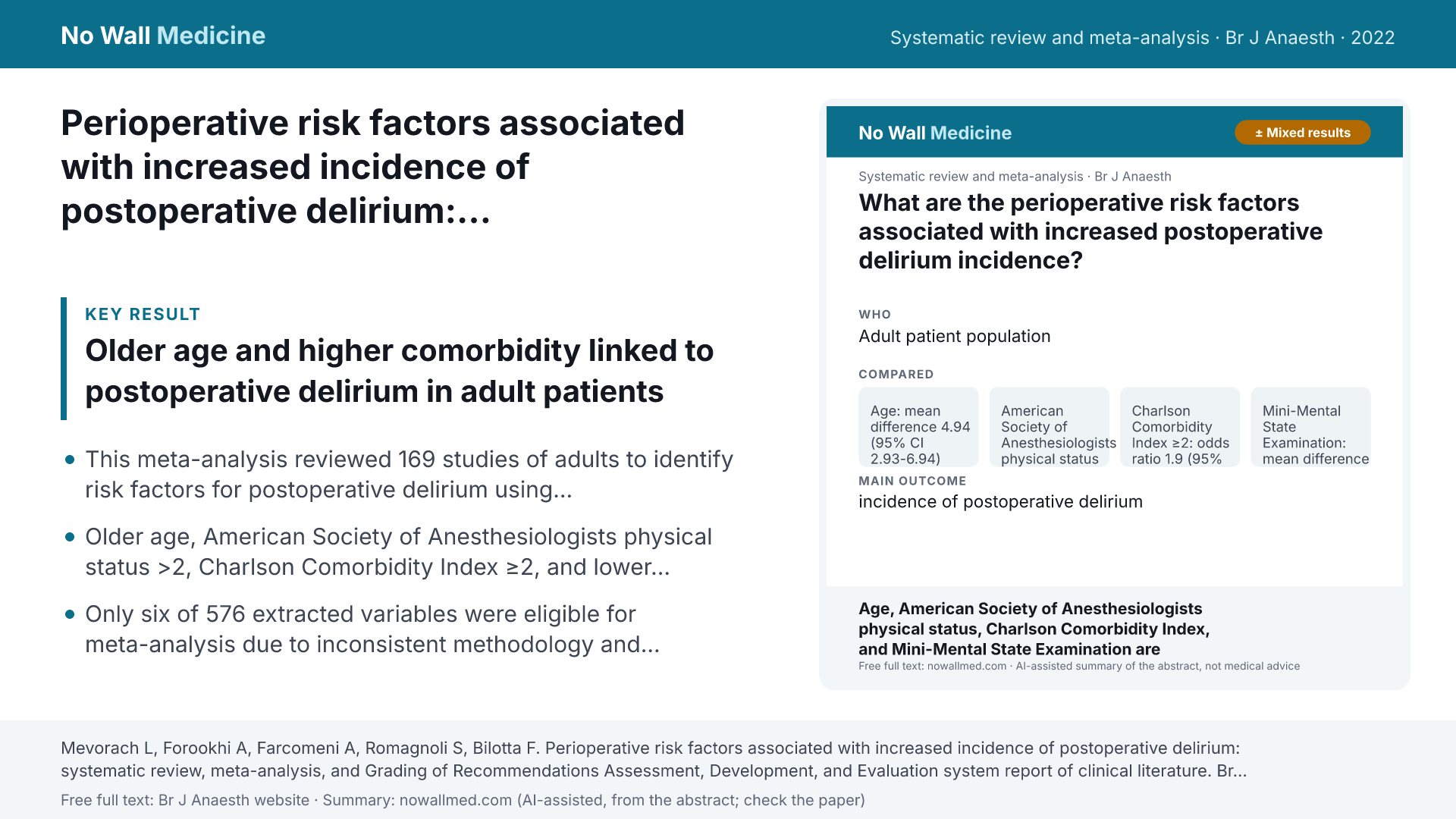
Older age and higher comorbidity linked to postoperative delirium in adult patients
Perioperative risk factors associated with increased incidence of postoperative delirium: systematic review, meta-analysis, and Grading of Recommendations Assessment, Development, and Evaluation system report of clinical literature
Systematic review and meta-analysisMixed results
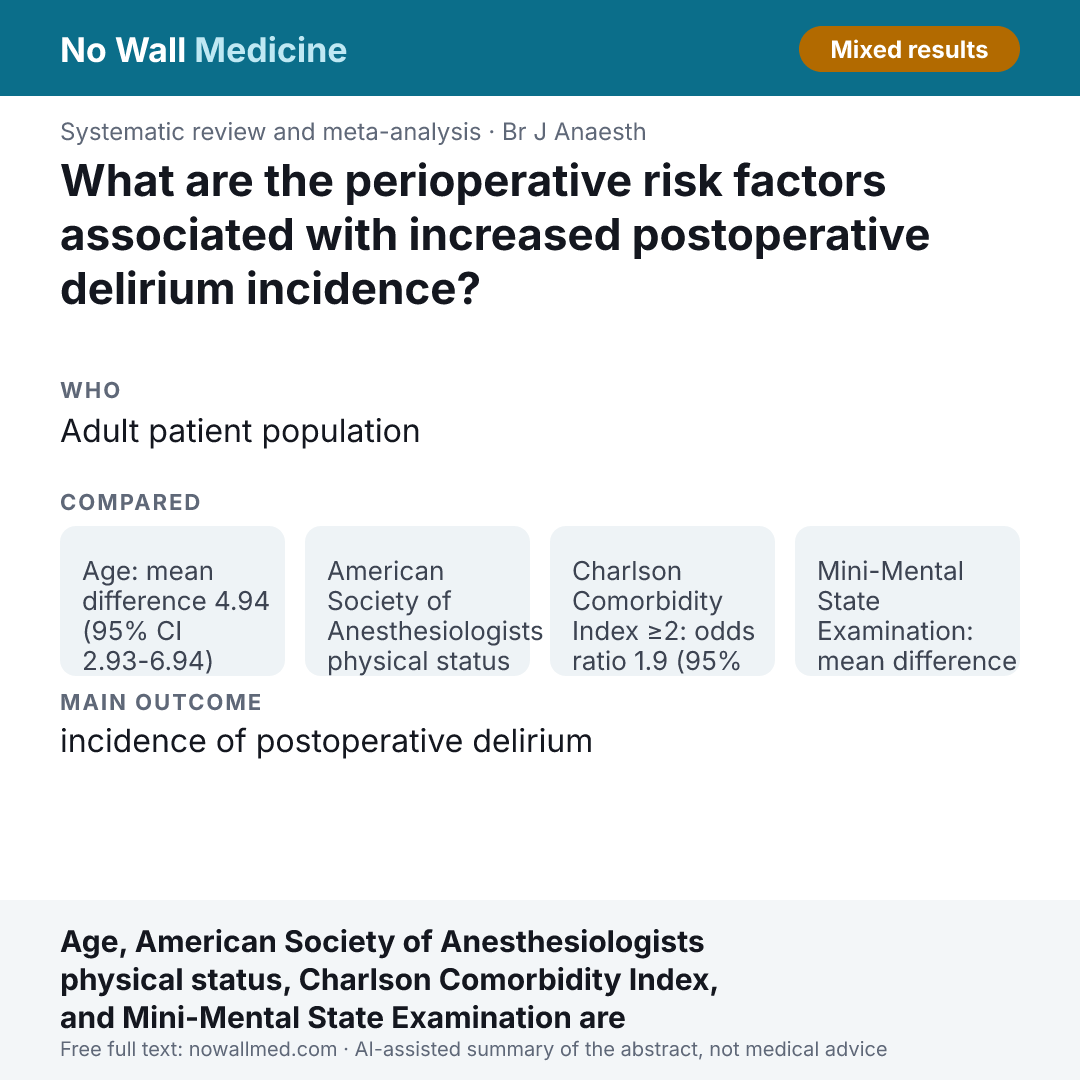
What are the perioperative risk factors associated with increased postoperative delirium incidence?
Who
Adult patient population
Compared
Age: mean difference 4.94 (95% CI 2.93-6.94)
American Society of Anesthesiologists physical status >2: odds ratio 2.27 (95% CI 1.47-3.52)
Charlson Comorbidity Index ≥2: odds ratio 1.9 (95% CI 1.11-3.25)
Mini-Mental State Examination: mean difference -1.94 (95% CI -3.6 to -0.27)
Main outcome
incidence of postoperative delirium
Bottom line: Age, American Society of Anesthesiologists physical status, Charlson Comorbidity Index, and Mini-Mental State Examination are significant risk factors.
Limitation: Inconsistent methodology and heterogeneous study designs lead to challenges in interpretation.
Br J Anaesth · 2022-07-07 · Save PNG
Clinical question: What are the perioperative risk factors associated with increased postoperative delirium incidence?
Why it matters: Applies to adult surgical patients; identifies specific preoperative factors associated with delirium risk to aid clinical decision-making and patient identification.
Key points
- This meta-analysis reviewed 169 studies of adults to identify risk factors for postoperative delirium using validated diagnostic scales.
- Older age, American Society of Anesthesiologists physical status >2, Charlson Comorbidity Index ≥2, and lower Mini-Mental State Examination scores were linked to delirium.
- Only six of 576 extracted variables were eligible for meta-analysis due to inconsistent methodology and reporting across the included studies.
Limitation the authors note: The authors noted inconsistent methodology and reporting in the literature, which created challenges in interpreting the results.
Headline and key points written with AI from the paper’s abstract, with every number checked against it. Read the paper before relying on them.
Was this summary helpful?
Subject terms
Headline, design, result, key points, caveat and citation as plain text.
Cite this article
Mevorach L, Forookhi A, Farcomeni A, Romagnoli S, Bilotta F. Perioperative risk factors associated with increased incidence of postoperative delirium: systematic review, meta-analysis, and Grading of Recommendations Assessment, Development, and Evaluation system report of clinical literature. Br J Anaesth. 2023;130(2):e254-e262. doi:10.1016/j.bja.2022.05.032
Spotted a mistake? Suggest a correction