Mass spectrometry in blood samples predicts survival outcomes for patients with newly diagnosed multiple myeloma
Peripheral Measurable Residual Disease Activity Assessment by MALDI-TOF Mass Spectrometry in Patients With Newly Diagnosed Multiple Myeloma in the Phase III GMMG-HD7 Trial
Phase III trial analysisBenefit found
Does mass spectrometry detect measurable residual disease activity in newly diagnosed multiple myeloma?
Who
617
Patients with newly diagnosed multiple myeloma · GMMG-HD7 trial
Compared
Mass spectrometry negative: superior progression-free survival
Mass spectrometry positive
Main outcome
progression-free survival
Result: hazard ratio 0.25 (95% CI 0.15 to 0.43)
Bottom line: Serum mass spectrometry is a sensitive biomarker where negativity is associated with superior progression-free survival.
J Clin Oncol · 2026-05-21Download image
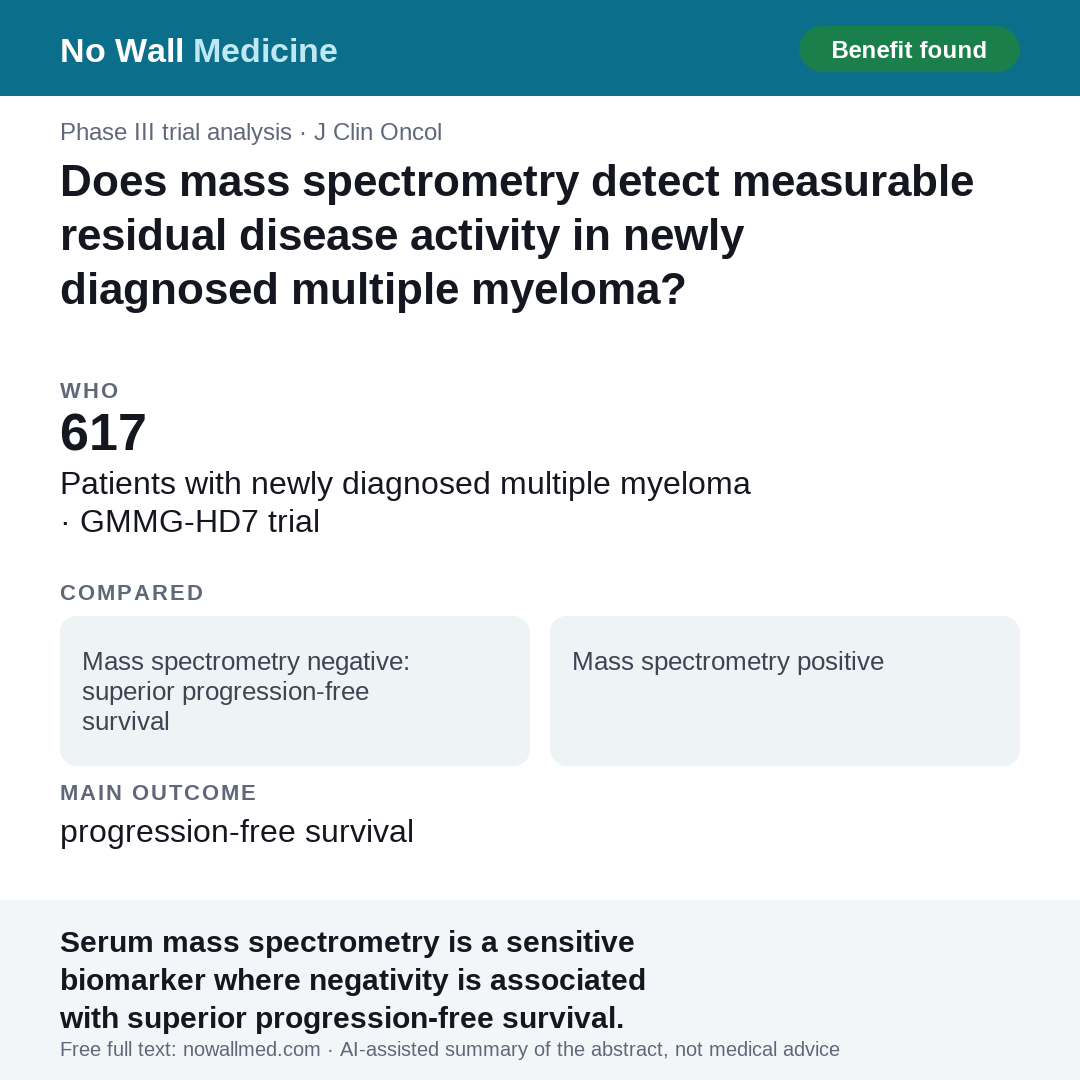
Clinical question: Does mass spectrometry detect measurable residual disease activity in newly diagnosed multiple myeloma?
Why it matters: Large prospective evaluations are limited regarding the use of mass spectrometry as a minimally invasive way to detect monoclonal proteins in multiple myeloma.
Key points
- Researchers analyzed 3,301 serum samples from 617 patients in the phase III GMMG-HD7 trial to evaluate mass spectrometry for detecting residual disease.
- Patients who tested negative via mass spectrometry had better progression-free survival, with a hazard ratio of 0.25 at 12 months of maintenance.
- Combining mass spectrometry with bone marrow measurable residual disease testing improved risk stratification, as patients positive for both had the worst survival outcomes.
Headline and key points written with AI from the paper’s abstract, with every number checked against it. Read the paper before relying on them.
Topics
Spotted a mistake? Suggest a correction