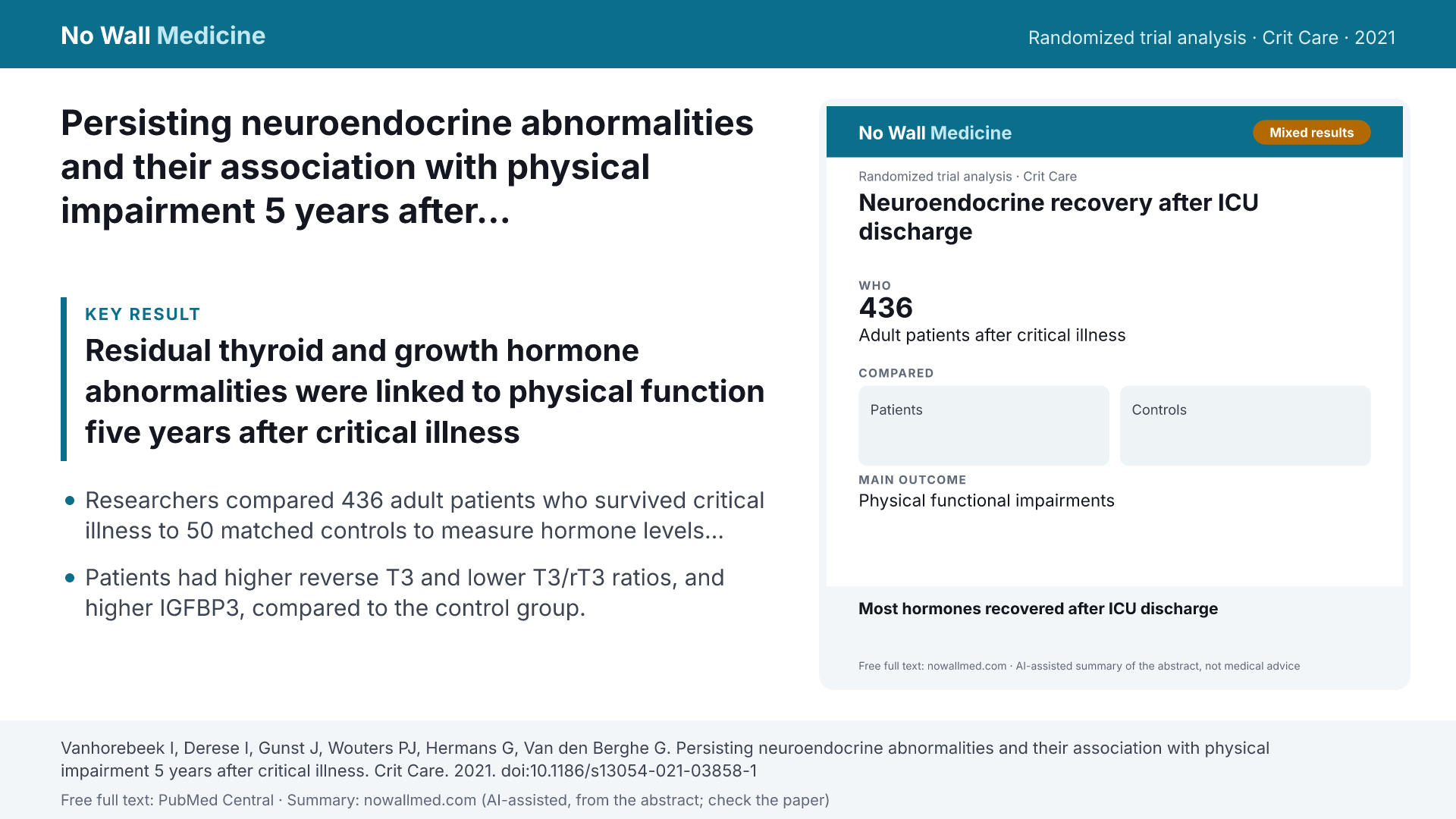
Persisting neuroendocrine abnormalities and their association with physical impairment 5 years after critical illness
Key result: Residual thyroid and growth hormone abnormalities were linked to physical function five years after critical illness
Key points
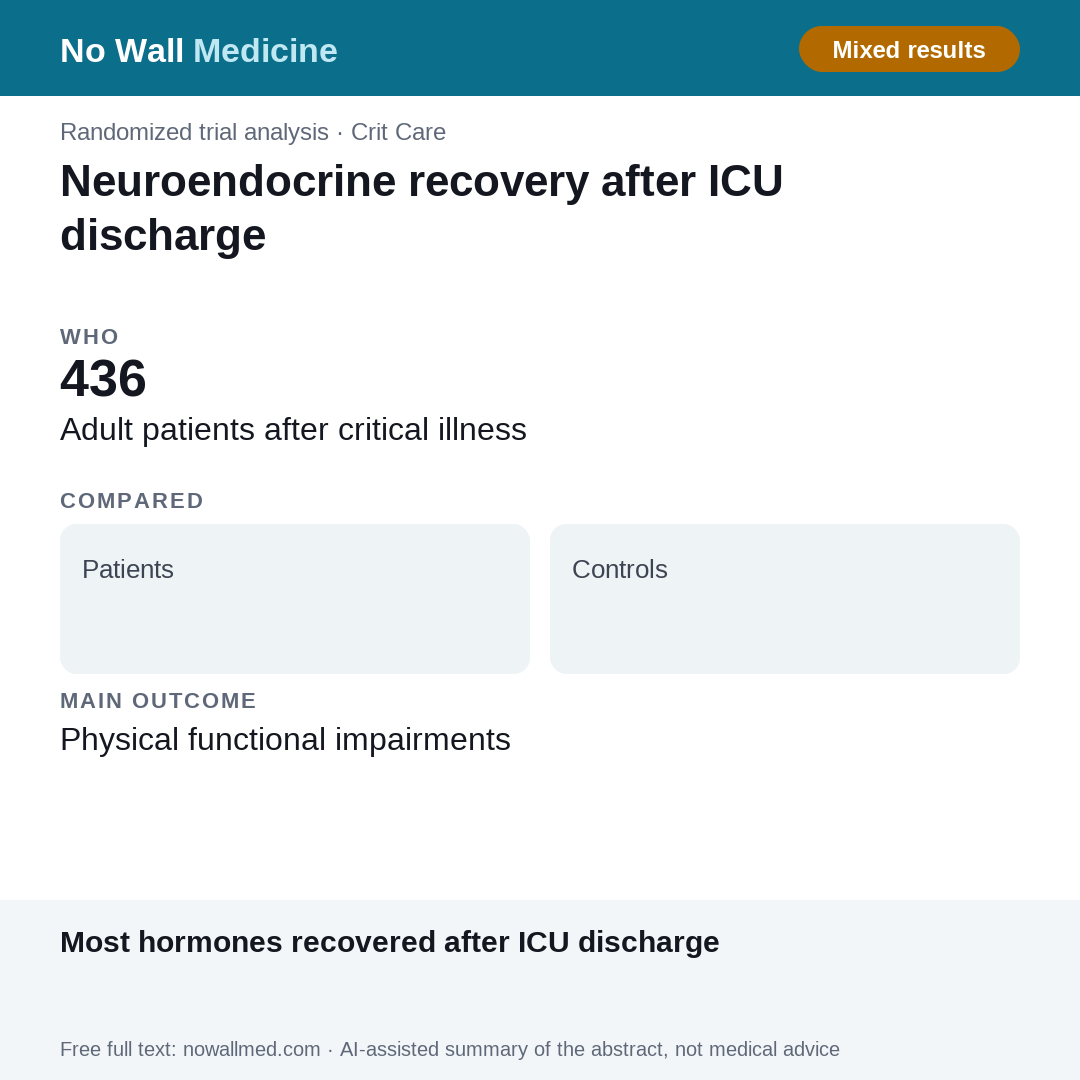
- Researchers compared 436 adult patients who survived critical illness to 50 matched controls to measure hormone levels and physical function five years later.
- Patients had higher reverse T3 and lower T3/rT3 ratios, and higher IGFBP3, compared to the control group.
- A lower T3/rT3 ratio was associated with lower handgrip strength and shorter 6-min walk distance, while higher IGFBP3 was associated with higher handgrip strength.
Why it matters: It was unknown if hormone systems recover after intensive care or if remaining hormonal abnormalities are linked to long-term physical impairments.
Discussion prompts
- Would these patients look like yours? Who was left out?
- Is the main outcome one that matters to patients?
- Is the difference large enough to change what you do?
Cite: Vanhorebeek I, Derese I, Gunst J, Wouters PJ, Hermans G, Van den Berghe G. Persisting neuroendocrine abnormalities and their association with physical impairment 5 years after critical illness. Crit Care. 2021. doi:10.1186/s13054-021-03858-1
Free full text: PubMed Central · Summary and visual abstract: nowallmed.com/a/persisting-neuroendocrine-abnormalities-and-their-association-with-s1elcs/ (AI-assisted from the abstract; check the paper before relying on it).