Randomized trialJournal of Clinical Oncology · Sep 9, 2026
Personalized tumor DNA analysis predicts survival and tracks treatment response in localized soft tissue sarcomas
Personalized Circulating Tumor DNA Analysis for Predicting Outcomes and Tracking Response to Radiotherapy and Pembrolizumab in Localized Sarcomas: Analysis of the SU2C-SARC032 Trial
Subramanian A, Nouth SCL, Nemat-Gorgani N, Soudi S, Ballman KV, Heise RS, et al
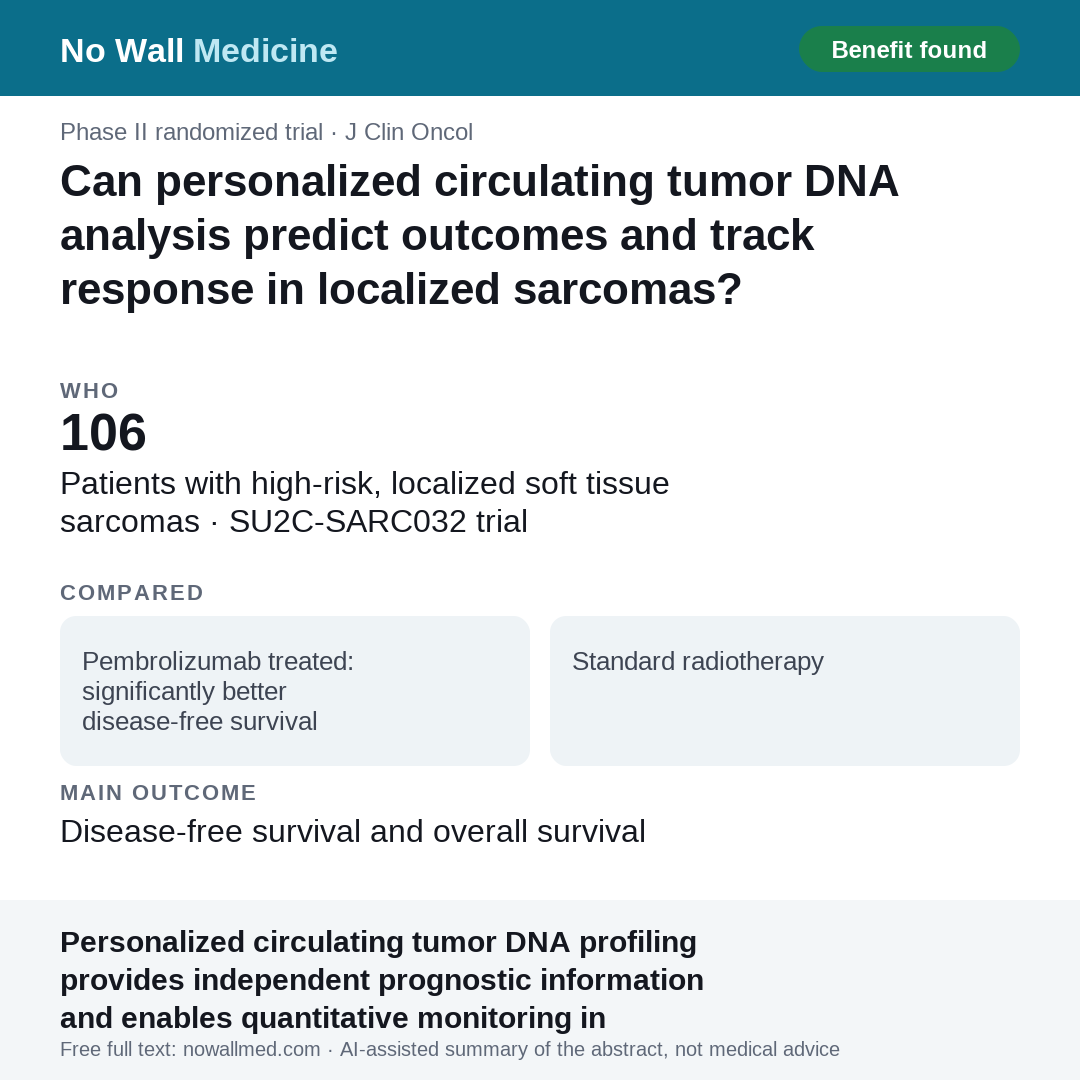
Bottom line: Personalized circulating tumor DNA profiling provides independent prognostic information and enables quantitative monitoring in localized soft tissue sarcomas.
Clinical question: Can personalized circulating tumor DNA analysis predict outcomes and track response in localized sarcomas?
Why it matters: It is technically challenging to use circulating tumor DNA to monitor rare and diverse tumors like soft tissue sarcomas that have low mutational burdens.
Key points
Researchers analyzed 313 plasma samples from 106 patients with high-risk, localized soft tissue sarcomas treated with radiotherapy and sometimes pembrolizumab, an immunotherapy.
Circulating tumor DNA levels measured before, during, and after treatment were strongly associated with disease-free survival and overall survival.
Patients receiving pembrolizumab had better disease-free survival and showed a greater decrease in tumor DNA levels after their initial therapy.
Headline and key points written with AI from the paper’s abstract, with every number checked against it. Read the paper before relying on them.
Prostate and pelvic nodal stereotactic body radiotherapy (SBRT) versus prostate-only SBRT for high-risk, localised prostate cancer (PACE-NODES): early adverse event results from an international, open-label, phase 3, randomised controlled trial