Repetitive transcranial magnetic stimulation increased consciousness levels in patients in a minimally conscious state
Perturbational complexity index in assessing responsiveness to rTMS treatment in patients with disorders of consciousness: a cross-over randomized controlled trial study
Double-blind, randomized, crossover, sham-controlled trialBenefit found
Does repetitive transcranial magnetic stimulation improve consciousness in minimally conscious state patients?
Who
20
Minimally conscious state patients
Compared
rTMS-active treatment: significantly higher scores in Coma Recovery Scale Revised total score
rTMS-sham
Main outcome
Coma Recovery Scale Revised total score
Bottom line: Ten hertz repetitive transcranial magnetic stimulation significantly increased consciousness levels in minimally conscious state patients.
J Neuroeng Rehabil · 2024-09-19Download image
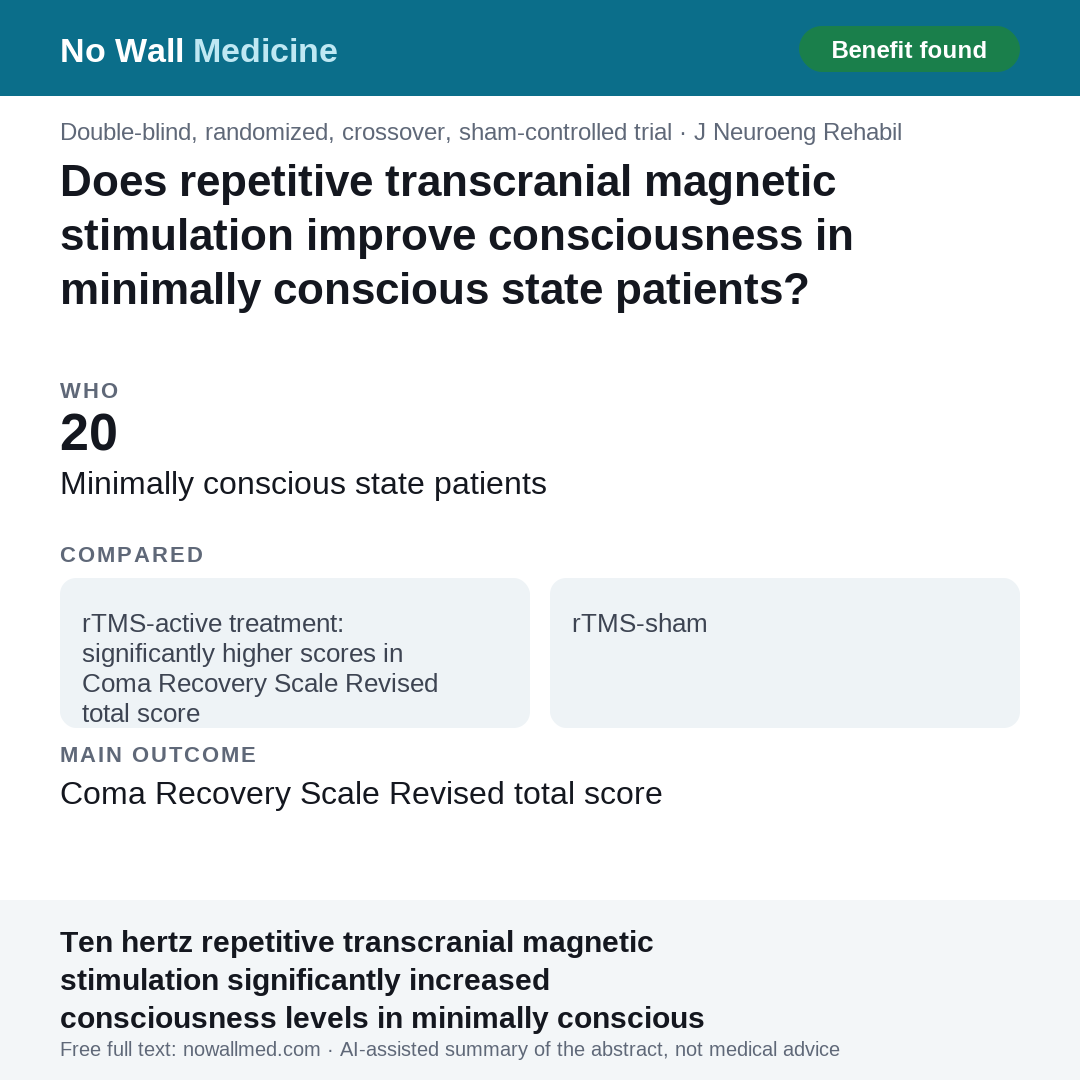
Clinical question: Does repetitive transcranial magnetic stimulation improve consciousness in minimally conscious state patients?
Why it matters: It is unknown if repetitive transcranial magnetic stimulation is effective for patients in a minimally conscious state or if specific neurophysiological indices can predict treatment response.
Key points
- Twenty patients in a minimally conscious state were randomized in a crossover trial to receive either active or sham repetitive transcranial magnetic stimulation for 10 days.
- Active treatment resulted in significantly higher Coma Recovery Scale Revised scores, relative alpha power, and perturbational complexity index based on state transitions compared to sham treatment.
- Among the 20 patients, 35% were identified as responders, and those with higher baseline perturbational complexity index based on state transitions had a more favorable prognosis.
Headline and key points written with AI from the paper’s abstract, with every number checked against it. Read the paper before relying on them.
Topics
Cite this article
Xu C, Yuan Z, Chen Z, Liao Z, Li S, Feng Y. Perturbational complexity index in assessing responsiveness to rTMS treatment in patients with disorders of consciousness: a cross-over randomized controlled trial study. J Neuroeng Rehabil. 2024. doi:10.1186/s12984-024-01455-1
Spotted a mistake? Suggest a correction
Top studies every Monday
The week’s key trials and guidelines in your specialties, plus any topics you follow. By email, free.
Get the weekly digest