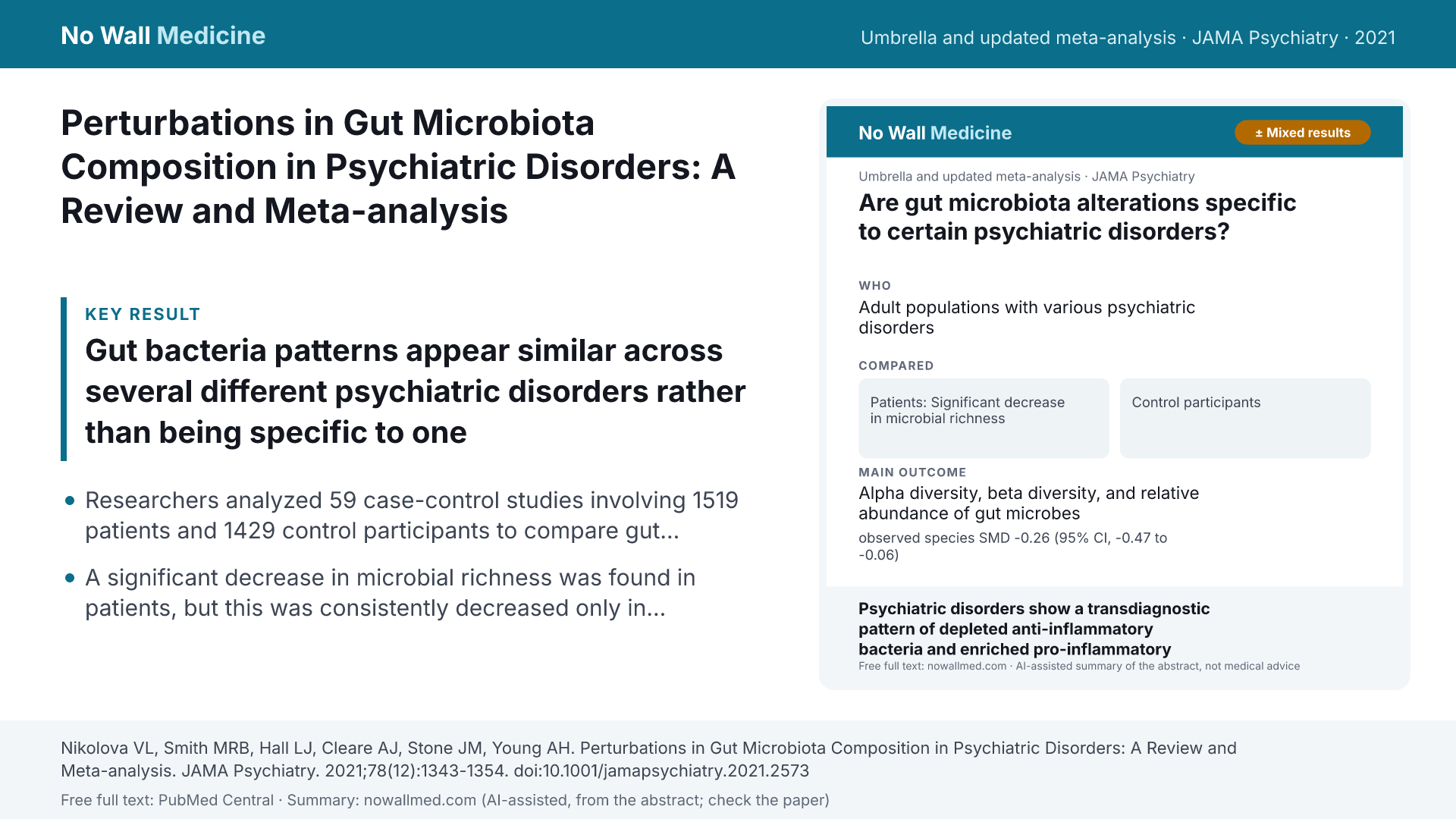
Gut bacteria patterns appear similar across several different psychiatric disorders rather than being specific to one
Perturbations in Gut Microbiota Composition in Psychiatric Disorders: A Review and Meta-analysis
Umbrella and updated meta-analysisMixed results
Are gut microbiota alterations specific to certain psychiatric disorders?
Who
Adult populations with various psychiatric disorders
Compared
Patients: Significant decrease in microbial richness
Control participants
Main outcome
Alpha diversity, beta diversity, and relative abundance of gut microbes
Result: observed species SMD -0.26 (95% CI, -0.47 to -0.06)
Bottom line: Psychiatric disorders show a transdiagnostic pattern of depleted anti-inflammatory bacteria and enriched pro-inflammatory bacteria.
JAMA Psychiatry · 2021-09-16 · Save PNG
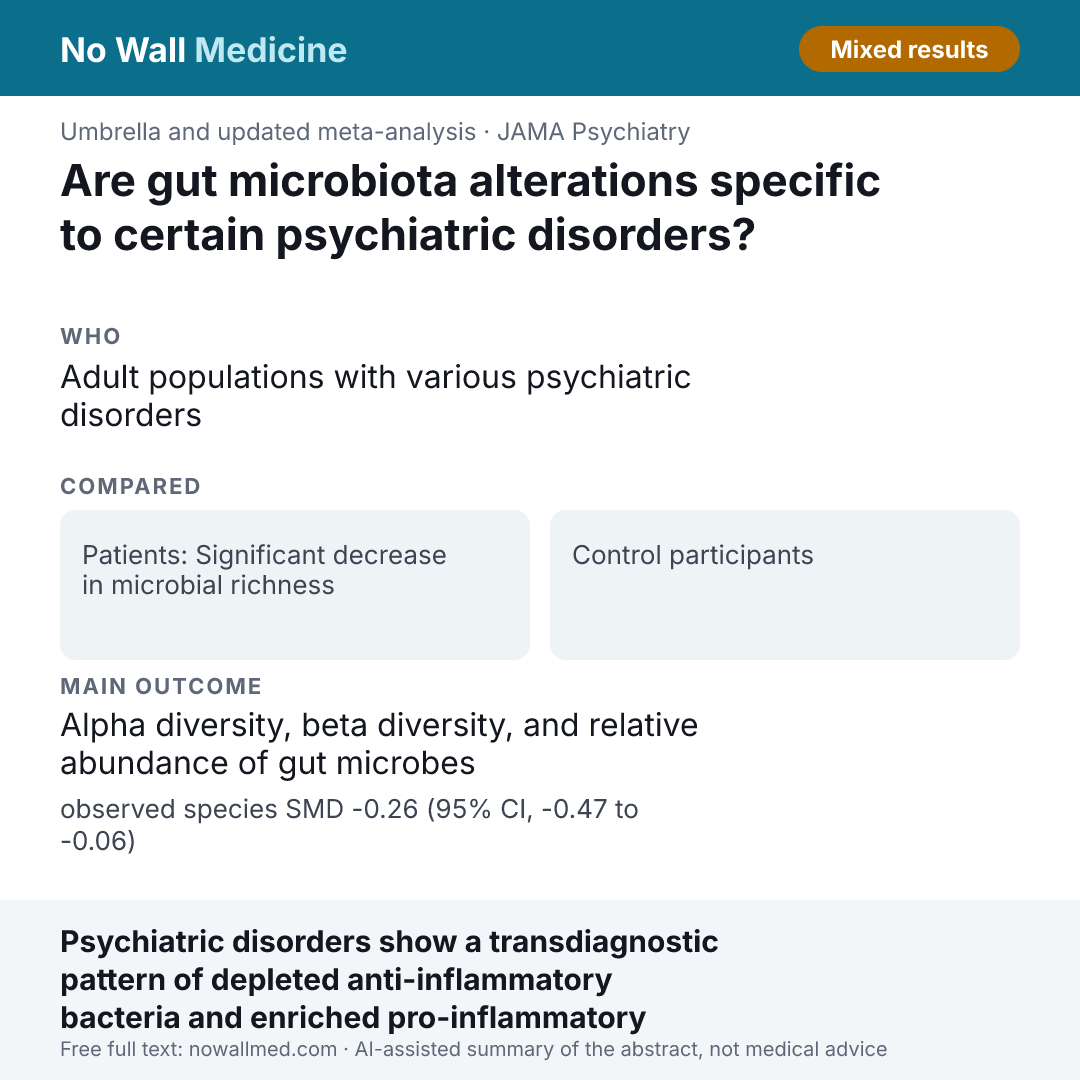
Clinical question: Are gut microbiota alterations specific to certain psychiatric disorders?
Key points
- Researchers analyzed 59 case-control studies involving 1519 patients and 1429 control participants to compare gut microbe diversity and abundance.
- A significant decrease in microbial richness was found in patients, but this was consistently decreased only in bipolar disorder when looking at individual diagnoses.
- Depleted levels of Faecalibacterium and Coprococcus and enriched levels of Eggerthella were shared between major depressive disorder, bipolar disorder, psychosis and schizophrenia, and anxiety.
Headline and key points written with AI from the paper’s abstract, with every number checked against it. Read the paper before relying on them.
Was this summary helpful?
Subject terms
Headline, design, result, key points, caveat and citation as plain text.
Cite this article
Nikolova VL, Smith MRB, Hall LJ, Cleare AJ, Stone JM, Young AH. Perturbations in Gut Microbiota Composition in Psychiatric Disorders: A Review and Meta-analysis. JAMA Psychiatry. 2021. doi:10.1001/jamapsychiatry.2021.2573
Spotted a mistake? Suggest a correction