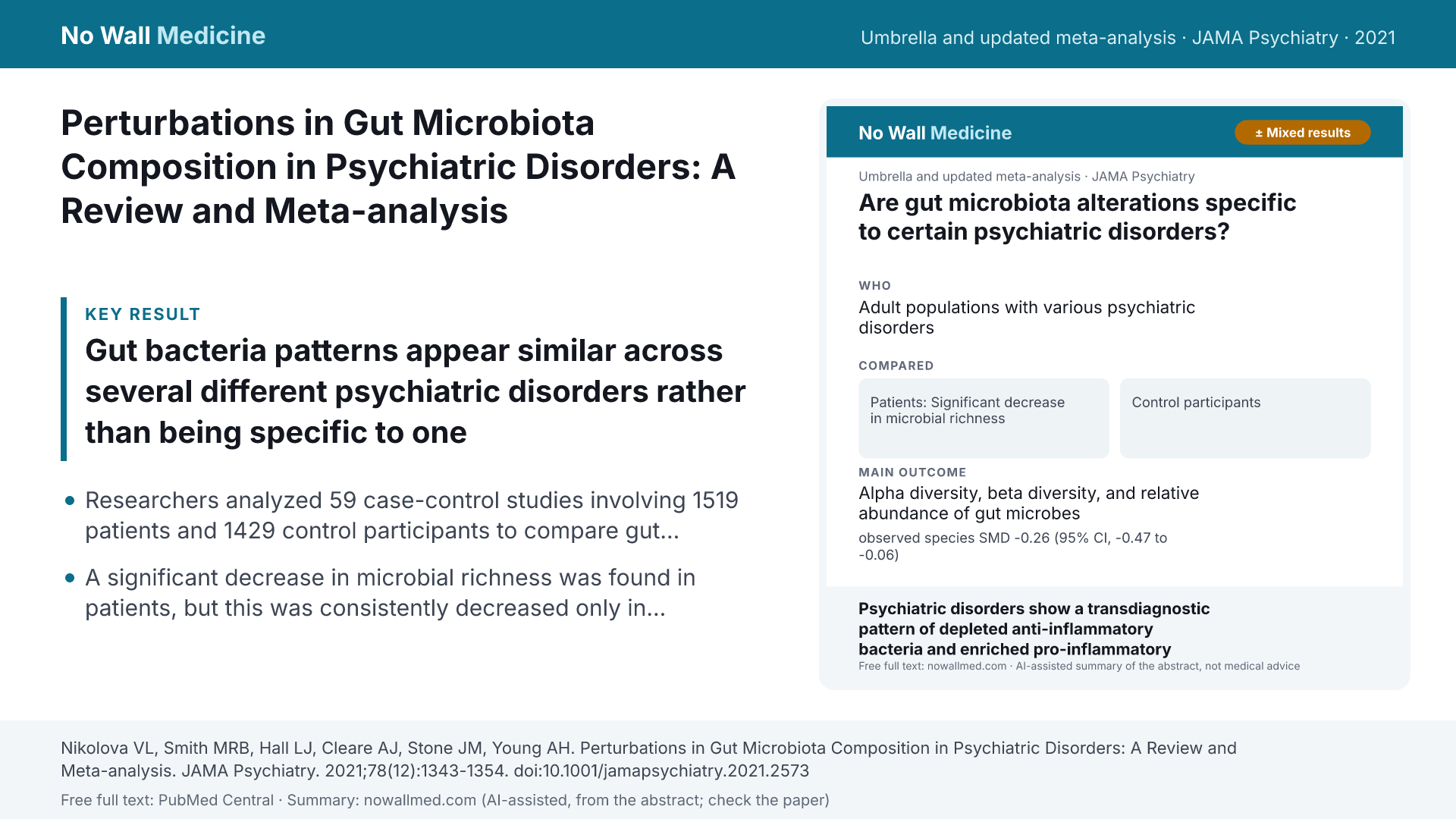
Perturbations in Gut Microbiota Composition in Psychiatric Disorders: A Review and Meta-analysis
Key result: Gut bacteria patterns appear similar across several different psychiatric disorders rather than being specific to one
Umbrella and updated meta-analysisMixed results
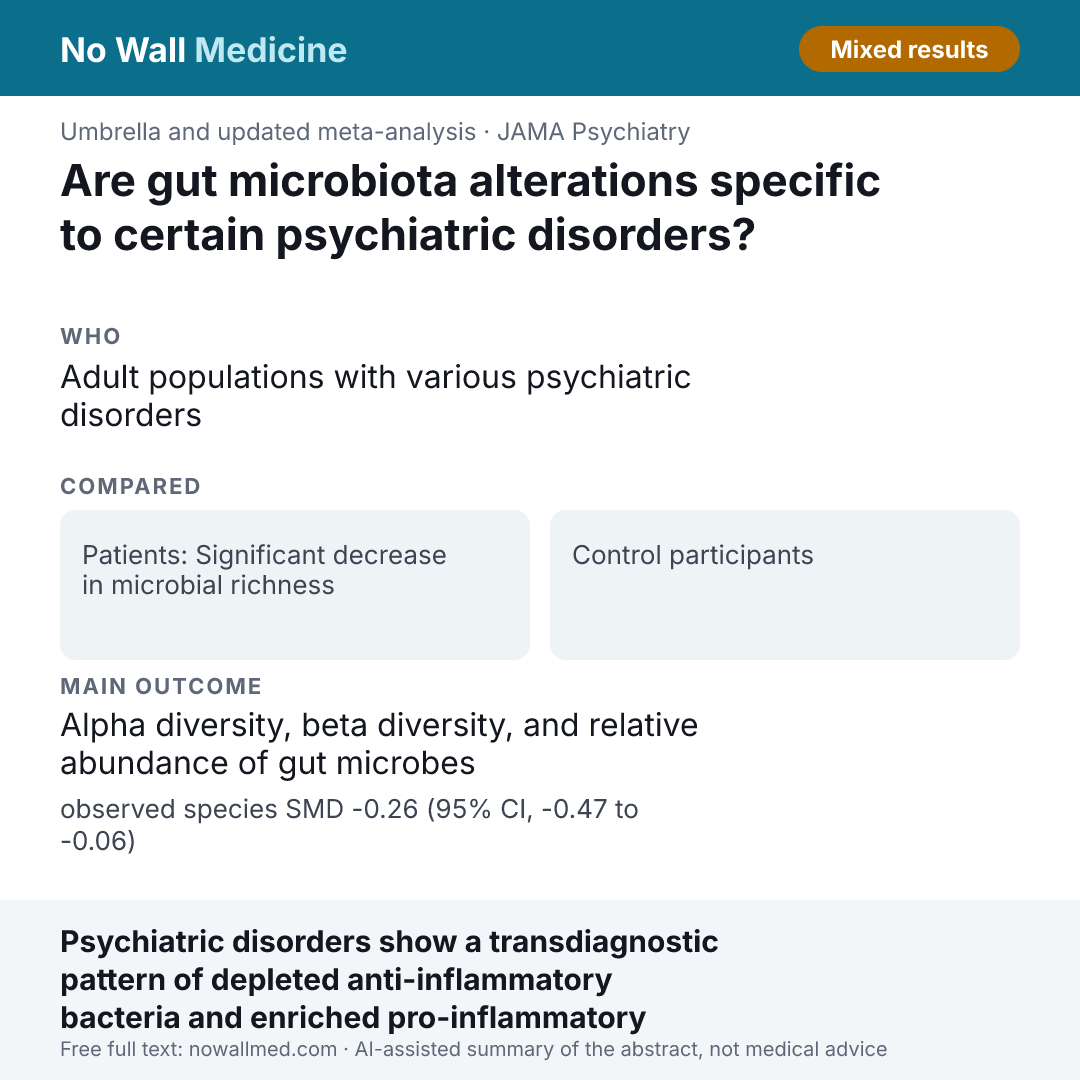
Are gut microbiota alterations specific to certain psychiatric disorders?
Who
Adult populations with various psychiatric disorders
Compared
Patients: Significant decrease in microbial richness
Control participants
Main outcome
Alpha diversity, beta diversity, and relative abundance of gut microbes
Result: observed species SMD -0.26 (95% CI, -0.47 to -0.06)
Bottom line: Psychiatric disorders show a transdiagnostic pattern of depleted anti-inflammatory bacteria and enriched pro-inflammatory bacteria.
JAMA Psychiatry · 2021-09-16 · Save PNG
Key points
- Researchers analyzed 59 case-control studies involving 1519 patients and 1429 control participants to compare gut microbe diversity and abundance.
- A significant decrease in microbial richness was found in patients, but this was consistently decreased only in bipolar disorder when looking at individual diagnoses.
- Depleted levels of Faecalibacterium and Coprococcus and enriched levels of Eggerthella were shared between major depressive disorder, bipolar disorder, psychosis and schizophrenia, and anxiety.
Discussion prompts
- Would these patients look like yours? Who was left out?
- Is the main outcome one that matters to patients?
- Is the difference large enough to change what you do?
Cite: Nikolova VL, Smith MRB, Hall LJ, Cleare AJ, Stone JM, Young AH. Perturbations in Gut Microbiota Composition in Psychiatric Disorders: A Review and Meta-analysis. JAMA Psychiatry. 2021. doi:10.1001/jamapsychiatry.2021.2573
Free full text: PubMed Central · Summary and visual abstract: nowallmed.com/a/perturbations-in-gut-microbiota-composition-in-psychiatric-disorders-1ezo3ne/ (AI-assisted from the abstract; check the paper before relying on it).