Cervical pessary was not proven to be as effective as cerclage for preventing preterm birth
Pessary or cerclage (PC study) to prevent recurrent preterm birth: a non-inferiority, randomised controlled trial
International, open-label, non-inferiority, randomised controlled trialNo clear difference
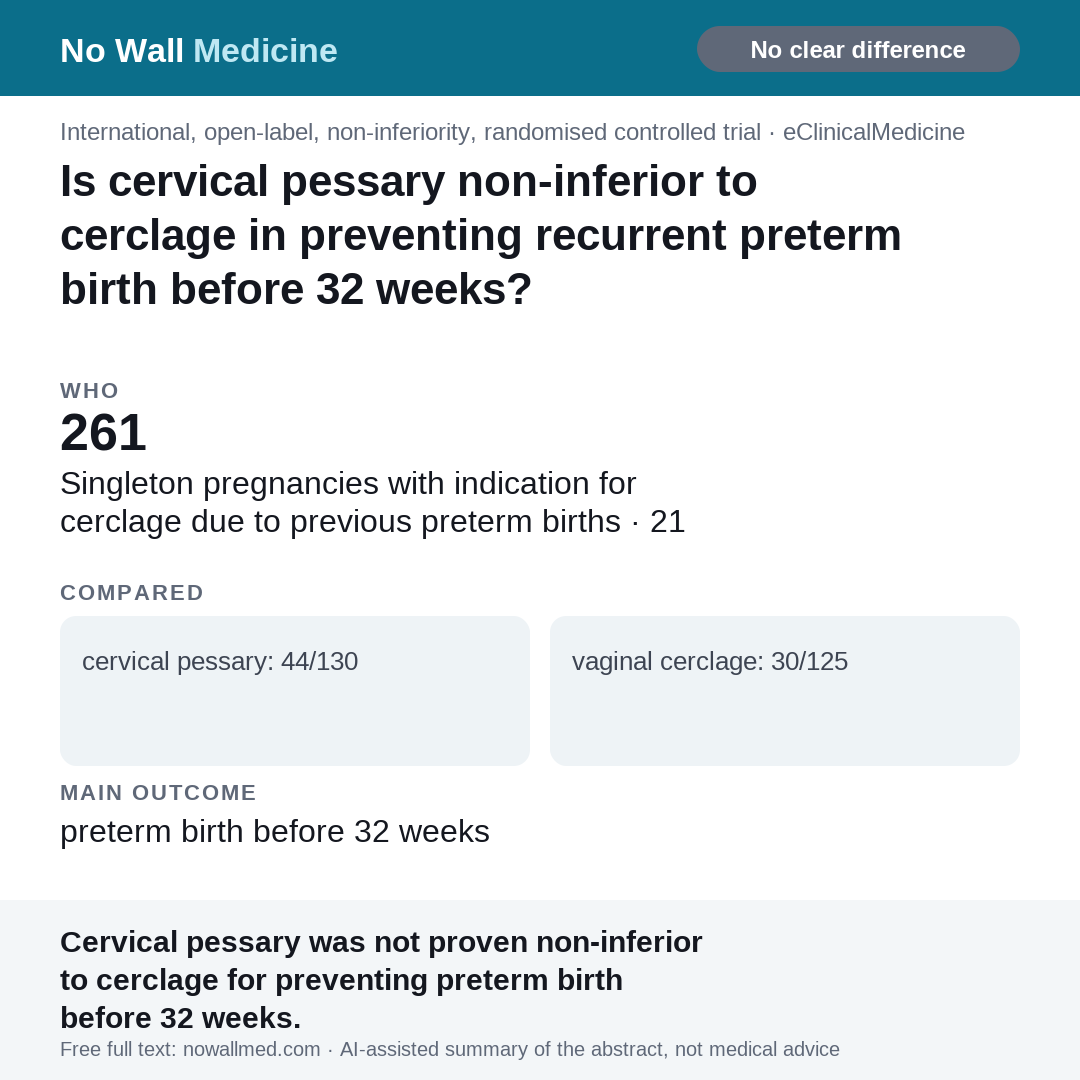
Is cervical pessary non-inferior to cerclage in preventing recurrent preterm birth before 32 weeks?
Who
261
Singleton pregnancies with indication for cerclage due to previous preterm births · 21 hospitals
Compared
cervical pessary: 44/130
vaginal cerclage: 30/125
Main outcome
preterm birth before 32 weeks
Result: absolute risk difference 9.8% (95% CI -1.2 to 20.9)
Bottom line: Cervical pessary was not proven non-inferior to cerclage for preventing preterm birth before 32 weeks.
Funded by: ZonMw, a Dutch Organisation for Health Research and Development
eClinicalMedicine · 2024-11-25Download image
Clinical question: Is cervical pessary non-inferior to cerclage in preventing recurrent preterm birth before 32 weeks?
Why it matters: It was unknown if a cervical pessary, a less invasive option, is as effective as cervical cerclage for preventing recurrent preterm birth.
Key points
- Researchers randomized 261 participants to receive either a cervical pessary or a vaginal cerclage, which is a stitch placed in the cervix.
- Preterm birth before 32 weeks occurred in 33.8% of the pessary group compared to 24.0% in the cerclage group.
- The composite of adverse perinatal outcomes, including perinatal death, occurred in 32.2% of the pessary group and 23.2% of the cerclage group.
Limitation the authors note: Recruitment was halted due to safety concerns and the apparent challenge in establishing non-inferiority of pessary treatment.
Headline and key points written with AI from the paper’s abstract, with every number checked against it. Read the paper before relying on them.
Was this summary helpful?
Cite this article
van Gils AL, van Dijk CE, Koullali B, Lugthart MA, Bet BB, van Zijl MD. Pessary or cerclage (PC study) to prevent recurrent preterm birth: a non-inferiority, randomised controlled trial. eClinicalMedicine. 2024. doi:10.1016/j.eclinm.2024.102945
Spotted a mistake? Suggest a correction
Top studies every Monday
The week’s key trials and guidelines in your specialties, plus any topics you follow. By email, free.
Get the weekly digest