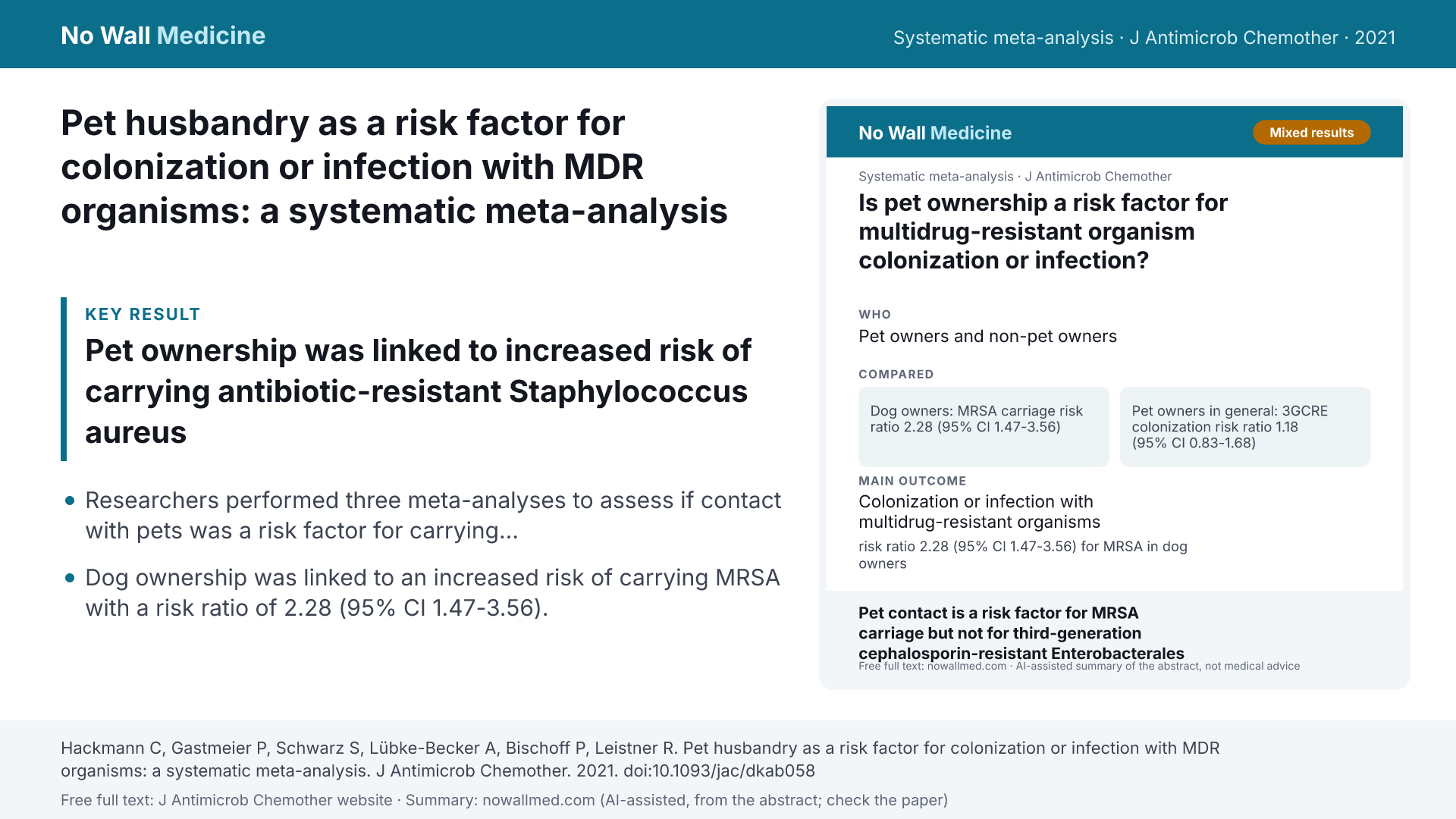
Pet ownership was linked to increased risk of carrying antibiotic-resistant Staphylococcus aureus
Pet husbandry as a risk factor for colonization or infection with MDR organisms: a systematic meta-analysis
Systematic meta-analysisMixed results
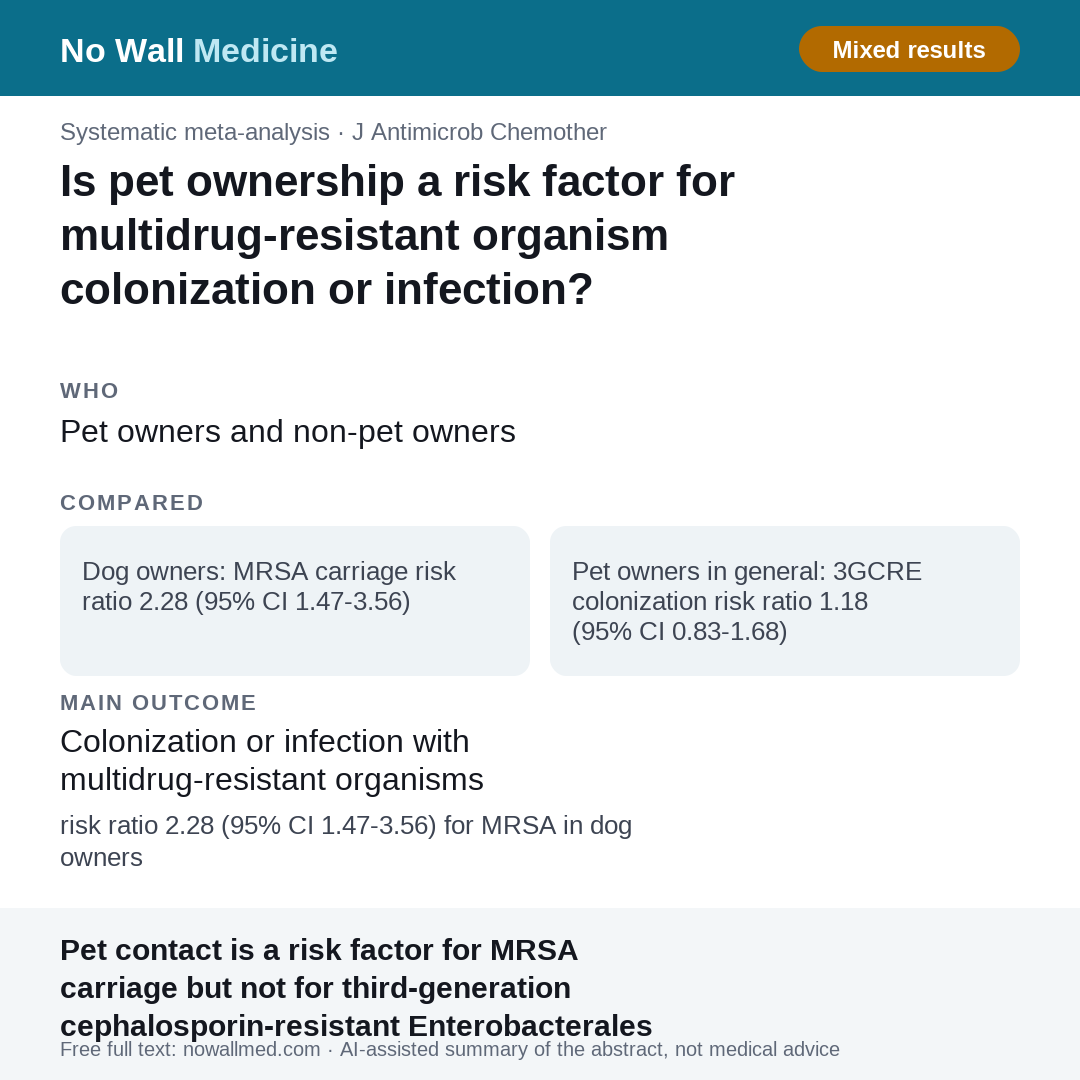
Is pet ownership a risk factor for multidrug-resistant organism colonization or infection?
Who
Pet owners and non-pet owners
Compared
Dog owners: MRSA carriage risk ratio 2.28 (95% CI 1.47-3.56)
Pet owners in general: 3GCRE colonization risk ratio 1.18 (95% CI 0.83-1.68)
Main outcome
Colonization or infection with multidrug-resistant organisms
Result: risk ratio 2.28 (95% CI 1.47-3.56) for MRSA in dog owners
Bottom line: Pet contact is a risk factor for MRSA carriage but not for third-generation cephalosporin-resistant Enterobacterales colonization.
J Antimicrob Chemother · 2021-04-18Download image
Clinical question: Is pet ownership a risk factor for multidrug-resistant organism colonization or infection?
Why it matters: It was unclear whether owning pets serves as a risk factor for acquiring multidrug-resistant organisms before a patient is hospitalized.
Key points
- Researchers performed three meta-analyses to assess if contact with pets was a risk factor for carrying antibiotic-resistant bacteria like MRSA, VRE, and Gram-negative bacteria.
- Dog ownership was linked to an increased risk of carrying MRSA with a risk ratio of 2.28 (95% CI 1.47-3.56).
- No significant risk was found for colonization with third-generation cephalosporin-resistant Enterobacterales among owners of various pet species.
Headline and key points written with AI from the paper’s abstract, with every number checked against it. Read the paper before relying on them.
Was this summary helpful?
Subject terms
Cite this article
Hackmann C, Gastmeier P, Schwarz S, Lübke-Becker A, Bischoff P, Leistner R. Pet husbandry as a risk factor for colonization or infection with MDR organisms: a systematic meta-analysis. J Antimicrob Chemother. 2021. doi:10.1093/jac/dkab058
Spotted a mistake? Suggest a correction
Top studies every Monday
The week’s key trials and guidelines in your specialties, plus any topics you follow. By email, free.
Get the weekly digest