Pet husbandry as a risk factor for colonization or infection with MDR organisms: a systematic meta-analysis
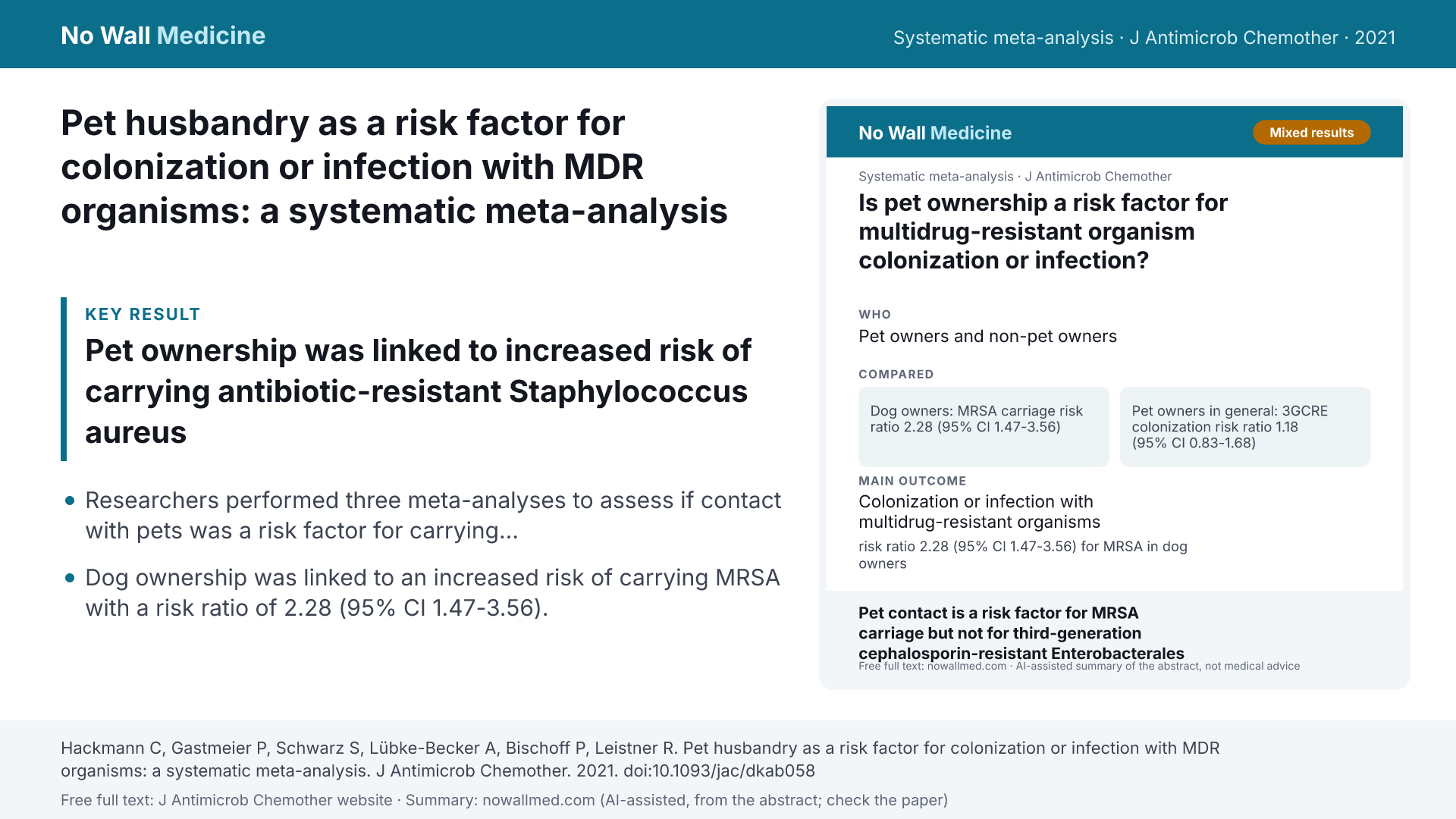
Key result: Pet ownership was linked to increased risk of carrying antibiotic-resistant Staphylococcus aureus
Systematic meta-analysisMixed results
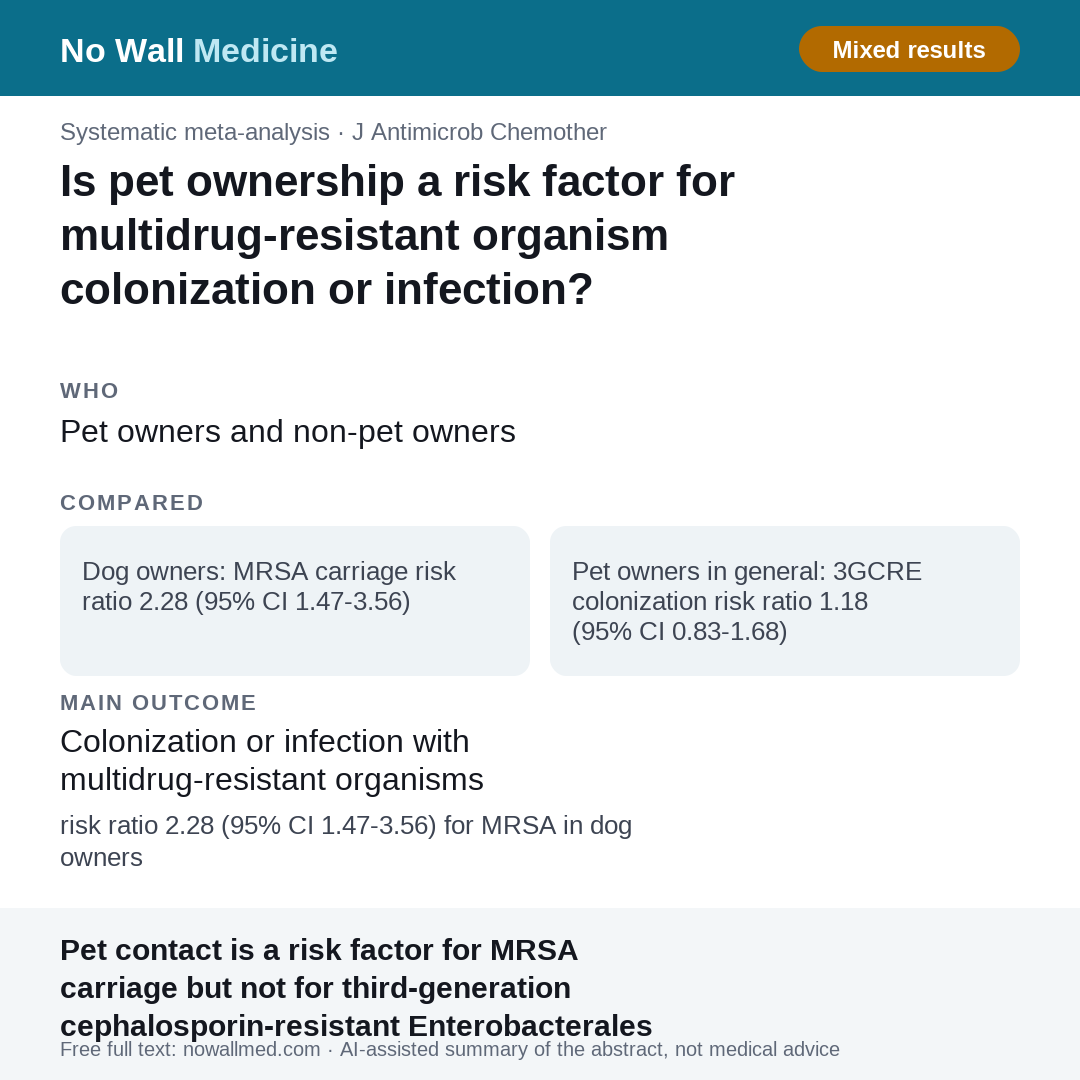
Is pet ownership a risk factor for multidrug-resistant organism colonization or infection?
Who
Pet owners and non-pet owners
Compared
Dog owners: MRSA carriage risk ratio 2.28 (95% CI 1.47-3.56)
Pet owners in general: 3GCRE colonization risk ratio 1.18 (95% CI 0.83-1.68)
Main outcome
Colonization or infection with multidrug-resistant organisms
Result: risk ratio 2.28 (95% CI 1.47-3.56) for MRSA in dog owners
Bottom line: Pet contact is a risk factor for MRSA carriage but not for third-generation cephalosporin-resistant Enterobacterales colonization.
J Antimicrob Chemother · 2021-04-18Download image
Key points
- Researchers performed three meta-analyses to assess if contact with pets was a risk factor for carrying antibiotic-resistant bacteria like MRSA, VRE, and Gram-negative bacteria.
- Dog ownership was linked to an increased risk of carrying MRSA with a risk ratio of 2.28 (95% CI 1.47-3.56).
- No significant risk was found for colonization with third-generation cephalosporin-resistant Enterobacterales among owners of various pet species.
Why it matters: It was unclear whether owning pets serves as a risk factor for acquiring multidrug-resistant organisms before a patient is hospitalized.
Discussion prompts
- Would these patients look like yours? Who was left out?
- Is the main outcome one that matters to patients?
- Is the difference large enough to change what you do?
Cite: Hackmann C, Gastmeier P, Schwarz S, Lübke-Becker A, Bischoff P, Leistner R. Pet husbandry as a risk factor for colonization or infection with MDR organisms: a systematic meta-analysis. J Antimicrob Chemother. 2021. doi:10.1093/jac/dkab058
Free full text: J Antimicrob Chemother website · Summary and visual abstract: nowallmed.com/a/pet-husbandry-as-a-risk-factor-for-colonization-or-infection-with-mdr-d0mbqe/ (AI-assisted from the abstract; check the paper before relying on it).