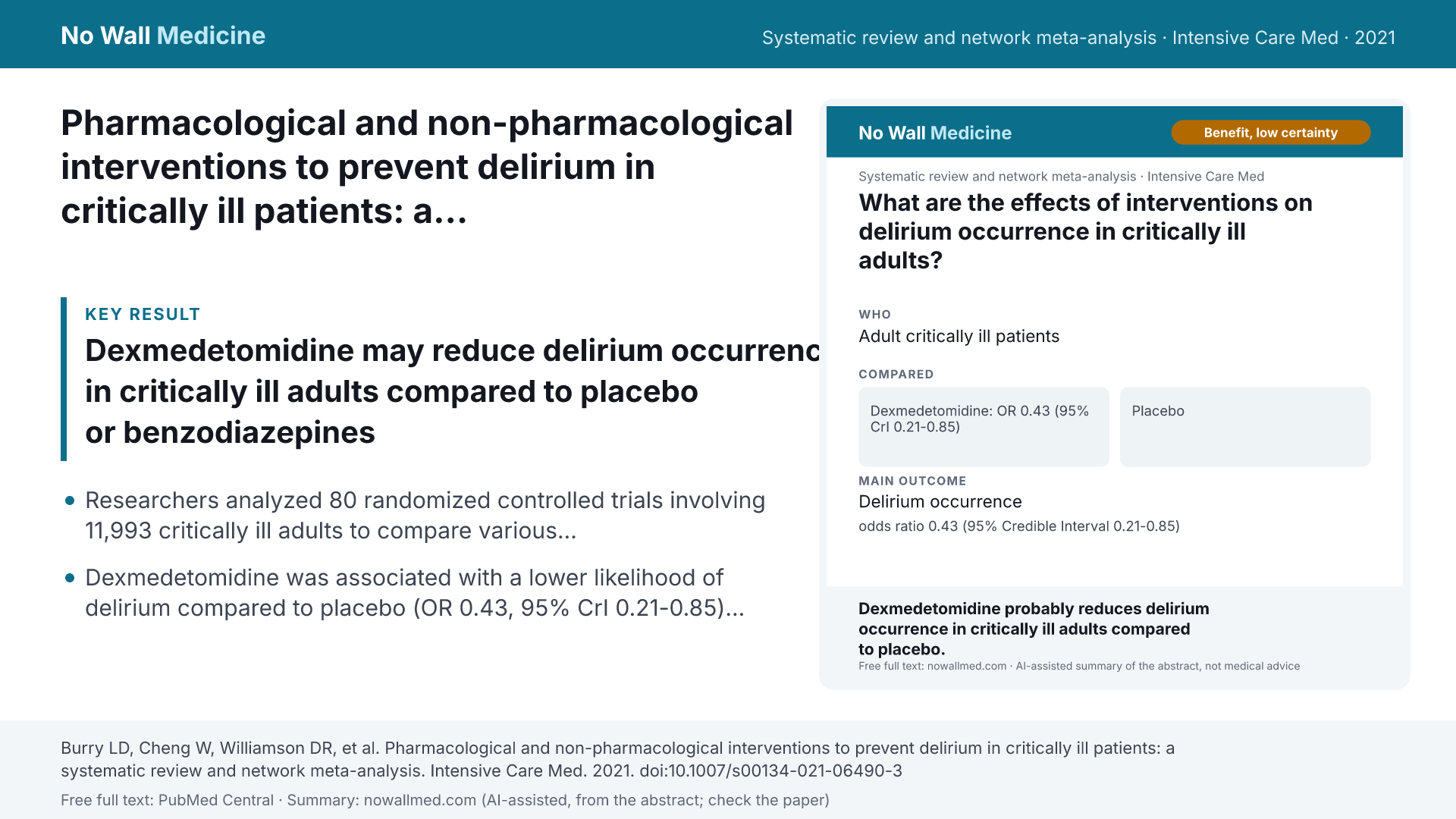
Dexmedetomidine may reduce delirium occurrence in critically ill adults compared to placebo or benzodiazepines
Pharmacological and non-pharmacological interventions to prevent delirium in critically ill patients: a systematic review and network meta-analysis
Systematic review and network meta-analysisBenefit, low certainty
What are the effects of interventions on delirium occurrence in critically ill adults?
Who
Adult critically ill patients
Compared
Dexmedetomidine: OR 0.43 (95% CrI 0.21-0.85)
Placebo
Main outcome
Delirium occurrence
Result: odds ratio 0.43 (95% Credible Interval 0.21-0.85)
Bottom line: Dexmedetomidine probably reduces delirium occurrence in critically ill adults compared to placebo.
Limitation: Evidence for sedation-minimization strategies to reduce delirium occurrence is very uncertain.
Intensive Care Med · 2021-08-11 · Save PNG
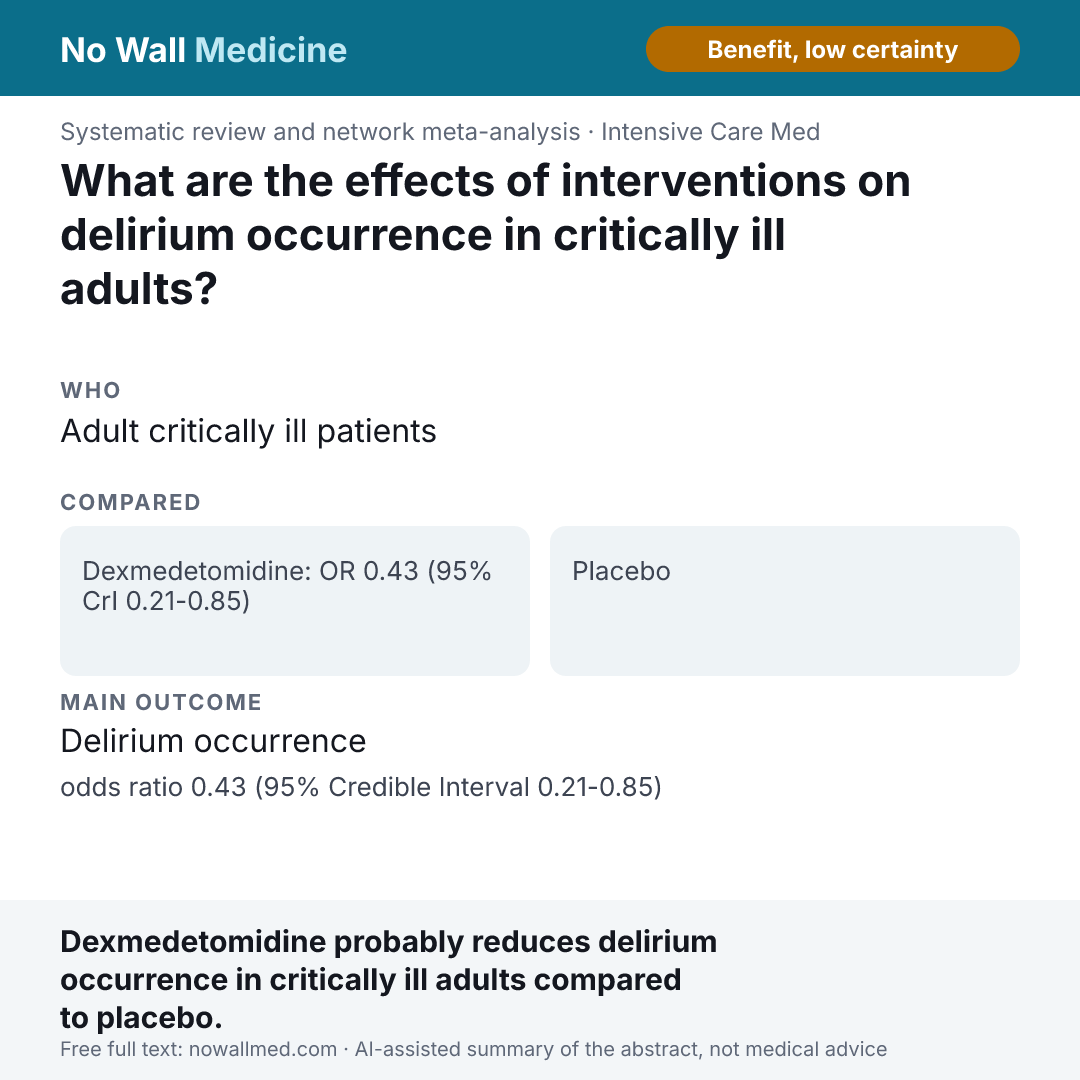
Clinical question: What are the effects of interventions on delirium occurrence in critically ill adults?
Key points
- Researchers analyzed 80 randomized controlled trials involving 11,993 critically ill adults to compare various delirium prevention methods.
- Dexmedetomidine was associated with a lower likelihood of delirium compared to placebo (OR 0.43, 95% CrI 0.21-0.85) and benzodiazepines (OR 0.21, 95% CrI 0.08-0.51).
- Dexmedetomidine was associated with a shorter intensive care unit stay compared to placebo (RoM 0.78, CrI 0.64-0.95) and antipsychotics (RoM 0.76, CrI 0.61-0.98).
Limitation the authors note: Single and multi-component non-pharmacological interventions did not connect to any evidence networks to allow for ranking and comparisons as planned.
Headline and key points written with AI from the paper’s abstract, with every number checked against it. Read the paper before relying on them.
Was this summary helpful?
Subject terms
Headline, design, result, key points, caveat and citation as plain text.
Cite this article
Burry LD, Cheng W, Williamson DR, et al. Pharmacological and non-pharmacological interventions to prevent delirium in critically ill patients: a systematic review and network meta-analysis. Intensive Care Med. 2021. doi:10.1007/s00134-021-06490-3
Spotted a mistake? Suggest a correction